Rate Hikes: Who Gets Hit First?
Variable-rate borrowers absorb a rate hike within weeks; fixed-rate borrowers remain insulated for years. This heterogeneity, hidden in aggregate statistics, explains the contradictory diagnoses around each tightening cycle.

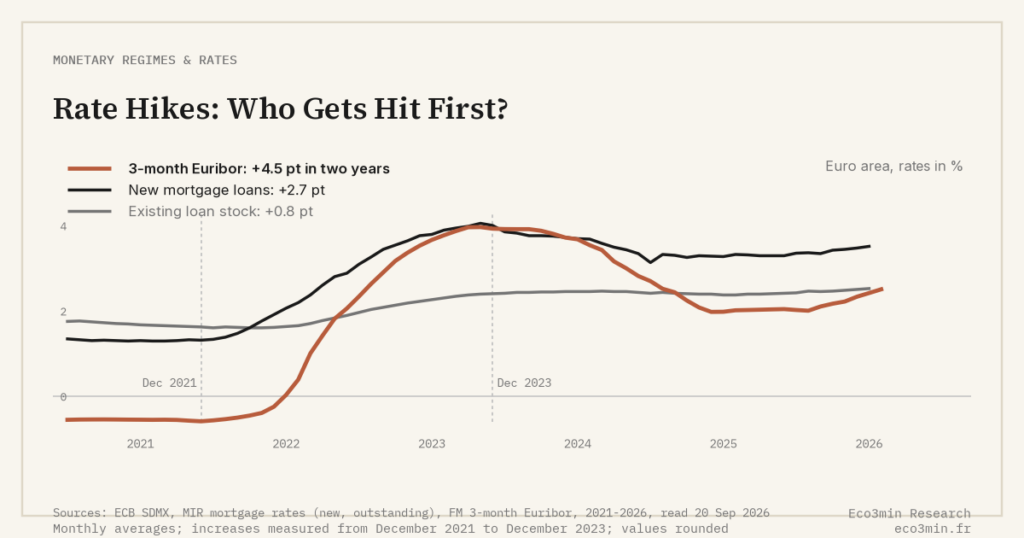
The effects of a rate hike are uneven across agents depending on credit access, debt levels, and financial position.
TL;DR
A single rate hike lands at radically different speeds: within weeks for variable-rate borrowers, years later for fixed-rate ones, which is why averages hide the gap.
- Variable-rate exposure spans under 5% of outstanding loans in France to roughly 55% in Portugal (ECB MFI Statistics, December 2025), so identical rate decisions transmit at very different national speeds.
- Firms on revolving lines indexed to 3-month Euribor feel hikes within weeks: the average overdraft rate for very small French firms hit 6.8% in Q3 2025, against 3.2% in early 2022 (Banque de France).
- The shock propagates in concentric circles — markets and variable-rate agents first (weeks), new borrowers and refinancing firms (months), employment and consumption last (one to two years).
A rate hike does not affect all economic agents simultaneously. Credit access, debt levels, and balance sheet structure determine how quickly the impact lands. This heterogeneity is often hidden by macroeconomic averages. Yet it explains the sharply contrasting experiences of the same monetary decision.
Who Feels the Hike First
The most immediately exposed agents are those whose financing is indexed to variable or short-duration rates. Households holding variable-rate mortgages — a minority in France (under 5% of outstanding loans) but more numerous in Spain (≈30%) or Portugal (≈55%, according to the ECB, MFI Statistics, December 2025) — see their monthly payments rise from the next contractual reset, sometimes within three months.
Firms financed through revolving credit lines or bank overdrafts experience a comparable effect. The chain of effects is traced in our study of the inversion / equity rally paradox. These facilities, whose rates are generally indexed to 3-month Euribor, pass on policy rate hikes within weeks. According to Banque de France data (cost of credit to firms, Q3 2025), the average overdraft rate for very small firms reached 6.8%, against 3.2% in early 2022 — a doubling in under three years.
Those Protected by Existing Contracts
Conversely, households borrowing at fixed rates feel no direct effect as long as their loan runs. In France, where fixed rates massively dominate, a household that borrowed in 2020 at 1.2% will continue to repay at the same pace regardless of the policy rate level. Only new borrowers face the tighter conditions — creating a generational divide between existing owners and prospective first-time buyers.
Large firms with long-term financing lines negotiated before the tightening enjoy a similar protection. According to ECB data on bond issuance (Q4 2025), the average residual maturity of investment-grade corporate bonds in the euro area exceeded six years. A significant share of the corporate debt stock therefore remains priced at pre-tightening conditions.
The mechanisms of uneven credit distribution create a stratification where agents already fully affected coexist with agents still largely insulated from the monetary shock. This coexistence blurs the macroeconomic reading: aggregate statistics average out radically different situations.
A Shock Wave Propagating in Concentric Circles
The impact sequence follows a relatively predictable order. Financial markets and variable-rate agents are hit first (weeks). New mortgage borrowers and firms refinancing follow (months). Firms in the investment phase adjust their projects (quarters). Employment and consumption react only last (one to two years), when the activity slowdown translates into hiring decisions and purchasing power.
The specific vulnerability of unlisted firms often places them in the first circles of impact. Their dependence on short-term bank credit and their limited bargaining power expose them to a rapid tightening of financing conditions, while large listed groups enjoy wider temporal leeway.
- Variable-rate and short-financing agents absorb the hike within weeks, while fixed-rate borrowers remain protected for years.
- In the euro area, the share of variable-rate loans ranges from under 5% (France) to over 55% (Portugal), producing very different national transmission speeds.
- Aggregate statistics mask the coexistence of agents already fully hit and agents still insulated from the monetary shock.
The heterogeneity of rate-hike effects explains the contradictory diagnoses that accompany every tightening cycle. Part of the economy suffers while another part feels nothing yet — a gap that fuels debates on the effectiveness or severity of monetary policy. The staggered timing of monetary diffusion can only be understood by abandoning the fiction of the representative agent. The calibration performed by monetary authorities seeks to account for this diversity of impacts, without being able to neutralize it. Related reading: Our analysis of how policy rates end up in corporate accounts.
Last updated — 20 September 2026
Disclaimer – Financial Information: The analyses, commentary, and content published on eco3min.fr are provided for informational and educational purposes only. They do not constitute investment advice or a solicitation to buy or sell financial instruments. Past performance is not indicative of future results. All investment decisions involve risk and are the sole responsibility of the reader.
Read next
Full pillar →Real Rates: The True Cost of Capital Is Repricing
Why real rates are reasserting themselves as markets' anchor and how to recalibrate investment and financing decisions facing…
Real Interest Rates: The Quiet Signal Reshaping Markets
Real interest rates: why their persistence in positive territory in 2026 is reshaping the rules for bonds, equities,…
OAT-Bund Spread: A Quiet Gauge of French Sovereign Risk
OAT-Bund spread: how this yield gap has become a key signal on French sovereign risk, fiscal policy and…