Monetary Policy and Non-Listed Firms: The Hidden Role of Bank Credit

Monetary policy is not transmitted solely through financial markets. It also operates through the banking channel, which shapes investment and cash flow across the non-listed productive sector — a central yet often overlooked dimension of the macroeconomic cycle.
TL;DR
Bank loans supply more than 75% of external financing for euro-area firms under 250 employees, channeling monetary tightening into their cash-flow lines and postponed investment that aggregate data rarely register.
- Bank loans cover more than 75% of external financing for euro-area firms under 250 employees (ECB monetary statistics, Q3 2025), leaving no immediate substitute when standards tighten.
- Overdrafts, factoring and revolving credit follow floating rates, so a 200 basis-point rise can absorb much of the profit of a business running on a 3% to 5% net margin.
- Intercompany payment delays lengthened by 2.4 days on average between 2023 and 2025 to reach 44.3 days (Banque de France), cascading from larger firms down to smaller suppliers.
- A Bpifrance barometer (September 2025) found 34% of French SMEs had postponed at least one investment over twelve months, a delayed cost absent from aggregate capital formation.
Non-listed companies, which make up the majority of the real economy, are structurally dependent on bank credit to finance projects and absorb cash flow shocks. The data behind it is compiled in our analysis of the inversion-credit-recession sequence. When financial conditions tighten, this dependence turns monetary decisions into operational constraints: higher cost of capital, more selective access to financing, and delayed investment decisions. Understanding this less visible channel is essential to assess the real impact of monetary policy on economic activity. A fuller account appears in our breakdown of monetary transmission across channels and lags.
Non-listed companies remain largely absent from standard monetary policy analysis. Attention typically focuses on asset markets, sovereign yields, or equity valuations. Yet most of the productive sector operates outside public markets and finances its development through bank intermediation rather than direct market access.
This financing structure creates a specific sensitivity to central bank decisions. Monetary tightening does not merely affect asset prices: it alters credit availability, tightens lending standards, and raises financing costs. For non-listed companies, these shifts translate concretely into postponed projects, delayed hiring, and more defensive cash management.
Transmission is therefore indirect but structurally significant. Ignoring this channel leads to overestimating immediate financial effects while underestimating real impacts on productive investment. Incorporating it allows for a more complete macroeconomic reading of monetary policy by linking central decisions to microeconomic constraints. In depth: the decomposition of rate-cycle effects on corporate profits.
Bank credit as the primary access point
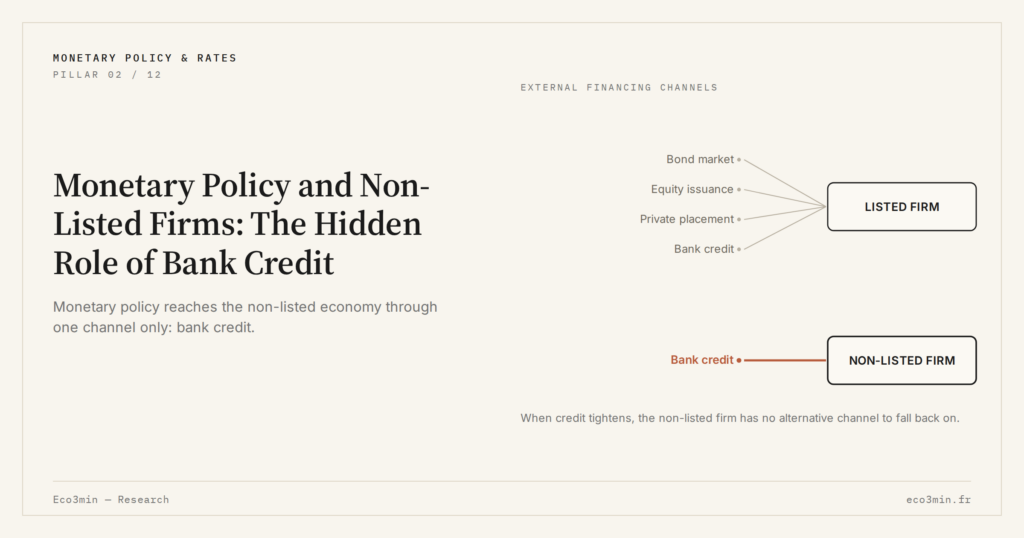
Unlike large listed corporations that can access bond markets, private equity, or private placements, non-listed SMEs and mid-sized firms rely almost exclusively on the banking system for external financing. In the euro area, according to ECB data (monetary statistics, Q3 2025), bank loans accounted for more than 75% of external financing for firms with fewer than 250 employees.
This concentration of financing through a single channel creates structural vulnerability. When banks tighten lending standards — in response to monetary tightening, a deterioration in economic conditions, or stricter prudential constraints — non-listed firms have no immediate alternative. The filtering role of the banking sector is particularly pronounced for this segment of the productive system.
The cash flow squeeze effect
Rising interest rates do not only affect the cost of new borrowing. They also deteriorate day-to-day liquidity conditions — overdraft facilities, factoring, revolving credit — whose rates are typically indexed to floating benchmarks. For a small business operating with a net margin of 3% to 5%, a 200 basis point increase in the cost of its liquidity lines can absorb a significant share of profitability. Also relevant: ETF liquidity and where hidden credit fragilities emerge.
Data from Banque de France (Corporate Financing Observatory, 2025 report) show that intercompany payment delays increased by an average of 2.4 days between 2023 and 2025, reaching 44.3 days. This extension reflects liquidity stress among larger firms, which cascades down to suppliers, often smaller and less capitalized entities.
The unequal distribution of credit across borrower profiles amplifies this effect. Non-listed firms concentrate both the risk of credit rationing and the highest sensitivity to short-term financing conditions.
Postponement rather than cancellation
Faced with a high-rate environment, non-listed companies do not abruptly cut investment — they postpone it. The lag between monetary signals and investment adjustment is amplified for these firms, whose decision horizons are often shorter and financial flexibility more limited.
A Bpifrance survey (SME Barometer, September 2025) indicated that 34% of French SMEs had postponed at least one investment project over the past twelve months, citing financing costs and macroeconomic uncertainty. This widespread postponement is not fully captured in aggregate capital formation data, as large listed firms maintain their investment programs. The effect is nonetheless real at the level of the local economic fabric.
- More than 75% of external financing for European SMEs comes from bank credit, making them highly exposed to monetary tightening.
- Lengthening intercompany payment delays represents an indirect transmission channel that is often overlooked in macroeconomic analysis.
- SME investment postponement constitutes a delayed economic cost that does not immediately appear in aggregate capital formation indicators.
The blind spot in monetary analysis often stems from its focus on financial markets and large listed firms. Non-listed companies — which account for more than 99% of firms in the euro area and around two-thirds of private employment according to Eurostat — experience monetary policy through a different lens, dominated by bank credit and day-to-day liquidity conditions. The process through which monetary impulses reach the productive economy cannot be understood without incorporating this dimension. Central bank policy tools, including targeted refinancing operations (TLTROs), are specifically designed to address this bottleneck — with mixed effectiveness.
Last updated — 12 July 2026
Disclaimer – Financial Information: The analyses, commentary, and content published on eco3min.fr are provided for informational and educational purposes only. They do not constitute investment advice or a solicitation to buy or sell financial instruments. Past performance is not indicative of future results. All investment decisions involve risk and are the sole responsibility of the reader.
Read next
Full pillar →Real Rates: The True Cost of Capital Is Repricing
Why real rates are reasserting themselves as markets' anchor and how to recalibrate investment and financing decisions facing…
Real Interest Rates: The Quiet Signal Reshaping Markets
Real interest rates: why their persistence in positive territory in 2026 is reshaping the rules for bonds, equities,…
OAT-Bund Spread: A Quiet Gauge of French Sovereign Risk
OAT-Bund spread: how this yield gap has become a key signal on French sovereign risk, fiscal policy and…