Traditional or Roth: The Tax-Timing Bet at the Heart of Retirement Saving

“Traditional or Roth” has no universal answer. The choice is not about a better account but about one bet: pay tax now, with Roth, or later, with traditional, on a future bracket no one can know in advance.
Most answers pick a side for the reader. A mechanical reading replaces the verdict with a question: under what conditions does paying tax now, or later, come out ahead.
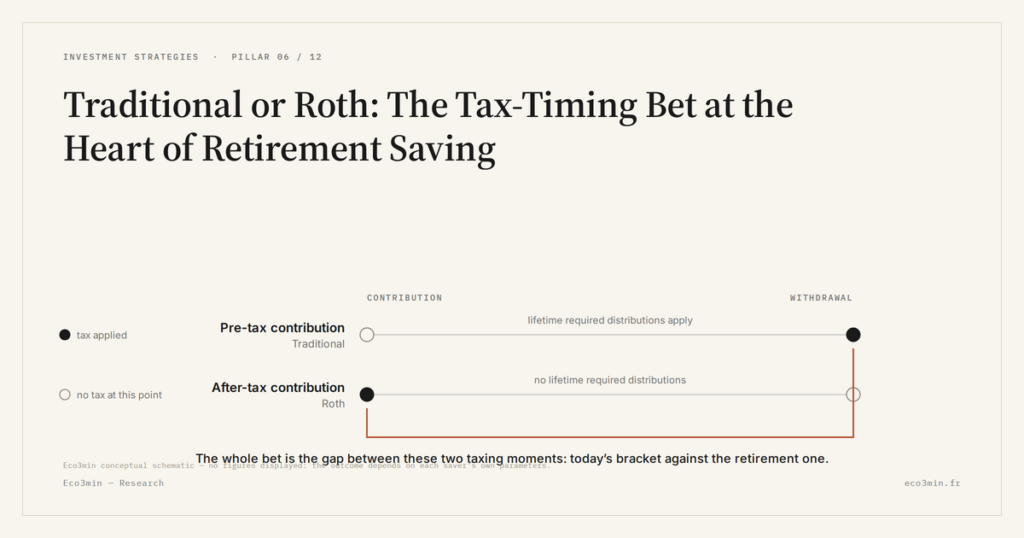
Traditional versus Roth is one timing bet: deduct now and be taxed at the retirement bracket, or pay now and withdraw tax-free later.
- Traditional defers tax and bets the retirement bracket is lower than the working-life bracket.
- Roth pays tax now and bets the future bracket is higher, or that statutory rates rise; qualified withdrawals then come out tax-free.
- A Roth conversion crystallizes tax today for a tax-free balance; Roth accounts also escape lifetime required distributions.
The question comes up constantly, and it is almost always framed the wrong way. Put as “which account is better”, it invites a verdict that neither traditional nor Roth can deliver in the abstract, because their respective edge depends on parameters specific to each saver. Reframed as “under what conditions does each come out ahead”, it opens a mechanical reading. The choice is not a contest between two products but a single bet with two directions: pay tax now or pay it later. This article lays out that timing bet and illustrates it with conditional cases, without crowning a winner. It describes how tax-deferred accounts work on both sides of the bet, and hands the comparison with a taxable account to a dedicated companion.
One bet, two directions
Traditional and Roth are the same vehicle with the tax timing reversed. A traditional contribution is made pre-tax: it lowers taxable income now, and the balance is taxed as ordinary income at withdrawal. A Roth contribution is made after-tax: it gives no deduction now, but qualified withdrawals, including the earnings, come out tax-free later. Everything else, the contribution limits, the investment menu, the compounding, is largely shared. The single variable that separates them is when the tax is paid, which is why the choice is a bet on the future rather than a ranking of two products. Betting on that timing is where the textbook parity argument breaks down, a point taken up in how Roth and traditional retirement accounts actually compare.
Because the only difference is timing, neither side is better in general. The traditional deduction is worth most to a saver whose bracket falls in retirement; the Roth exit is worth most to a saver whose bracket rises, or who expects statutory rates to climb. Each direction of the bet wins under a different future, and the future is unknown at the moment of contribution. That is the structural reason a single answer is impossible, and the reason the useful reading examines the conditions rather than declaring a winner.
What the two share is worth stating, because it isolates the bet. Both draw on the same contribution limits, invest in the same kind of menu, and compound identically; an employer match, where it exists, is itself made on a pre-tax basis regardless of whether the employee contributes to a traditional or a Roth account. The vehicles are not two different investments but two tax treatments of the same investment. Stripping away everything they have in common leaves only the timing of the tax, which is precisely the variable the saver is betting on and the only one that distinguishes the outcomes.
The bracket path is the whole question
The decisive variable is the path of the marginal bracket between working life and retirement. Traditional earns its deduction at the current bracket and pays tax at the retirement bracket, so it captures a gain whenever the retirement bracket is lower, and turns costly whenever it is higher. Roth does the opposite: it pays tax at the current bracket and escapes it entirely at withdrawal, so it captures a gain whenever the future bracket, or future statutory rates, would have been higher. The bet is symmetric, and the same bracket path that favors one side disfavors the other.
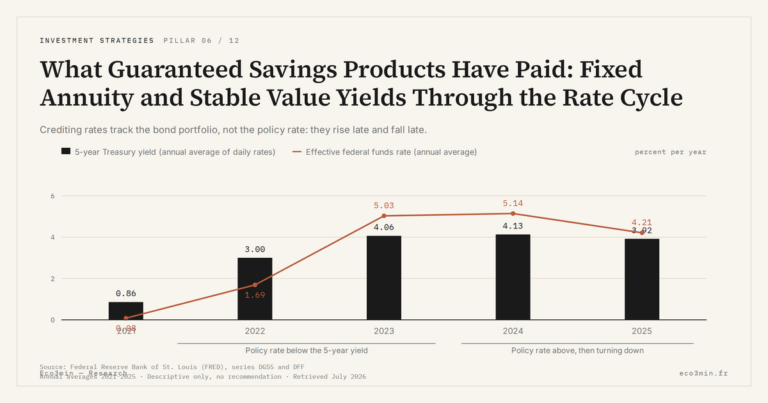
The value of deferral itself is not fixed, either. It depends on the rate regime crossed during the saving phase, since deferring a tax is worth more when a sheltered balance compounds at high real rates and less when it does not. The regime dimension of that logic is set out in the value of deferral by regime. Roth, whose advantage lands at the exit as a tax-free withdrawal, does not run on exactly the same lever. Comparing the two without the rate regime in view freezes a bet whose value is, in part, regime-dependent.
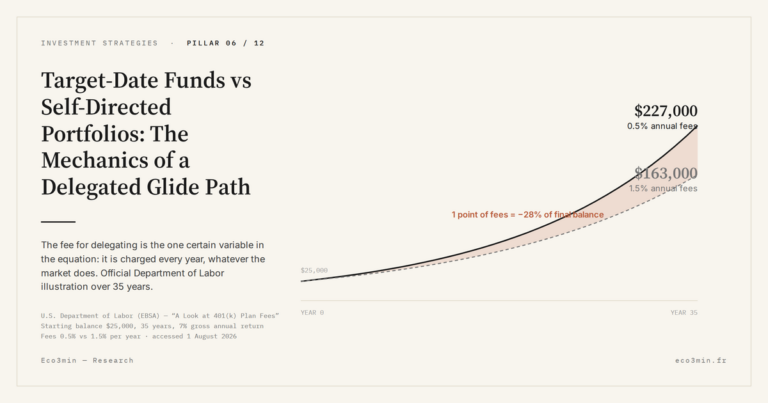
The bracket path that decides the bet is, itself, hard to forecast. It depends on the career trajectory, the balance accumulated, the interaction of withdrawals with Social Security and required distributions, and the statutory schedule that will apply decades later, none of which is known at the time of contribution. Retirement income tends on average to fall relative to working income, which statistically favors the traditional side, but that is a population tendency, not an individual guarantee. The honest description is therefore a range of outcomes rather than a point forecast, and the choice between the two sides is a way of positioning within that range, not of eliminating it. A closer look: our analysis of 401(k) fund selection.
The Roth conversion makes the bet explicit
A Roth conversion moves an existing pre-tax balance into a Roth account, paying ordinary income tax on the converted amount in the year of the conversion. It crystallizes the bet: tax paid today buys a balance that will grow and be withdrawn tax-free. The conversion is advantageous under the same condition as a Roth contribution, that the bracket paid now is lower than the bracket that would have applied later, and costly under the reverse. It is often considered in years of unusually low income, when the conversion is taxed at a lower bracket, though whether that condition holds is specific to each situation and to the statutory schedule in force.
Two features sharpen the bet without settling it. Roth accounts are not subject to required minimum distributions during the owner’s lifetime, which changes the drawdown arithmetic and the estate picture, whereas traditional balances are forced out on the RMD schedule. And the choice is not all-or-nothing: many savers split contributions between pre-tax and Roth, hedging the bracket bet rather than committing to one side. That split narrows the range of outcomes instead of trying to win the bet, an admission that the future bracket path is unknowable. Holding both kinds of balance also gives a retiree some control over the exit: drawing from the traditional side up to a target bracket and from the Roth side beyond it can keep the combined income under thresholds that matter, though the arithmetic of doing so is specific to each situation. More on this: the gap-to-fill view of retirement.
Reading the bet through conditional cases
Recombined, these mechanics produce cases, not recommendations. They read as mechanical observations, valid under the stated conditions, not as instructions. First case: a saver in a high bracket now with a long horizon and no expectation of a higher retirement bracket captures more from the traditional deduction, all the more as the retirement bracket is lower. Second case: a saver in a low bracket now gains little from the deduction, since the entry saving is proportional to the bracket, so the Roth’s tax-free exit carries relatively more weight. Third case: a saver who expects statutory rates or personal income to rise values the Roth’s locked-in, tax-free withdrawals, independently of any single-year calculation. Background: the clock-by-clock view of tax levers.
These cases neither exclude one another nor transfer from one person to the next. A single saver can fall into several at once, or into none, as the bracket path, the horizon and expectations about future rates change. They do not indicate what to do; they show how the timing bet resolves under different assumptions, which each reader has to weigh with their own parameters. This reading by situation and regime, rather than by product, sits within the frame on wrappers under shifting macro regimes, alongside the way guaranteed funds and unit-linked by rate regime shift with the cycle.
- Traditional and Roth are one vehicle with the tax timing reversed: pay tax later, or pay it now.
- Traditional wins when the retirement bracket is lower; Roth wins when the future bracket, or statutory rates, would have been higher.
- A Roth conversion crystallizes the bet; Roth also escapes lifetime RMDs. The outcome turns on the bracket path, which no article can know for a given reader.
The traditional-versus-Roth choice has no designated winner, and claiming otherwise hides the conditions under which each side comes out ahead. The mechanics do not say which to pick; they make legible the parameters that tip the bet, the bracket path, the horizon, expectations about future rates, and the presence of RMDs. It falls to each saver to weigh them, in light of their situation and the regime crossed, rather than to a ready-made verdict. What the article offers is a map of the bet, not a bet placed on the reader’s behalf.
Last updated — 29 August 2026
Disclaimer – Financial Information: The analyses, commentary, and content published on eco3min.fr are provided for informational and educational purposes only. They do not constitute investment advice or a solicitation to buy or sell financial instruments. Past performance is not indicative of future results. All investment decisions involve risk and are the sole responsibility of the reader.
Read next
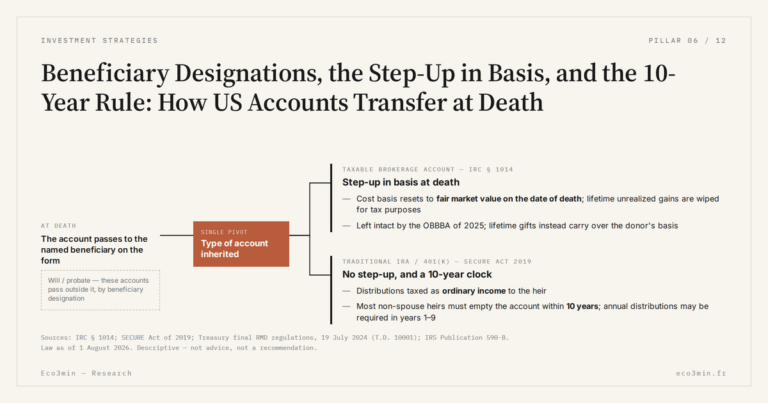
Full pillar →Beneficiary Designations, the Step-Up in Basis, and the 10-Year Rule: How US Accounts Transfer at Death
At death, most US financial accounts pass outside the will, straight to a named beneficiary, under tax rules…
The Fee Stack in Variable Annuities: M&E Charges, Riders, and Subaccount Costs
A variable annuity does not carry one fee, but a stack of them. Mortality and expense charges, subaccount…
The Conventional 401(k)-Match-First Funding Order: Where It Comes From, How It Works
The question of what order to fund accounts in usually draws a fixed list, presented as a rule…