Real Rates and Asset Valuations: The Discounting Mechanism
Real rates determine asset valuations through the discount rate applied to future cash flows. The mechanism explains why nominal rate cuts can coexist with valuation corrections, and why long-duration assets bear the sharpest adjustments.


Every asset valuation rests on the discounting of future cash flows at a rate that incorporates the real return investors require. Real rate levels therefore govern prices across all asset classes.
TL;DR
A policy rate cut that leaves the anticipated real rate unchanged barely moves fundamental asset value, which is why nominal easing can coincide with valuation corrections.
- Sensitivity scales with cash-flow duration: a 30-year bond loses roughly 20% of its value for a 100bp real-rate rise versus 2% for a 2-year bond, and growth stocks, with profits concentrated far out, took the sharpest hit when real rates rose in 2022.
- Risk premia amplify the channel: the New York Fed's ACM model put the 10-year Treasury term premium near 60bp in January 2026, and per the IMF (October 2025) the worst corrections since 2020 lined up with term-premium widenings rather than policy-rate hikes.
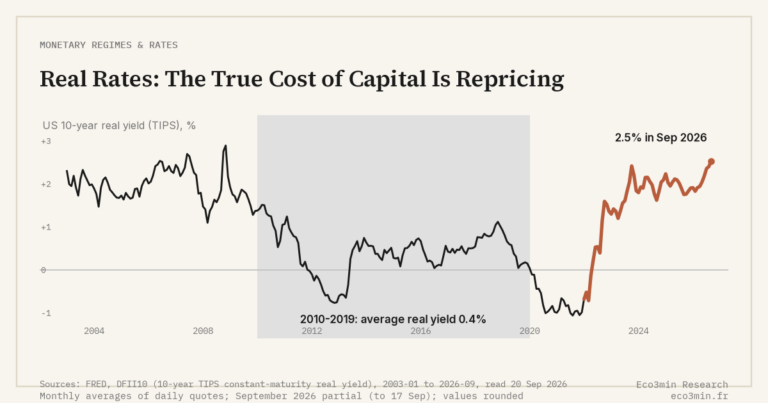
- The 2021-to-2026 re-rating fits the mechanism: US real rates moved from -1% to +2% and S&P 500 forward multiples normalized from ≈24x to ≈20x, consistent with a 300bp rise in the real discount rate.
The discounting mechanism directly links the real rate regime to price levels for bonds, equities, real estate and alternative assets.
Real rates determine asset valuations through the discount rate applied to future cash flows. This is unpacked carefully in this analysis of safe withdrawal rate valuations. Analysis of risk premia and adjustment dynamics.
The most common explanation for the equity rally between late 2023 and early 2026 emphasizes anticipated policy rate cuts. The data behind it is compiled in the observed dynamic between yield curve signals and equity flows. This intuitive reading is incomplete. What determines financial valuations is not the nominal rate set by central banks, but the real rate — the return investors require once inflation is netted out. A nominal rate move that leaves the anticipated real rate unchanged has, in theory, no effect on the fundamental value of assets. This mechanism, often obscured by market commentary, explains why nominal rate cuts can coexist with valuation corrections.
Discounting Future Cash Flows: The Core Mechanism
The price of a financial asset equals the sum of its future cash flows discounted at a rate that reflects the required real return plus a risk premium. When real rates rise by 100 basis points, the discount rate rises by the same amount — and the present value of future cash flows mechanically contracts, even if revenue prospects remain unchanged.
The magnitude of this effect depends on the duration of the cash flows. A 30-year bond loses roughly 20% of its value for a 100 basis point rise in real rates, while a 2-year bond loses only 2%. The same principle applies to equities: growth stocks, whose profits are concentrated in the distant future, are more sensitive than regular-dividend names. This differentiated sensitivity explains why the 2022 rise in real rates hit technology stocks with disproportionate severity. To understand the central role of real rates, this discounting mechanism constitutes the most direct financial channel.
Risk Premia: Amplifying the Transmission
The discount rate does not reduce to the risk-free real rate. It incorporates a risk premium that compensates for uncertainty around future cash flows and around the level of real rates themselves. According to estimates from the New York Fed (ACM model, January 2026), the term premium on 10-year Treasuries stands at around 60 basis points — a level that reflects persistent uncertainty about the inflation trajectory. Data reference: our 10-year term-premium data.
This premium adds a layer of volatility to the valuation process. When uncertainty about future real rates rises, the risk premium increases and valuations compress beyond what observed real rate moves alone would justify. According to the IMF’s Global Financial Stability Report (October 2025), the most severe market corrections since 2020 have coincided with term premium widenings, not with policy rate hikes.
Attributing valuation moves to policy rates alone ignores the role of risk premia and inflation expectations. A policy rate cut accompanied by a term premium widening can produce a net tightening of financial conditions. The effective discount rate is not read off the policy rate, but off the entire real yield curve.
When Adjustments Turn Abrupt
Phases of rapid real rate increases produce adjustments that are more violent the more extreme the starting point. At the end of 2021, with US real rates at -1%, S&P 500 valuation multiples reached ≈24 times forward earnings according to S&P Global. In early 2026, with real rates at +2%, this multiple normalized to around 20 — an adjustment consistent with the 300 basis point rise in the real discount rate. More context: the Eco3min framework on how monetary policy reaches corporate earnings.
These adjustments are not confined to equities. Commercial real estate, infrastructure and private equity are subject to the same mechanism with a time lag. Exiting a regime of negative real rates reveals the distortions tied to negative real rates that had accumulated in valuations. These corrections sit within the monetary framework and financing conditions that determine the cost of capital at each point in time.
What the Discounting Mechanism Implies
- The real rate is the structural determinant of financial valuations — nominal rate moves only have an effect to the extent they alter the anticipated real rate.
- Asset sensitivity to rising real rates is proportional to the duration of their cash flows: long bonds and growth stocks bear the sharpest adjustments.
- Risk premia amplify the transmission of real rates to asset prices, particularly during periods of heightened uncertainty about the inflation trajectory.
Last updated — 12 July 2026
Disclaimer – Financial Information: The analyses, commentary, and content published on eco3min.fr are provided for informational and educational purposes only. They do not constitute investment advice or a solicitation to buy or sell financial instruments. Past performance is not indicative of future results. All investment decisions involve risk and are the sole responsibility of the reader.
Read next
Full pillar →Real Rates: The True Cost of Capital Is Repricing
Why real rates are reasserting themselves as markets' anchor and how to recalibrate investment and financing decisions facing…
Real Interest Rates: The Quiet Signal Reshaping Markets
Real interest rates: why their persistence in positive territory in 2026 is reshaping the rules for bonds, equities,…
OAT-Bund Spread: A Quiet Gauge of French Sovereign Risk
OAT-Bund spread: how this yield gap has become a key signal on French sovereign risk, fiscal policy and…