Real Rates: A Central Signal for Financial Markets
Financial markets do not value assets on nominal rates but on expected real rates. The discounting mechanism explains why inflation surprises generate larger price moves than fully-anticipated policy decisions across the entire yield curve.


Market participants do not think in nominal rates: they fold inflation expectations into their estimate of the real return on assets — the pivot of any financial valuation.
TL;DR
Markets price the real rate behind every asset: on 10 June 2026 a US inflation print of 4.2% year on year took the S&P 500 down 1.6% intraday.
- Two dates move the real rate: between 2021 and 2026 the S&P 500 swung 0.88% on average in absolute terms on CPI release days and 0.97% on FOMC decision days, against 0.73% on an ordinary session (Eco3min calculation on the BLS and FOMC calendars).
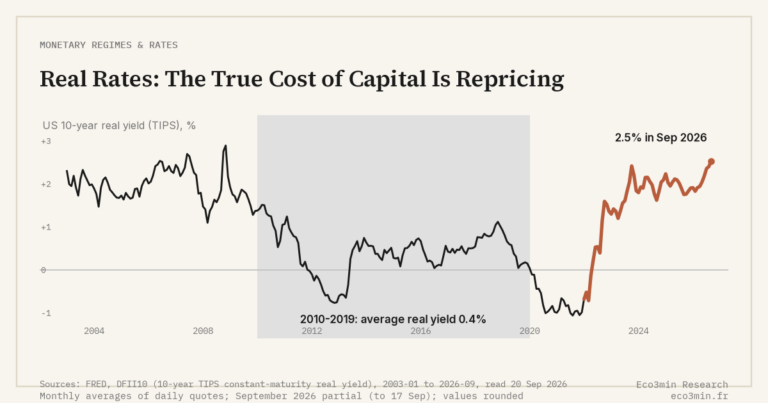
- The US 10-year real rate, derived from TIPS, swung from -1.04% on 31 December 2021 to 2.15% on 15 June 2026, 319 basis points, and 2.68% on 18 September 2026, a level it had not reached since July 2009.
- The statistical link is looser than it looks: over 2003-2026 monthly changes in the earnings yield correlate +0.15 with the real 10-year rate and -0.16 with the nominal one, so the real rate carries the sign theory predicts and the nominal one does not.
The expected real rate sets the discount rate applied to future cash flows — and therefore the price of every financial asset, from bonds to equities.
Financial markets watch real rates to recalibrate valuations. An analysis of the discounting mechanism and inflation expectations.
On 10 June 2026, the release of the May US consumer price index at 4.2% year on year, according to the Bureau of Labor Statistics, took the S&P 500 down 1.6% intraday. Six months earlier, on 13 January, the same release printed 2.7% and the index shed 0.2%. The level does not make the move: the gap to what was already in the price does. Financial markets do not react to nominal rates as such, but to implicit real rates, and inflation that strays from the anticipated path shifts that real rate across the whole curve within seconds. A related perspective: our reference page on the transmission of monetary policy to company results.
The real rate as the discount rate
Every financial valuation rests on discounting future cash flows. The rate used in that operation embeds the real return required by the investor — that is, the nominal rate minus expected inflation, plus a risk premium. When expected real rates rise, that discount rate goes up and the present value of future cash flows falls — mechanically, asset prices decline.
This mechanism explains why the rise in US real rates between 2022 and 2023 disproportionately compressed growth-stock valuations. Tech firms, whose cash flows are concentrated far in the future, suffer more from a higher discount rate than firms with shorter cash flow profiles. According to data derived from TIPS (Treasury Inflation-Protected Securities), the US 10-year real rate moved from -1.04% on 31 December 2021 to 2.15% on 15 June 2026, a swing of 319 basis points that reset the macroeconomic compass of real rates for every asset class.
Why inflation surprises dominate
Monetary policy decisions are largely priced in by markets. Fed Funds futures embed expected policy moves with growing precision, eroding their capacity to surprise. This is unpacked carefully in our analysis of equity dynamics under an inverted rate structure. Inflation, by contrast, remains intrinsically harder to forecast. Each inflation release instantly recalibrates implicit real rates across the entire yield curve.
The calendar shows it. Between 2021 and 2026, the absolute move in the S&P 500 averaged 0.88% on consumer price index release days and 0.97% on FOMC decision days, against 0.73% on other sessions. Both dates carry information, and which one dominates depends on the regime: in 2022-2023, when inflation set the path of rates, both averaged above 1.2%. What separates a release from a meeting is not the size of the move but its source. The first reveals realised inflation, the second the central bank’s reaction function, and the expected real rate is where the two meet.
- Financial markets value assets on the basis of expected real rates, not headline nominal rates — a 100 basis-point increase in real rates compresses valuations across all asset classes.
- Inflation releases and Fed decisions both move indices more than an ordinary session, and for the same reason: each one reshapes the implicit real rate across the entire yield curve.
- Long-duration assets — growth stocks, long-dated bonds, real estate — are the most sensitive to changes in real rates due to the discounting mechanics.
What this changes in reading markets
Reading markets through the lens of real rates reshapes several conventional diagnostics. The rally in equity indices between late 2023 and early 2026, often attributed to expectations of nominal rate cuts, is also explained by the stabilisation of expected real rates after their sharp re-rating. The statistical link stays loose, however: over 2003-2026, monthly changes in the earnings yield (the inverse of the CAPE ratio) correlate +0.15 with changes in the 10-year real rate and -0.16 with changes in the nominal one. The real rate carries the sign theory predicts and the nominal rate carries the opposite one, but neither explains the level of multiples on its own.
For multi-asset portfolios, the level of real rates determines the relative attractiveness of each class. With the US 10-year real rate at 2.68% on 18 September 2026, bonds offer a positive real return they had not paid since July 2009 — which reshapes the concrete impact on asset prices and the trade-offs between equities and bonds. This reconfiguration sits within the liquidity conditions that have shaped markets since the monetary cycle turned.
Last updated — 22 September 2026
Disclaimer – Financial Information: The analyses, commentary, and content published on eco3min.fr are provided for informational and educational purposes only. They do not constitute investment advice or a solicitation to buy or sell financial instruments. Past performance is not indicative of future results. All investment decisions involve risk and are the sole responsibility of the reader.
Read next
Full pillar →Real Rates: The True Cost of Capital Is Repricing
Why real rates are reasserting themselves as markets' anchor and how to recalibrate investment and financing decisions facing…
Real Interest Rates: The Quiet Signal Reshaping Markets
Real interest rates: why their persistence in positive territory in 2026 is reshaping the rules for bonds, equities,…
OAT-Bund Spread: A Quiet Gauge of French Sovereign Risk
OAT-Bund spread: how this yield gap has become a key signal on French sovereign risk, fiscal policy and…