Real Rates and Economic Trade-Offs: Consumption, Saving, Investment
Real rates set the price of time and shape the fundamental trade-offs between consumption, saving and investment. The intertemporal substitution mechanism remains the most direct channel through which they act on aggregate demand. The shift from negative to mildly positive real rates is rewiring household and corporate decisions across the euro area.

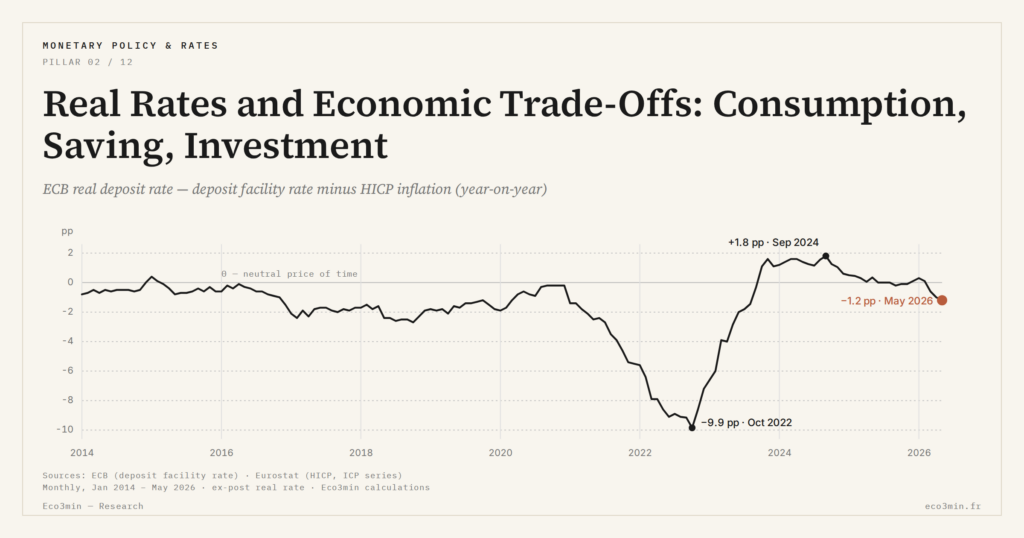
Real rates set the price of time in any economy. Their level shapes the trade-off between consuming now and saving, between investing and waiting.
TL;DR
After a decade of negative real rates, the euro area's return to mildly positive territory in early 2026 is rewiring how households and firms weigh spending, saving and investment.
- The ECB deposit rate sits at 2.75% in early 2026 after four consecutive cuts, yet the euro-area household saving rate held near 15.7% of disposable income in Q3 2025 (Eurostat), as nominal easing has not pulled saving down.
- The intertemporal substitution effect, the direct channel from real rates to spending and saving, is offset by an opposing income effect that makes household responses non-linear rather than mechanical.
The intertemporal substitution mechanism — rarely made explicit in mainstream economic commentary — remains the most direct channel through which real rates shape aggregate demand.
Real rates shape fundamental choices between consumption, saving and investment. An analysis of the intertemporal substitution mechanism.
The ECB’s deposit rate stands at 2.75% in early 2026, after four consecutive cuts. The euro area household saving rate reached ≈15.7% of disposable income in Q3 2025 according to Eurostat — above the pre-pandemic average. The gap between nominal easing and persistently high saving illustrates a fundamental mechanism: it is not headline rates that shape economic agents’ decisions, but the variable that anchors major economic decisions — the real rate. With inflation around 2.4%, the real return on remunerated savings remains low, but positive. This shift away from a decade of negative real rates is reshaping the intertemporal trade-offs faced by households and firms. Where those trade-offs are actually measured, households deviate from the textbook path, and that deviation is the whole substance of the gap between modelled and observed household saving.
The real rate as the price of time
Saving means giving up consumption today in exchange for future purchasing power. The real rate measures precisely that reward. When it is materially positive, deferring consumption becomes attractive: every euro left unspent gains real value. When it is negative, the incentive flips — waiting erodes purchasing power, which pushes agents toward immediate spending or alternative stores of value.
This mechanism, known as the intertemporal substitution effect, is the most direct channel through which real rates act on demand. But it does not operate alone. The income effect runs in the opposite direction: when real rates rise, wealth holders reach their saving targets faster and may relax their effort. The balance between these two forces depends on household profiles, time horizons and initial wealth — which is why the real-rate determinants of saving behaviour often produce counter-intuitive responses to rate changes.
Investing or waiting: the real-rate filter
For firms, the trade-off takes a different form but rests on the same principle. The mechanism is mapped out in our review of the macro drivers behind a rally on an inverted curve. A project is greenlit only if its expected return exceeds the real cost of financing. According to the ECB Bank Lending Survey (Q4 2025), corporate credit demand in the euro area remains subdued despite nominal rate cuts — a signal consistent with still-positive real rates that maintain a demanding selection filter.
This filter has an important macroeconomic consequence. Under low or negative real-rate regimes, as between 2015 and 2021, projects with low marginal productivity cleared the viability threshold. Investment volumes rose, but quality deteriorated. The return to positive real rates reverses this dynamic: only the most profitable projects survive the screen. This selection mechanism is at the core of the specific channel of productive investment and its implications for long-run growth.
What the current regime changes
The shift from negative to mildly positive real rates — the early-2026 configuration — does not produce a sharp shock but a gradual rewiring of behaviour. According to INSEE data (Q3 2025), flows into French regulated savings products slowed after the 2023 peak, but did not reverse. Households continue to save, but progressively reallocate toward instruments whose real return offsets inflation. Related work: our study on how monetary policy reaches corporate earnings.
For firms, the persistence of positive real rates means the opportunity cost of capital is no longer negligible. Long-horizon projects — energy transition, digitalisation, industrial expansion — must now incorporate a real financing cost that had vanished from calculations for a decade. This normalisation of the price of time restructures trade-offs in ways that nominal indicators do not fully capture. Reading this dynamic correctly requires looking at the financial conditions that frame these choices through the prism of real rates, not headline rates.
- The intertemporal substitution effect — the direct channel from real rates to consumption and saving — is offset by the income effect, which makes household responses non-linear.
- The return to positive real rates in the euro area restores a selection filter on investment that had disappeared during the decade of negative rates.
- The persistently high euro-area saving rate in early 2026 reflects this regime change more than nominal indicators alone would suggest.
Last updated — 28 July 2026
Disclaimer – Financial Information: The analyses, commentary, and content published on eco3min.fr are provided for informational and educational purposes only. They do not constitute investment advice or a solicitation to buy or sell financial instruments. Past performance is not indicative of future results. All investment decisions involve risk and are the sole responsibility of the reader.
Read next
Full pillar →Real Rates: The True Cost of Capital Is Repricing
Why real rates are reasserting themselves as markets' anchor and how to recalibrate investment and financing decisions facing…
Real Interest Rates: The Quiet Signal Reshaping Markets
Real interest rates: why their persistence in positive territory in 2026 is reshaping the rules for bonds, equities,…
OAT-Bund Spread: A Quiet Gauge of French Sovereign Risk
OAT-Bund spread: how this yield gap has become a key signal on French sovereign risk, fiscal policy and…