Tax wrappers and their contents across the rate regime

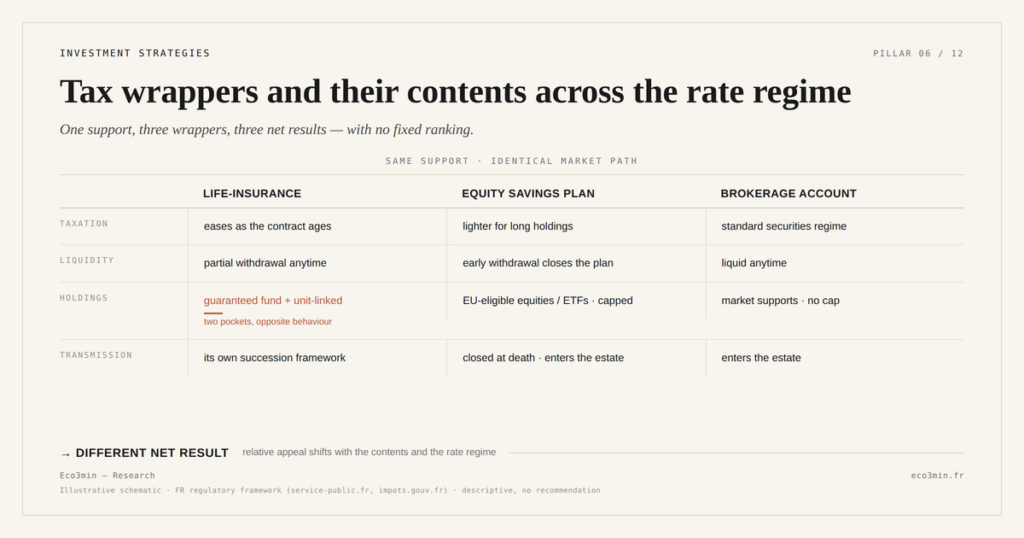
The same support does not produce the same net result held in a life-insurance-style contract, an equity savings plan or a brokerage account. The wrapper does not change the asset’s nature, but its tax treatment, its liquidity and the relative appeal of wrappers depend partly on the rate regime and the holding period.
TL;DR
The same ETF yields three different net results across a life-insurance contract, an equity savings plan and a brokerage account, because each wrapper taxes, restricts and transmits differently.
- A wrapper sets four parameters behind the net result: taxation of gains, liquidity, the menu of permitted supports, and transmission rules; reducing the choice to tax alone is incomplete.
- The life-insurance-style contract is the only one of the three to house two pockets with opposite behaviour, a guaranteed fund and unit-linked holdings, while the equity savings plan and the brokerage account hold only market supports.
- Relative appeal shifts with the rate regime through the contents: a money-market or short-bond support pays a real income in a high-rate regime and almost nothing in a low-rate one, so the most efficient wrapper-and-contents pairing has no fixed ranking.
The choice of an investment often collapses to the instrument — this stock, this ETF, this fund. The wrapper that holds it is treated as administrative detail. That framing is a mistake. Life-insurance-style contracts, equity savings plans and ordinary brokerage accounts differ in tax treatment, in what they can hold, and in liquidity. The same ETF held in one or another will not produce the same after-tax result, and their relative appeal depends partly on the rate regime and the holding period. This article describes the three-layer interaction — wrapper, contents, regime — and shows why reasoning about the instrument alone, ignoring the wrapper, leads to misleading comparisons. The aim is descriptive: to set out the structural trade-offs, not to designate which wrapper would suit any particular situation. For more detail: pre-tax contributions and marginal brackets.
The wrapper is not administrative detail
Before comparing supports, one has to compare what holds them. A savings wrapper is not a neutral container: it sets four parameters that determine what the saver actually keeps from an investment. First, the taxation of gains, which varies markedly from one wrapper to another, both on exit and during the holding period. Second, liquidity — the ease and cost of a withdrawal. Third, the range of permitted supports, which is not the same everywhere. Fourth, the transmission rules, which make some wrappers inheritance tools and not others. Companion study: the timing behind tax-reduction levers.
The cost of treating the wrapper as a detail is concrete. Two savers can hold the identical support, achieve the identical gross return, and walk away with materially different sums simply because one chose a wrapper suited to their horizon and the other did not. Nothing in the market explains the gap; it lives entirely in the structure that held the asset. This is why the wrapper deserves to be examined before, not after, the support — it sets the terms on which any return is realised. Holding several wrappers at once turns that examination into an annual choice, which is the argument behind tax diversification and the optionality it creates.
These four parameters explain why the too-common framing — wrapper A or wrapper B, posed as a simple tax comparison — stays incomplete. Tax is only one layer. Reducing the choice of wrapper to its tax treatment alone, as most basic comparisons do, ignores that liquidity, the support menu and transmission weigh just as much — and that their relative value shifts with the rate regime. This article therefore does not rehearse the classic “which wrapper to choose” grid; it describes how wrapper, contents and regime interact, which is a distinct question. Adjacent reading: REITs weighed against the tax-advantaged wrapper.
The life-insurance-style contract holds a special place here, because it is the only one of the three to house, within itself, two pockets with opposite behaviour — the guaranteed fund and unit-linked holdings. An equity savings plan and a brokerage account hold only market supports. This singularity, already described at the level of the contract, structures the insurance wrapper and its two pockets; here it is approached by comparison with the other wrappers.
The same support, three net results
The heart of the matter holds in a simple thought experiment: take one ETF, and place it in turn in a life-insurance-style contract, an equity savings plan and a brokerage account. The support’s market path is rigorously identical in all three — the wrapper does not touch the market value. But the net result the saver keeps differs, because the taxation of gains, the moment it applies and the withdrawal rules are not the same.
An ordinary brokerage account taxes gains under the standard regime for securities, with no holding-period condition and no contribution cap, but no particular advantage either. An equity savings plan reserves a lighter tax frame for long holdings, in exchange for a restricted investment universe and a contribution cap. A life-insurance-style contract applies yet another logic, with taxation that eases as the contract ages and its own transmission rules. The same gross gain can therefore translate into appreciably different net amounts depending on the wrapper and the horizon — not because the investment performed better or worse, but because the wrapper levies differently. Related reading: investments seen through the prism of the cycle.
Liquidity adds a dimension that tax alone hides. A brokerage account can be liquidated at any moment, without condition. An equity savings plan tolerates withdrawals, but a withdrawal before a certain age in principle closes the plan and forfeits its tax frame. A life-insurance-style contract stays accessible by partial withdrawal at any time, but its exit taxation eases with age, creating an implicit incentive to hold. Three wrappers, three relationships to time: one indifferent to duration, one rewarding it all-or-nothing, one rewarding it gradually. This temporal dimension weighs as much as the tax rate on the result actually available. Further reading: our frame for gold across regimes.
And this net result also depends on the rate regime, through the contents. A bond ETF, for instance, does not behave the same way whether rates rise or ease, and the wrapper merely sets the taxation of the gain or loss that results. This is the link between the instrument and its environment: the same ETF across the regime produces opposite paths, which the wrapper then takes in its own way. Wrapper and regime do not substitute for each other: they compound.
The three-layer interaction: wrapper, contents, regime
From these observations emerges a three-layer reading grid that has to be held simultaneously. The first layer is the wrapper: its tax treatment, its liquidity, its transmission, its support menu. The second is the contents: the nature of the support held, which determines risk and responsiveness. The third is the rate-and-inflation regime, which governs the behaviour of the contents and shifts the relative appeal of wrappers. A rigorous comparison proceeds layer by layer, without confusing what belongs to one with what belongs to the others.
The main source of error is to attribute to a wrapper what in fact belongs to the contents, or to the regime. Claiming that a wrapper “pays more” is a shortcut: it is the support it holds that produces the return, and the regime that modulates its behaviour; the wrapper merely organises the taxation and the liquidity. Conversely, judging a support without accounting for its wrapper ignores a substantial part of the net result. The two errors are symmetric, and both lead to misleading comparisons.
The holding period threads through all three layers. A wrapper that rewards duration is worth little to a saver who will withdraw soon, and a great deal to one who will hold for years; a support whose risk needs time to average out fits the long horizon and not the short one; and the regime itself turns over those same years, so that the pairing chosen at the start may not be the one that proves apt by the end. Time is not a fourth layer but the axis along which the other three are read.
A concrete example lights up this compounding. In a high-rate regime, a money-market or short-bond support again offers a non-trivial income; held in a wrapper that is lightly taxed over time, it combines a decent current yield with a soft long-run tax. In a low-rate regime, that same support earns almost nothing, and the wrapper’s advantage shifts towards other, more growth-oriented contents. The wrapper-and-contents pairing that appears most efficient is therefore not the same from one regime to another — not because the wrappers changed, but because the return on the contents changed with rates. It is the clearest illustration of why one must reason on the three layers at once, thinking jointly about wrapper and rate cycle rather than one without the other.
- The wrapper does not change a support’s market value, but it alters its taxation, liquidity, menu and transmission: the same ETF produces different net results across the three wrappers.
- Reducing the choice of wrapper to its tax treatment alone is incomplete: liquidity, permitted supports and transmission weigh just as much.
- The life-insurance-style contract is the only one of the three to house two pockets with opposite behaviour (guaranteed fund and unit-linked); the others hold only market supports.
- The relative appeal of wrappers depends on the contents and the rate regime: it shifts with the holding period and the phase of the cycle, with no fixed ranking.
Wrapper, contents and regime thus form a system: none of the three reads on its own. This is why a wrapper comparison run outside the context of contents and regime teaches only part of the story, and why this article keeps to describing the interaction rather than designating a preferable wrapper. One last widening remains, internal to the guaranteed fund itself: the new-generation formats, which modulate the guarantee and the sensitivity to the cycle, and which blur the sharp boundary between the guaranteed pocket and the exposed one. What these structures change is treated in the analysis of new-generation guaranteed vehicles. The conclusion to keep here is that, before choosing a support, one has to understand the wrapper that holds it and the regime that governs it — three layers, never one alone.
Last updated — 29 August 2026
Disclaimer – Financial Information: The analyses, commentary, and content published on eco3min.fr are provided for informational and educational purposes only. They do not constitute investment advice or a solicitation to buy or sell financial instruments. Past performance is not indicative of future results. All investment decisions involve risk and are the sole responsibility of the reader.
Read next
Full pillar →Beneficiary Designations, the Step-Up in Basis, and the 10-Year Rule: How US Accounts Transfer at Death
At death, most US financial accounts pass outside the will, straight to a named beneficiary, under tax rules…
The Fee Stack in Variable Annuities: M&E Charges, Riders, and Subaccount Costs
A variable annuity does not carry one fee, but a stack of them. Mortality and expense charges, subaccount…
The Conventional 401(k)-Match-First Funding Order: Where It Comes From, How It Works
The question of what order to fund accounts in usually draws a fixed list, presented as a rule…