Why Credit Often Matters More Than Interest Rates
Low rates do not guarantee access to financing. Lending standards, shaped by lender risk perception and balance-sheet constraints, drive credit availability and economic activity more directly than rate levels alone — a distinction that explains why monetary easing can coexist with stagnating real activity.


The gap between credit pricing and effective access — and why the second drives the cycle more than the first.
TL;DR
French mortgage rejection rates reached roughly 42% in late 2025, against about 15% in 2021, even as borrowing costs eased: access drives the cycle, set by lending standards.
- Every loan passes two independent filters that move on different timescales: its cost, which shapes project profitability, and the probability of being granted it at all, set by lending standards.
- Across the euro area's 2015-2019 window, credit to non-financial corporations grew only about 2% a year despite negative policy rates and heavy liquidity injections, a near-zero price that failed to lift quantity.
- The ECB's quarterly Bank Lending Survey tracks how many banks tighten or ease criteria; persistent tightening signals constrained access even when policy rates sit flat or falling.
Interest rates capture the analytical attention. Each ECB or Fed meeting generates expectations, repricings, headlines. Yet the price of credit and access to credit are two distinct variables that can move in opposite directions for extended periods. The economic impulse is not driven by the rate at which a loan would be granted; it is driven by whether the loan is actually granted, and to whom. This distinction explains why monetary easing can coexist with stagnating activity, and why tightening can take months to bite — a key mechanism behind why home prices rise and fall.
Price and Access — Two Separate Constraints
A borrower faces two independent filters. The cost of financing affects project profitability. The probability of being granted financing — set by lending standards — determines whether the project can exist at all. These two dimensions move on different timescales and respond to different determinants.
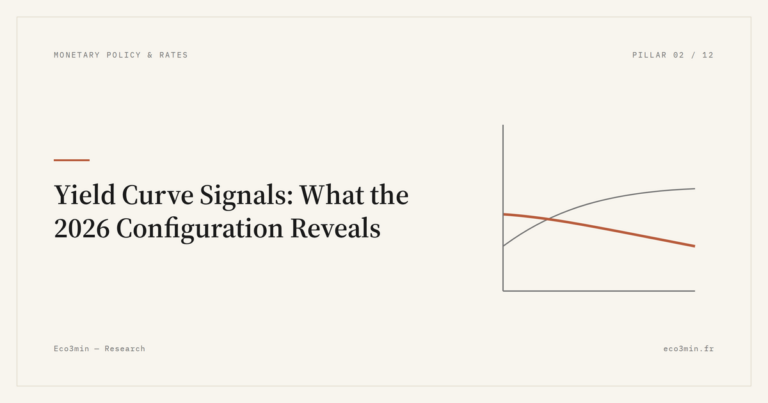
Policy rates feed into market rates with variable but mechanical lags. Lending standards, by contrast, depend on each lender’s risk perception, balance-sheet capacity and prudential constraints. The dissociation between rate levels and effective financing conditions is one of the mechanisms behind the apparent disconnect between markets and an inverted yield curve.
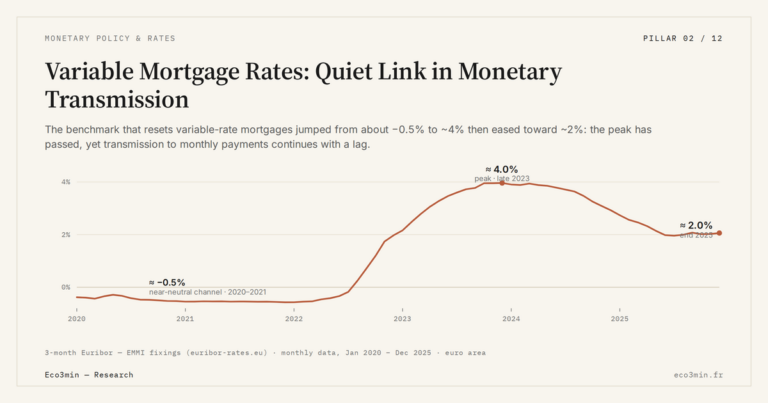
In France, the rejection rate on mortgage applications reached ≈42% in late 2025, against ≈15% in 2021. The shift unfolded while rates, after a sharp rise, had started retreating. The price was falling; access remained closed. Headline rate dynamics did not capture the operative variable.
Why Lending Standards Drive the Cycle
In the tightening phase, banks become more selective. They anticipate deteriorating borrower quality. They protect their balance sheets against future losses. The caution translates into stricter criteria, independent of where policy rates sit.
The behavior is procyclical and amplifies fluctuations. When the economy slows, banks restrict origination, deepening the slowdown. When the economy accelerates, they ease criteria, fueling expansion. The credit cycle in its causal dimension shows that this lender-side dynamic precedes and shapes real activity. The asymmetry is also a central feature of financing-rationing phases.
The ECB’s quarterly Bank Lending Survey captures this qualitative dimension. It tracks how many banks tightened or eased their criteria, providing information that rate aggregates do not reveal. Persistent tightening signals constrained access, even when policy rates are flat or declining.
The Zero-Rate Decade as a Natural Experiment
The 2010-2020 period provided a real-world illustration. Policy rates remained near zero for years across advanced economies. Yet credit growth stayed moderate. In the euro area, despite negative rates and massive liquidity injections, credit to non-financial corporations grew only ≈2% per year on average between 2015 and 2019.
Lending standards stayed cautious. Borrower demand stayed subdued. A near-zero price proved insufficient to stimulate quantity. The episode prompted economists to revisit monetary transmission models. The credit channel — distinct from the rate channel — gained analytical weight in the literature. For the broader picture: Our account of the sensitivity of earnings to the rate regime.
What This Means for Policy Levers
If access matters more than price, the policy levers differ. Cutting rates does not suffice to revive financing when banks maintain restrictive criteria or borrowers lack confidence. Tools targeting credit conditions directly gain relevance: public guarantee programs — such as those deployed during the Covid crisis — facilitate access by reducing lender risk. Macroprudential measures can be eased to relax origination constraints.
The breakdown of the role of lending standards in the credit cycle details these mechanisms and their impact on financial stability.
Reading a rate cut as an automatic easing of financing conditions. The price of credit and access to credit are two distinct variables. Low rates can coexist with rationed credit when banks maintain strict criteria, when borrower balance sheets remain weak, or when demand stays cautious.
What the Consensus Tends to Simplify
Economic commentary focuses on central bank rate decisions because they are observable, scheduled and discrete. Each meeting generates a clear event. Effective financing conditions — those determining real access — receive less attention. They are harder to observe in real time. They depend on decentralized decisions taken by thousands of institutions whose criteria are not directly published.
The asymmetry of attention creates analytical biases. Markets can anticipate a recovery because rates fall, while lending standards remain restrictive. The gap between expectations and reality eventually closes, sometimes abruptly — a typical scenario of mid-cycle disappointment.
Indicators Complementing Rate Tracking
To capture effective financing conditions, three indicators complement rate aggregates.
The ECB’s Bank Lending Survey provides a direct measure of how lending criteria evolve. Persistent tightening signals constrained credit despite potential rate cuts.
New credit flows — distinct from outstanding stocks — measure effective financing dynamics. Stagnant flows despite attractive rates reveal a transmission breakdown.
Rejection rates on credit applications, published by certain brokers or sectoral surveys, capture the access dimension beyond price.
Together, these three describe what rates alone cannot: whether the credit channel is open or closed.
What This Implies for Reading the Cycle
Credit functions as a quantity as much as a price. Models that retain only interest rates miss an essential dimension of financing dynamics. This gets a fuller treatment in this question on credit card interest rates. The relevant question for households and corporations is no longer only “at what rate can I borrow?” but “can I borrow at all?” The answer to the second depends on lending standards, lender risk perception and balance-sheet configurations — variables that move independently of the headline rate, and on which the cycle ultimately turns.
Last updated — 12 July 2026
Disclaimer – Financial Information: The analyses, commentary, and content published on eco3min.fr are provided for informational and educational purposes only. They do not constitute investment advice or a solicitation to buy or sell financial instruments. Past performance is not indicative of future results. All investment decisions involve risk and are the sole responsibility of the reader.
Read next
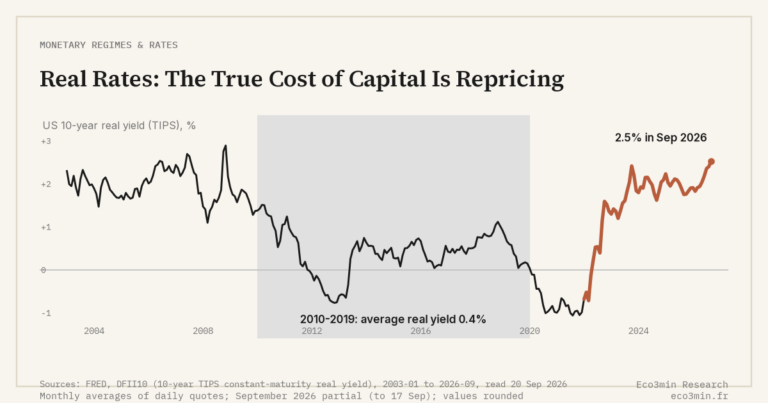
Full pillar →Real Rates: The True Cost of Capital Is Repricing
Why real rates are reasserting themselves as markets' anchor and how to recalibrate investment and financing decisions facing…
Real Interest Rates: The Quiet Signal Reshaping Markets
Real interest rates: why their persistence in positive territory in 2026 is reshaping the rules for bonds, equities,…
OAT-Bund Spread: A Quiet Gauge of French Sovereign Risk
OAT-Bund spread: how this yield gap has become a key signal on French sovereign risk, fiscal policy and…