Credit Tightening: Why the Real Effect Lags by 12 to 18 Months
Credit tightening rarely shows up in activity data for 12 to 18 months. Existing contracts keep the prior regime running while underlying conditions deteriorate. Reading the lag as resilience is the most common mistake of every late-cycle phase.

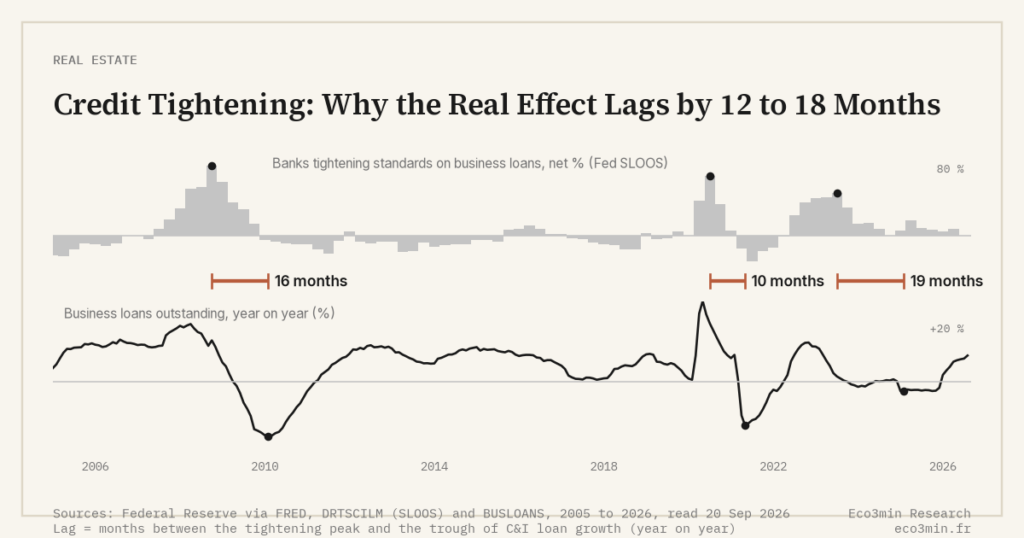
Why the gap between credit tightening and its visible effects on activity is structural rather than incidental — and why misreading it produces the most predictable error of every late-cycle phase.
TL;DR
In advanced economies, 12 to 18 months separate tighter lending standards from the slowdown they cause; output holds up in the interval because existing contracts keep the prior regime running.
- New origination slows immediately, but outstanding credit can keep growing for quarters as existing loans and drawn credit lines run on; in late 2025 ECB surveys had flagged tighter standards for three straight quarters while euro-area corporate credit growth held near 2.3% year-on-year.
- The structure of the credit stock changes the lag: in France, where fixed-rate mortgages exceed 95%, debt service stays flat for years, whereas the United Kingdom's roughly 30% short-rate-indexed mortgages transmit hikes to household income within months.
- Transmission arrives in sequence — corporate capex bends with a 6-to-12-month lag, employment adjusts hours, then hiring, then layoffs, adding another 6 to 9 months — which is why the unemployment rate is the worst leading indicator of a turn.
- Bank lending-standard surveys (ECB BLS, Fed SLOOS) lead activity by 9 to 12 months yet draw the least news coverage; a confidence shock can collapse the lag, as the 2023 US regional-bank stress compressed cumulative tightening into a single quarter for parts of corporate lending.
Why the lag is a feature, not an anomaly
Credit tightening produces no immediate effect on activity. Decisions taken before the regime change keep running through contracts already signed. This inertia masks the shift in financial conditions for several quarters. Output appears to hold up while conditions deteriorate underneath. The lag is frequently misread as resilience — and the misreading is the costliest analytical error of every late-cycle phase.
Between the moment banks start tightening lending standards and the moment activity rolls over, 12 to 18 months typically elapse in advanced economies, according to BIS estimates. The delay is not anecdotal: it dictates how every cyclical indicator should be read, and which ones to trust during the transition.
Existing commitments keep the prior regime running
When tightening begins, loans already extended continue to fund existing projects. Corporates keep drawing on undrawn credit lines negotiated under earlier conditions. Households service mortgages signed at the rates of two years ago. The flow of new credit decelerates immediately; the stock effect takes far longer to absorb. The absorption itself is measurable: the annual growth rate of French housing loans, monthly since 2012 only turned negative in 2024.
Total outstanding credit can therefore keep growing for several quarters after tightening has begun. New origination slows, but the accumulated stock maintains a residual impulse to spending and investment.
The euro area in late 2025 illustrates the mechanism. ECB lending surveys had been signalling tighter credit standards for three consecutive quarters. Euro-area corporate credit growth remained positive at roughly 2.3% year-on-year. The gap is the lag itself, measured in real time.
Why fixed-rate contracts extend the inertia
In economies where mortgages are predominantly fixed-rate — France, where the share exceeds 95% — households absorb rate hikes only when they refinance or originate a new loan. This propagation channel is detailed in the analysis of the housing credit cycle and price formation, which traces how rate shocks reach property prices through the lending channel. Debt service stays flat for years on the existing stock.
The contrast with variable-rate economies is sharp. In the United Kingdom, roughly 30% of mortgages are indexed to short-term rates. The tightening transmits to household disposable income within months. The same monetary policy produces different lag profiles depending on the structure of the credit stock — a point standard models capture poorly.
Why the lag distorts the cycle read
The gap between financial conditions and activity creates a recurring misinterpretation. When activity prints solid despite tighter conditions, the natural temptation is to conclude that the economy has decoupled from monetary policy — that this cycle is different.
It usually has not decoupled. It has not yet absorbed the shift. The reading that unpacks this causal sequence is detailed in the framework on the credit cycle and its timing. The transmission is slow, but it is operative throughout — the visible effect is what is delayed, not the underlying force.
Consensus forecasts tend to underestimate these lags systematically. Growth projections built on partial-adjustment models embed a faster transmission than the historical evidence supports. The asymmetry creates a recurring pattern: expectations get revised late, all at once, after the data has already turned.
The transmission channels, in order of arrival
Corporate investment responds to financing conditions with a 6 to 12-month lag. Projects already committed see through. New projects get postponed gradually, not abruptly. The capex cycle is the first to bend, but the bend takes quarters to register in the official series.
Household consumption follows the disposable-income channel before the cost-of-credit channel. Negative wealth effects from falling asset prices take time to alter saving behaviour — and the alteration shows up first in big-ticket discretionary spending, only later in headline retail sales.
Employment is a second-order lagging variable. Firms first adjust hours worked, then hiring, before moving to layoffs. The sequence adds another 6 to 9 months to the transmission, which explains why the unemployment rate is the worst possible leading indicator of a turn.
- The average lag between credit tightening and a visible slowdown in activity is 12 to 18 months in advanced economies.
- Existing contracts — particularly fixed-rate mortgages — extend the effects of the prior regime well after the new one has begun.
- Solid activity prints during a tightening phase do not signal structural resilience. They signal incomplete transmission.
What can shorten or extend the lag
A confidence shock — a bank failure, a geopolitical flare-up, a credit event in a systemic counterparty — can collapse the lag to weeks. The 2023 regional bank stress in the US compressed the transmission of cumulative tightening into a single quarter for parts of the corporate lending market. Conversely, rapid central bank intervention to restore liquidity can extend the inertia phase by buying time on the funding side. Also relevant: our study on the real estate credit cycle and its price dynamics.
In early 2026, the non-financial corporate debt ratio in the euro area stood near 80% of GDP, according to Eurostat. The level points to heightened sensitivity to financing conditions — but with the cycle’s characteristic lag structure intact.
What indicators to read during the transition
Lending standards captured by bank surveys (ECB BLS, Fed SLOOS) are the most reliable leading indicator for anticipating a slowdown before it shows up in GDP. They lead activity by 9 to 12 months on average. They are also the indicator least covered by the daily news flow.
The credit crunch mechanism is the extreme form of this same dynamic — what happens when the lag collapses and the stock effect reverses simultaneously.
What the timing changes for analysis
Reading activity indicators too quickly during a tightening phase produces a specific error: concluding that the cycle has extended when the turn has already started but is not yet visible in the headline data. The data will catch up. It always does.
The risk during tightening is not that policy fails to slow the economy. The risk is that it succeeds with a lag long enough for expectations to have committed in the wrong direction — and for positioning to have adjusted to the wrong scenario.
Last updated — 20 September 2026
Disclaimer – Financial Information: The analyses, commentary, and content published on eco3min.fr are provided for informational and educational purposes only. They do not constitute investment advice or a solicitation to buy or sell financial instruments. Past performance is not indicative of future results. All investment decisions involve risk and are the sole responsibility of the reader.
Read next
Full pillar →US Rental Property Real Yield: What Cap Rate and NOI Actually Leave You
A rental listing leads with a yield. Divide the annual rent by the price and the number looks…
Cap Rate Spread: What Rental Yield Pays Over the 10-Year Treasury
A 5% cap rate sounds attractive. But 5% against what? A risk-free 10-year Treasury yields near 4.5% in…
Vacancy and Turnover: The Cost That Erodes a Landlord’s Real Return
A listing shows full rent, twelve months a year. The owner knows the gaps between tenants, the make-ready…