Why Scarcity Alone Does Not Create Value in Crypto Assets

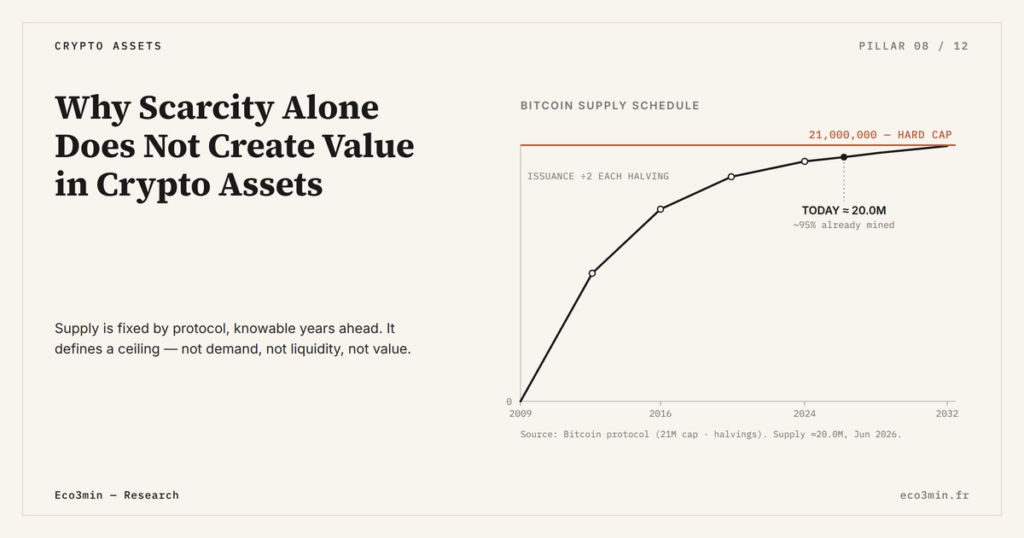
Programmed scarcity is not enough to create value without demand, usage, and liquidity. An analysis of the underlying economic mechanisms.
TL;DR
Programmed scarcity only sets a supply ceiling; in crypto, value still forms at the margin, where demand and liquidity cycles set the price.
- Gold's stock-to-flow ratio illustrates the limit: scarcity defines a potential framework, it does not create the buying flows that actually move price.
- Since late 2024 tighter financial conditions cut the liquidity available to risk assets, and in 2025 several strictly capped crypto assets saw trading volumes fall even though their issuance never changed.
- Markets track holder concentration, volume turnover and the ratio of real transactions to market capitalization more than theoretical supply; when these deteriorate, scarcity loses its narrative power even while technically intact.
Scarcity is often presented as a guarantee of value, particularly when embedded in a protocol. This view oversimplifies the economic mechanisms at play. Without stable demand, identifiable use cases, and sufficient market depth, scarcity remains a formal property. The common mistake is to isolate supply while ignoring the conditions of circulation and exchange. Understanding the joint role of demand and liquidity helps place scarcity in its proper role in value formation.
Limited supply does not imply active demand
Part of the consensus equates scarcity with valuation, based on a simple intuition: a limited asset should mechanically appreciate as interest grows. This logic holds in markets where demand is structural and persistent. It becomes far more fragile when demand is intermittent, speculative, or dependent on financial cycles.
In the case of crypto assets, supply can be perfectly constrained at the algorithmic level while still facing unstable demand. A capped issuance says nothing about the intensity of net buying, nor about the market’s ability to absorb selling during periods of stress. That gap between capped issuance and actual price is the crux of the supply mechanics of the bitcoin halving. Scarcity does not create flows—it merely defines a potential framework. Companion analysis: Gold’s structural scarcity seen through the stock-to-flow ratio.
This point connects to another common misconception: the idea that adoption alone is sufficient to transform a supply constraint into sustained price appreciation, whereas the diffusion of use cases does not necessarily translate into net buying flows, as detailed in the analysis of crypto adoption and price formation.
Formal scarcity vs real liquidity: a structural gap
Economic value is formed at the margin, where buyers and sellers meet. However, most crypto assets exhibit fragmented liquidity, concentrated on a limited number of platforms or time windows. Under these conditions, scarce supply can coexist with erratic price movements or prolonged stagnation.
This mechanism aligns with the broader framework on the economic nature of crypto assets presented in the reference analysis: without institutional anchoring or recurring economic flows, scarcity remains dependent on global liquidity cycles. This finding is put in perspective by the Eco3min frame on Bitcoin and liquidity cycles.
Why this mechanism is more visible now
Since late 2024, tighter financial conditions have reduced the abundance of liquidity available for risk assets. In 2025, several crypto assets with strictly limited supply saw trading volumes decline even as their issuance policies remained unchanged. This environment makes the disconnect between programmed scarcity and effective value creation more visible. Related coverage: Our breakdown of the macro-financial frame for crypto.
What consensus assumes—and what it underestimates
The baseline scenario adopted by many participants assumes that, over time, scarcity will assert itself as adoption increases. This hypothesis requires an upgrade in use cases, regulatory stabilization, and sufficient market depth to convert scarcity into sustained buying pressure.
This analysis diverges on a key point: as long as demand remains cyclical and liquidity depends on external macro-financial factors, scarcity alone cannot serve as a value anchor. It acts as an amplifier during expansion phases but is largely neutralized during contraction phases. The wider context: how macro regimes shape bitcoin.
This asymmetry explains why scarcity tends to amplify price movements when flows return, producing sharper rallies and corrections, as observed in the analysis of structurally more volatile crypto cycles compared to equities.
What the market actually watches
In contrast, certain indicators receive more attention than theoretical supply: holder concentration, volume turnover, and the ratio of actual transactions to total market capitalization. When these metrics deteriorate, scarcity loses its narrative power, even if it remains technically intact.
An unexpected demand shock, regulatory tightening, or a sharp reversal in flows could quickly invalidate a supply-centric interpretation.
Observable economic implications
This gap explains why scarce crypto assets can remain under pressure for extended periods during phases of financial tightening. For companies exposed to these ecosystems, it complicates the predictability of revenues tied to volumes. For markets, it increases sensitivity to liquidity fluctuations rather than intrinsic supply characteristics.
A relevant indicator is the ability of a scarce asset to sustain stable trading volumes over several quarters, independently of euphoric phases.
Confusing programmed scarcity with economic value leads to ignoring the central role of demand and liquidity. Limited supply without stable buying flows does not provide a durable valuation foundation.
Outlook and forward interpretation
This is not the central scenario today, but a shift toward use cases generating recurring economic flows could restore a structuring role for scarcity. As long as crypto assets remain driven by liquidity cycles, scarcity will remain a necessary but largely insufficient condition in assessing their value, within the broader economic and financial framework of crypto assets.
- Scarcity defines a supply constraint, not effective demand.
- Value is formed at the margin, based on flows and available liquidity.
- During financial tightening, scarcity loses explanatory power over price dynamics.
Last updated — 21 July 2026
Disclaimer – Financial Information: The analyses, commentary, and content published on eco3min.fr are provided for informational and educational purposes only. They do not constitute investment advice or a solicitation to buy or sell financial instruments. Past performance is not indicative of future results. All investment decisions involve risk and are the sole responsibility of the reader.
Read next
Full pillar →Crypto Seasonality: Why the Signal Is Weaker Than It Looks
Crypto’s cyclical regularities, monthly seasonality or the four-year cycle, rest on a very small number of observations. That…
Bitcoin Halving: How the Programmed Supply Cut Works
The halving writes bitcoin’s scarcity into an immutable rule, applied without exception since 2012. It shapes the pace…
Crypto Cycles: Why Their Amplitude Dwarfs Equity Swings
Crypto cycles post drawdowns two to four times deeper than equity markets. The asymmetry stems from market microstructure,…