Why Crypto-Asset Cycles Are More Extreme Than Equity Cycles
Fragmented liquidity, dominant narratives and the absence of cash-flows explain why crypto-asset cycles are structurally more violent than those of equity markets.


Fragmented liquidity, dominant narratives and the absence of cash-flows explain why crypto-asset cycles are structurally more violent than those of equity markets.
TL;DR
Crypto cycles swing harder than equity cycles because price rests on marginal flows alone; with no dividends or buybacks as anchors, rallies self-reinforce and corrections rarely come gradual.
- Most crypto-assets generate no recurring cash-flows, so nothing internal stabilizes prices when inflows slow, while equity dividends and buybacks create anchor points crypto lacks.
- In 2025, several leading assets traded daily volumes roughly 40% below their 2021–2022 peaks while market caps stayed elevated, letting modest flow shifts move prices disproportionately.
- Dominant narratives such as institutional adoption and scarcity synchronize buying, leverage and derivatives at once, so when they fracture the exit is collective rather than segmented by sector.
Crypto markets regularly alternate between phases of rapid euphoria and abrupt corrections. This amplitude does not stem solely from one-off speculative excess. It is rooted in an economic structure different from that of equity markets, where valuation rests on income flows, balance sheets and longer investment horizons. Understanding this gap allows reading crypto volatility not as an anomaly, but as a regime of operation. Eco3min places this question within the link between real rates and crypto cycles.
A rarely discussed starting point: the absence of stabilizing flows
On equity markets, cycles are dampened by relatively predictable flows: dividends, share buybacks, profit reinvestment. These flows create anchor points, even when the macro-financial backdrop deteriorates. By contrast, most crypto-assets do not generate recurring cash-flows. Their valuation rests almost exclusively on price movement and expectations.
This structural difference explains why upward phases can self-reinforce more rapidly, but also why corrections are rarely gradual. When inflows slow, no internal mechanism exists to stabilize prices.
Fragmented liquidity and threshold effects
Another key factor lies in market structure. Liquidity in crypto-assets remains concentrated on a limited number of platforms and time windows. In 2025, several leading assets posted daily volumes ≈40% below their 2021–2022 peaks, while their market capitalization remained elevated. This means that modest variations in flows can produce disproportionate price moves. That disproportion is what opens the amplitude gap between crypto and equity cycles. Further reading: Our breakdown of the structural drivers behind crypto volatility.
This extreme sensitivity to marginal flows is explained by a more fundamental feature: most crypto-assets do not fulfill the economic functions of a currency, which deprives them of structural stabilizing mechanisms, as detailed in the analysis of the economic nature of crypto-assets.
At the margin, it is net transactions — not overall market size — that set the price. This logic ties into the broader framework on the economic nature of crypto-assets developed in the reference analysis, where the absence of monetary and institutional anchoring reinforces sensitivity to flows.
Dominant narratives and synchronized behaviors
Part of the consensus attributes the violence of crypto cycles to the irrationality of retail investors. This reading is incomplete. The central role of narratives — institutional adoption, scarcity, technological innovation — synchronizes behaviors well beyond a single segment of actors.
When these narratives gain credibility, they simultaneously attract speculative capital, derivatives products and leverage. Conversely, when they fracture, the exit is collective. Equity markets, more segmented by sector and investment style, absorb this type of reversal more effectively.
Why this mechanism is becoming more visible now
Since the normalization of monetary policies that began in late 2024, financial conditions have remained more constraining. In 2025, policy rates at major central banks were still around ≈4%–5% for developed economies. This context has reduced the abundance of liquidity available for assets without intrinsic yield, amplifying the cyclicality of crypto markets. The link between monetary scarcity and the amplitude of crypto cycles is documented in our reading of the connection between global liquidity and crypto cycles.
Observed volatility is therefore not simply a legacy of past cycles: it reflects an adjustment to a less favorable liquidity regime.
What the consensus assumes… and what it underestimates
The central scenario adopted by many actors assumes that as the market matures, crypto cycles will gradually converge with those of equities. This hypothesis rests on regulatory stabilization and increased diversification of usage.
The analysis diverges on a precise point: as long as crypto-assets remain primarily dependent on external financial flows — and not on internal economic flows — their structural volatility will remain elevated. Technological maturity is not enough to alter this regime.
What the market is reading the other way
Conversely, certain indicators are gaining importance: position concentration, the share of volumes traded on derivatives, or the ratio of spot volumes to market capitalization. When these indicators deteriorate simultaneously, cycles tend to accelerate, regardless of positive announcements.
Tighter-than-expected monetary policy, a regulatory shock or a sharp reversal in global flows could rapidly invalidate the hypothesis of a convergence toward more moderate cycles.
Observable economic implications
This cyclical structure has concrete consequences. For firms exposed to crypto ecosystems, visibility on revenue tied to volumes remains low. For markets, this strengthens the correlation with global liquidity conditions, sometimes more than with internal sector developments.
A relevant KPI for tracking this dynamic is the gap between realized crypto volatility and equity volatility on a 90-day rolling basis. When this gap widens durably, the extreme-cycle regime is generally already in place.
Equating crypto volatility with mere market immaturity leads to ignoring the central role of liquidity and the absence of stabilizing economic flows.
Outlook and forward reading
This is not the central scenario today, but a wider integration of usage generating recurring flows could attenuate certain excesses. As long as crypto-assets remain dominated by liquidity cycles and synchronized narratives, their cycles should remain more violent than those of equities, within the broader set of economic and financial issues surrounding crypto-assets.
- The absence of cash-flows makes prices more dependent on marginal financial flows.
- Fragmented liquidity amplifies threshold effects during reversals.
- Narratives synchronize behaviors and accentuate cycles.
Last updated — 21 July 2026
Disclaimer – Financial Information: The analyses, commentary, and content published on eco3min.fr are provided for informational and educational purposes only. They do not constitute investment advice or a solicitation to buy or sell financial instruments. Past performance is not indicative of future results. All investment decisions involve risk and are the sole responsibility of the reader.
Read next
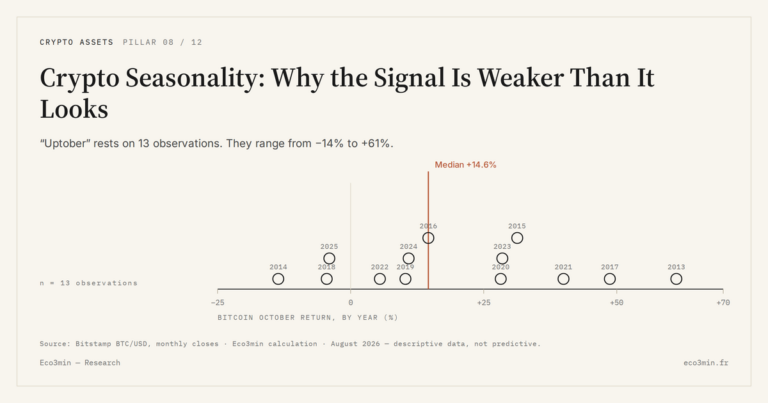
Full pillar →Crypto Seasonality: Why the Signal Is Weaker Than It Looks
Crypto’s cyclical regularities, monthly seasonality or the four-year cycle, rest on a very small number of observations. That…
Bitcoin Halving: How the Programmed Supply Cut Works
The halving writes bitcoin’s scarcity into an immutable rule, applied without exception since 2012. It shapes the pace…
Crypto Cycles: Why Their Amplitude Dwarfs Equity Swings
Crypto cycles post drawdowns two to four times deeper than equity markets. The asymmetry stems from market microstructure,…