Why Deleveraging Phases Can Last for Years
Balance-sheet adjustment after credit expansion unfolds over years, not quarters. Deleveraging compresses spending, weighs on aggregate demand and prolongs the cycle's downward phase well beyond the initial shock — a structural asymmetry between borrowing and unwinding that reshapes the post-cycle phase.

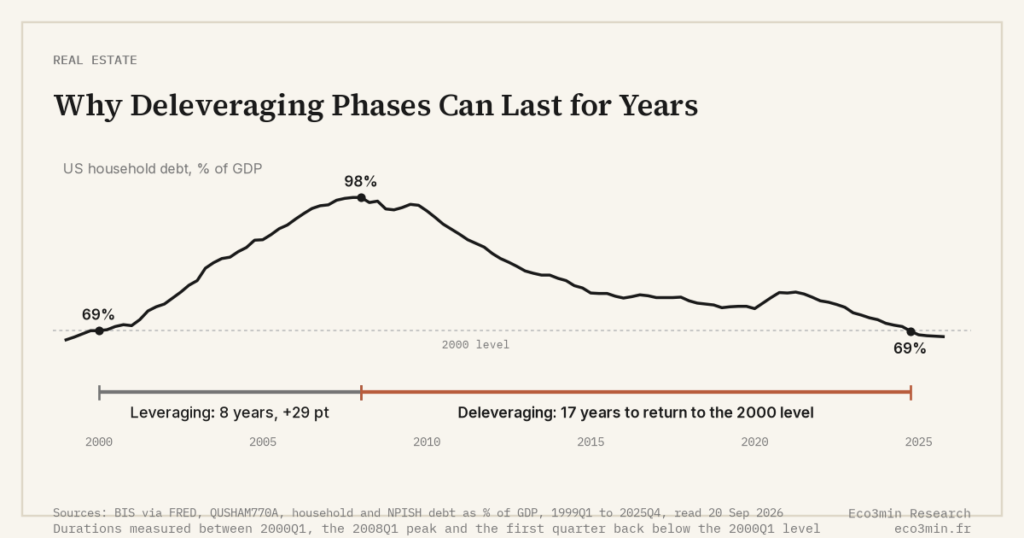
Why balance-sheet adjustment after credit expansion unfolds over years, not quarters — and why the asymmetry between leverage and deleveraging shapes the entire post-cycle phase.
TL;DR
Borrowing accelerates spending instantly; repaying it requires compressing spending for years — a mechanical asymmetry that stretches a five-year expansion into a decade-long unwind.
- Japan's private sector took more than thirty years to deleverage despite two decades of expansionary monetary and fiscal policy, with insufficient nominal growth extending the adjustment.
- After 2008, the US household debt-to-disposable-income ratio needed roughly ten years to return to its 2000 level; Spanish household deleveraging ran more than eight years.
- Falling asset prices prolong the unwind by moving the denominator against repayment: euro-area property fell about 4% on average between 2022 and 2025 (Eurostat), holding debt-to-wealth ratios up.
- By end-2025 French household debt sat near 100% of income, close to its pre-2008 level, indicating the post-2008 adjustment had largely completed before the recent rate cycle.
Deleveraging is not the symmetric counterpart of leverage. Borrowing accelerates spending immediately; deleveraging requires compressing it durably to free up the flows needed for repayment. The asymmetry is mechanical, not psychological. It explains why an expansion phase that took five years to build can require ten years to unwind, and why post-cycle stagnation typically lasts longer than the cycle that preceded it. Treating this prolonged phase as a “weak recovery” misreads its nature: it is not a delayed return to the prior trend, but the working out of a stock-flow constraint that takes time to resolve. The chronology of this adjustment is analyzed in the timing of mortgage credit cycles.
The Mechanics of Constrained Deleveraging
When economic agents — households or firms — carry excessive debt relative to their income or asset values, they must adjust their behaviour. Two options are available: raise income or reduce spending. In practice, adjustment runs primarily through spending compression. Households cut consumption. Firms postpone investment. This contraction in demand weighs on overall economic activity, which in turn limits income growth and prolongs the adjustment.
The paradox of thrift operates fully. What is rational at the individual level — repaying debt — becomes collectively recessionary. Each agent who reduces spending lowers the income of others, complicating their own deleveraging. The system cannot deleverage faster than activity allows, but activity cannot recover until deleveraging is sufficiently advanced. Historical data illustrate the resulting duration. After the 2008 crisis, the US household debt-to-disposable-income ratio took nearly 10 years to return to its 2000 level. In Spain, household deleveraging stretched over more than 8 years.
Why Growth Alone Is Not Enough
In theory, sustained economic growth could reduce debt ratios without spending compression. The denominator — GDP or income — would rise faster than the numerator. The favourable outcome assumes conditions rarely met after a credit crisis: weakened demand limits growth, cautious expectations hold back investment, and catch-up potential remains constrained by impaired balance sheets.
Japan since the 1990s illustrates the impasse. Despite expansionary monetary and fiscal policies sustained for two decades, private-sector deleveraging stretched over more than thirty years. Insufficient nominal growth — and persistent disinflation — indefinitely prolonged the adjustment. The assessment of the credit cycle and its phases shows that the duration of deleveraging depends on the amplitude of the expansion that preceded it. A larger imbalance requires a longer unwind, regardless of the policy stance.
The Role of Asset Prices
Asset valuation — property in particular — conditions wealth perception and borrowing capacity. When prices fall, household net worth shrinks. The wealth effect erodes. The propensity to consume declines. The channel amplifies and prolongs deleveraging. Even as repayment flows progress, falling asset values can keep debt ratios at high levels. Stock adjustment takes longer than flow adjustment, because the denominator moves against the deleveraging effort.
In the euro area, property prices retreated by ≈4% on average between 2022 and 2025 according to Eurostat. The correction, modest compared to 2008, nevertheless weighed on household wealth and held back the recovery in consumption.
Sectoral Heterogeneity
Deleveraging does not affect the economy uniformly. The most indebted sectors face the strongest constraints. Agents who had benefited most from the credit expansion bear the bulk of the adjustment. Highly leveraged homeowners with high debt-service ratios concentrate the consumption squeeze. Firms in cyclical sectors — construction, durable goods — face durably weakened demand. Banks exposed to non-performing loans restrict their credit supply, transmitting the contraction beyond the directly exposed agents.
The heterogeneity prolongs the adjustment phase. Healthy sectors do not fully offset the weakness of deleveraging ones — the spending compression in one segment lowers the income flowing to others. The recovery remains fragmented and incomplete. The non-linear nature of cycle turning points explains why exiting a crisis does not follow a path symmetric to its onset.
- Deleveraging imposes a durable spending compression that weighs on aggregate demand for several years.
- Economic growth alone is generally insufficient to reduce debt ratios after an excessive expansion.
- Falling asset prices prolong adjustment by keeping debt-to-wealth ratios at high levels.
What the Consensus Tends to Underestimate
Post-crisis economic forecasts generally assume a swift return to the prior trend. The catch-up assumption ignores the structural constraints associated with deleveraging. After 2008, growth projections for the euro area were systematically revised downward for nearly five years — each new forecast lower than the previous, each subsequent realization lower than the forecast.
The recurring error has practical implications. Economic policies calibrated on a rapid rebound arrive too early or with insufficient intensity. The policy debate that follows tends to attribute the disappointment to insufficient stimulus, when the structural constraint sits elsewhere — in the stock-flow adjustment that has not yet completed.
Variables That Can Shorten or Extend the Phase
Inflation acts as a potential accelerator: by eroding the real value of debt, it eases repayment without requiring spending compression. The euro-area inflation surge of 2022-2023 played this role partially for fixed-rate borrowers. Restructuring policies — partial debt forgiveness, moratoria — can speed up the adjustment but remain politically difficult to implement at scale. The sectoral distribution of debt also influences duration: debt concentrated in agents with high marginal propensity to consume produces a stronger demand drag than the same volume distributed across less constrained agents.
Indicators to Monitor
The household and corporate debt-to-income ratio measures progress in deleveraging. In France, the ratio for households reached ≈100% at end-2025 — close to its pre-2008 level, indicating that the post-2008 adjustment had effectively completed before the recent rate cycle. The savings rate provides a complementary indicator: its level above the long-term average can signal ongoing balance-sheet repair rather than precautionary behaviour driven by income uncertainty.
What This Temporality Implies
The duration of deleveraging changes the cyclical reading. A sluggish recovery does not necessarily signal an inappropriate policy stance; it can reflect a structural constraint that no policy can bypass without taking on the debt itself — through public balance-sheet expansion. This reading fits within the full dynamic of a financing cycle, where the unwind phase is as defining as the expansion that preceded it.
Last updated — 20 September 2026
Disclaimer – Financial Information: The analyses, commentary, and content published on eco3min.fr are provided for informational and educational purposes only. They do not constitute investment advice or a solicitation to buy or sell financial instruments. Past performance is not indicative of future results. All investment decisions involve risk and are the sole responsibility of the reader.
Read next
Full pillar →US Rental Property Real Yield: What Cap Rate and NOI Actually Leave You
A rental listing leads with a yield. Divide the annual rent by the price and the number looks…
Cap Rate Spread: What Rental Yield Pays Over the 10-Year Treasury
A 5% cap rate sounds attractive. But 5% against what? A risk-free 10-year Treasury yields near 4.5% in…
Vacancy and Turnover: The Cost That Erodes a Landlord’s Real Return
A listing shows full rent, twelve months a year. The owner knows the gaps between tenants, the make-ready…