Dollar Stablecoins: The Quiet Shift Reshaping Crypto
Dollar stablecoins concentrate crypto liquidity and tighten the link with global macro. Analysis of risks, flows and implications for investors and corporates.

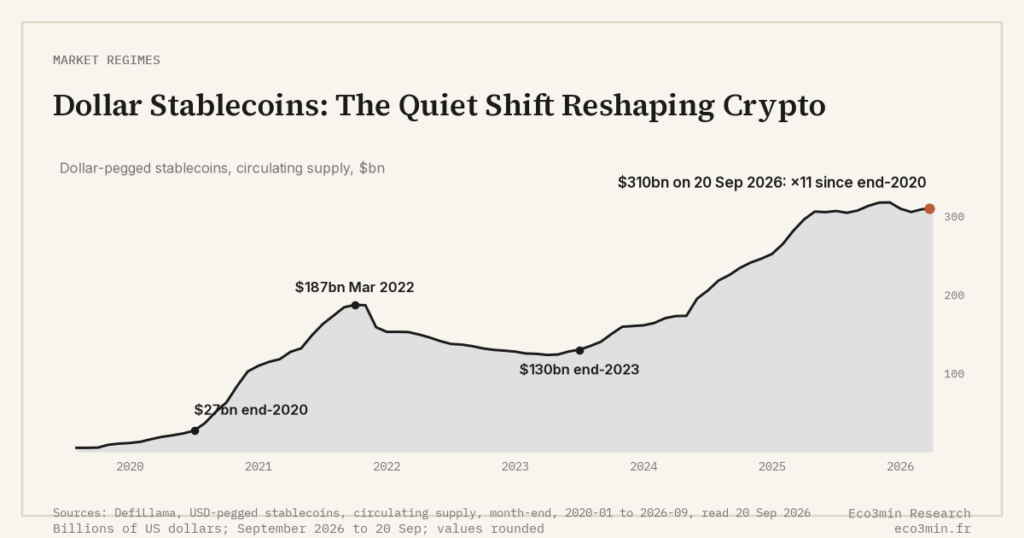
Dollar-pegged stablecoins are no longer a simple technical tool. Their rising weight reveals a quiet recomposition of crypto flows and a tighter link with the global macro picture.
TL;DR
The combined market cap of major dollar-pegged stablecoins reached roughly $140bn by end-2025, up from about $20bn in 2020, tying crypto liquidity ever closer to US monetary policy. In depth: the Eco3min framework on asset-class correlations across regimes.
- More than 70% of trading on major platforms runs through a stablecoin pair, making the dollar crypto's de facto unit of account.
- In stress phases, flows exit volatile tokens into stablecoins rather than into bank cash: internal arbitrage that keeps capital inside the crypto system.
- Stablecoin growth accelerates fastest in regions facing high inflation or capital controls, where they serve as store of value and payment rail rather than speculation.
- Their quasi-private money-market role makes them dependent on issuer reserve quality: a credibility shock at a major issuer would propagate quickly across crypto markets.
In the crypto ecosystem, attention often focuses on bitcoin’s price or on innovation narratives. In the background, however, a more structural shift is taking hold: the growing dominance of dollar-pegged stablecoins. This dynamic reframes the relationship between crypto, currencies, and monetary policy, already visible in debates around a strong dollar and shifting FX equilibria. The topic deserves attention, because it touches both market liquidity and the very nature of crypto risk.
To understand this shift, it helps to place stablecoins within the broader framework of FX markets and global monetary mechanisms. Behind their apparent technical neutrality, they extend the dollar’s dominance as unit of account and store of value, along the same logic already at work in traditional FX markets. The pillar page on currencies and the FX market highlights this continuity between traditional finance and crypto, beyond the visible price moves alone.
What may surprise in this picture: many treat stablecoins as neutral. In reality, their expansion reflects a collective preference for dollar stability, at a moment when distrust in some local currencies and volatility in risk assets remain elevated.
Today’s Key Points
- Rising weight: by end-2025, the cumulative market cap of major dollar stablecoins exceeds ≈$140bn, up from ≈$20bn in 2020. → Crypto liquidity is concentrating.
- Dominant usage: more than 70% of trading on major platforms goes through a stablecoin pair. → The dollar has become the de facto unit of account.
- Intra-crypto safe haven: during stress phases, flows exit volatile tokens into stablecoins rather than into bank cash. → Internal arbitrage, not exit from the system.
- Macro link: demand for stablecoins rises when real rates remain positive. → Direct interaction with monetary policy.
In-Depth Analysis
The dominant consensus still views crypto as a parallel universe, disconnected from classic monetary dynamics. This reading is increasingly hard to sustain. The rise of dollar stablecoins shows that participants are seeking, above all, digital exposure to the greenback rather than a radical break with the existing system. In other words, crypto is gradually embedding itself within the global monetary hierarchy, instead of replacing it. Also relevant: the tax trail behind buying bitcoin.
One revealing detail: stablecoin growth accelerates most in regions facing high inflation or capital controls. For these users, stablecoins are not a speculative bet but a tool for store of value and payments. This brings crypto closer to issues already analyzed in debates on global monetary fragmentation.
Where the analysis diverges from the central scenario is on systemic risk. Many argue that stablecoins simply recycle existing dollars. Yet their role as a quasi-private money market creates strong dependence on the quality of reserves, on regulation, and on confidence. A credibility shock at a major issuer would have rapid contagion effects across crypto markets.
Direct Impact: What Changes Now
- For investors: stablecoins have functioned as a treasury sleeve, not as a risk-free asset. Weights documented in crypto allocation research typically sit in the 10–20% range of total crypto exposure as a prudence-oriented benchmark.
- For overall allocation: the heavy presence of stablecoins reinforces the indirect correlation between crypto and the dollar. To be incorporated within a 60/30/10-type framework, in line with broader asset-allocation strategies.
- For corporates: accepting or holding stablecoins exposes to regulatory and counterparty risk. Key KPI: transparency and composition of the chosen issuer’s reserves.
Subtle but Significant Signals
- Net inflows into stablecoins: a sharp pickup over a few weeks has often signaled a phase of caution, sometimes latent stress.
- Treasury yield spreads: the higher US short-term rates remain, the more attractive yield-bearing stablecoins have historically become.
- Regulation: announcements on stablecoin legal frameworks have triggered abrupt rotations between issuers.
Three Plausible Paths
Scenario 1 — Managed Integration: stablecoins become a recognized pillar of crypto financial infrastructure, with progressive regulation. Systemic risk remains contained.
Scenario 2 — Confidence Shock: a problem at a major issuer triggers massive outflows and extreme volatility across crypto markets. The market does not appear to fully price this option.
Scenario 3 — Regulatory Pullback: abrupt tightening of rules, contraction of stablecoin supply, and lower liquidity. The most speculative assets would be hit first.
What could invalidate this reading? A rapid decline in real rates or the credible emergence of stablecoins not pegged to the dollar. In that case, current dominance would be called into question.
Dollar stablecoins are therefore not a technical detail. They reveal how crypto is adapting to the world as it is, rather than to the one it once promised. For investors as well as corporates, ignoring this signal amounts to misreading the map of risks and flows. We will revisit this with a possibly different market tomorrow.
3 Key Points
- Dollar stablecoins concentrate liquidity and redefine crypto risk.
- They create a direct bridge between crypto and US monetary policy.
- Their apparent stability masks a systemic risk still poorly priced.
Last updated — 20 September 2026
Disclaimer – Financial Information: The analyses, commentary, and content published on eco3min.fr are provided for informational and educational purposes only. They do not constitute investment advice or a solicitation to buy or sell financial instruments. Past performance is not indicative of future results. All investment decisions involve risk and are the sole responsibility of the reader.
Read next
Full pillar →Euro Below Parity in 2022: What Parity Means
In September 2022, the euro fell below parity with the dollar, to around 0.95, a low not seen…
Eurozone Fragmentation: Sovereign Spreads and the Euro
The euro is issued by a monetary union without a complete fiscal union: nineteen sovereign debts coexist under…
The Euro’s Energy Import Bill: the Gas Shock and the Currency
In 2022, the surge in gas prices turned the euro area's historic current-account surplus into a deficit and…