Why Equity Markets Often Lead Economic Cycles
Equity markets often turn before economic cycles materialize in macroeconomic statistics. This forward-looking mechanism, structural to financial markets, explains the persistent timing gap between equity prices and economic data.

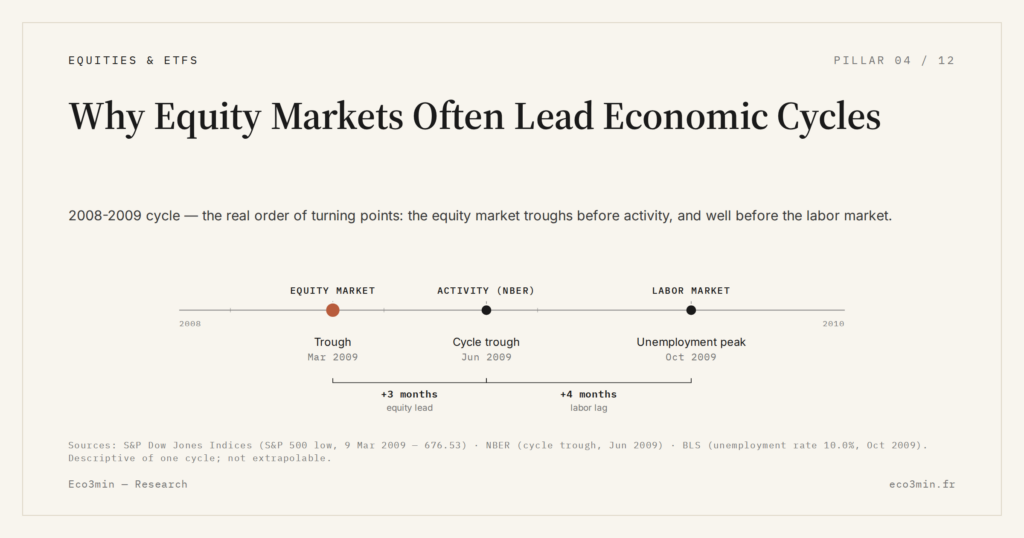
Equity markets often lead economic cycles. Analysis of the timing gap between stock prices and the real economy.
TL;DR
Since the 1970s, US equity markets have bottomed on average four to nine months before recessions officially end, because prices discount expected earnings and rate paths ahead of the data. The wider context: our breakdown of how index stability can mask growing risk.
- In December 2025, euro-area manufacturing PMIs sat mostly below the 50 expansion threshold while several equity markets had already priced a stabilisation scenario over a 6-to-12-month horizon.
- Because prices discount anticipated earnings and rate paths rather than present levels, weak data can temporarily support equities by shifting expectations on monetary policy or liquidity.
Equity markets operate on a logic of permanent anticipation. Prices incorporate information, expectations and probabilities well before the real economy reflects them in statistics. This timing gap explains why market lows or highs often appear while macroeconomic indicators continue to deteriorate or, conversely, remain solid. This lead is frequently interpreted as a collective error. It actually corresponds to a forward-looking mechanism specific to financial markets. This specific point is developed further in our breakdown of the gap between equity markets and the real economy.
The recent trigger: markets running ahead of macro indicators
Since late 2025, several developed economies have shown a visible slowdown in confidence surveys and leading indicators, while some equity markets have stopped declining and have even started a partial recovery. In December 2025, manufacturing PMIs remained mostly below the 50 threshold in the euro area, while equity markets had already priced in a stabilization scenario over a 6 to 12-month horizon.
This kind of lag is not exceptional. It reflects a different temporality between the production of economic data, often delayed, and price formation, instantaneous by construction.
An anticipation mechanism rooted in flows and expectations
Equity markets do not react to economic levels, but to anticipated changes in those levels. Weak but stable growth can be perceived as an improvement if the prior scenario was more degraded. Conversely, a still-solid economy can be punished if expectations deteriorate. A complementary angle: Why GDP Growth Is a Poor Indicator for Equity Markets.
Capital flows play a central role in this temporal lead. Portfolio adjustments are made on the basis of assumptions about future earnings, rate paths or expected financial conditions. Future earnings, however uncertain, are immediately discounted into prices. This mechanism explains why equity markets can turn several quarters before the economic cycle changes direction.
Dominant consensus and a frequent blind spot
Part of the consensus assumes that markets should reflect the present state of the economy. This reading implicitly relies on synchronization between economic activity and equity valuation. In practice, this synchronization rarely holds.
The divergence stems from the very nature of markets: they arbitrage future scenarios, not past observations. Attention often focuses on published macro data, while the decisive factor lies in their expected dynamics. This structural lag explains why markets can appear “ahead” or “behind” depending on the chosen vantage point.
This anticipation logic also explains apparently paradoxical reactions, when negative economic data temporarily support equity markets by altering expectations on monetary policy or liquidity.
A logic embedded in the structure of equity markets
This forward-looking temporality fits into a broader framework of durable divergence between equity markets and the real economy. Equity indices reflect capital flows, profit expectations and global financial conditions far more than the instantaneous state of the economic cycle.
For illustration, in previous cycles US equity markets historically reached a low on average between 4 and 9 months before the official end of economic recessions, based on cycles observed since the 1970s. This lead is neither constant nor guaranteed, but it constitutes a notable statistical regularity.
Why this mechanism is particularly visible today
The context of durably elevated real rates and an expected inflection in monetary policy reinforces this anticipation logic. Markets are seeking less to read the present situation than to estimate the moment when financial constraints will stop tightening. This focus accentuates the gap between still-degraded economic data and asset prices already adjusted.
This sensitivity to the monetary calendar is directly tied to the role of real rates in discounting future cash flows, detailed in the analysis of their impact on equity valuation.
Underlying human reading
This debate actually masks a simpler concern: how to interpret markets that rise or stabilize while the economy still appears fragile? The point is not to judge the immediate validity of prices, but to understand that equity markets reason on probable trajectories, not on fixed situations.
What could invalidate this market lead
This reading remains conditional. A more violent macroeconomic shock than anticipated, a prolonged monetary tightening or a rapid deterioration in earnings could undermine the lead of equity markets. Similarly, a sharp reversal in liquidity flows or an unincorporated exogenous event would alter the hierarchy of scenarios currently implicit in prices.
Structuring indicators to read market timing
- Evolution of leading indicators (PMI, confidence surveys) relative to equity indices.
- Revisions to earnings expectations over a 6 to 12-month horizon.
- Global financial conditions and the level of real rates.
Directly comparing equity markets to published economic data leads to a misleading reading. Statistics describe the recent past, while prices incorporate future expectations often offset by several quarters.
This reading fits into the broader analysis of equity markets and ETFs, where the temporality of flows and expectations plays a central role in price formation.
Conclusion: a structural lead, not an anomaly
The fact that equity markets often lead economic cycles is neither a collective error nor a systematic speculative excess. It is a logical consequence of their forward-looking functioning. This lead can sometimes prove premature, but it remains an essential reading framework for interpreting the apparent gaps between markets and the economy.
- Equity markets price in future expectations, not the present state of the economy.
- Market reversals often appear before visible macroeconomic inflections.
- This timing gap reflects a structural mechanism, not a one-off anomaly.
Last updated — 12 July 2026
Disclaimer – Financial Information: The analyses, commentary, and content published on eco3min.fr are provided for informational and educational purposes only. They do not constitute investment advice or a solicitation to buy or sell financial instruments. Past performance is not indicative of future results. All investment decisions involve risk and are the sole responsibility of the reader.
Read next
Full pillar →Reading Earnings Surprises: Cash Flow, Margins, Guidance
How to analyze an earnings surprise beyond the simple beat or miss: cash flow, margins, guidance, and weak…
Equal-Weight ETFs: The Quiet Signal Behind Rising Indices
Equal-weight ETFs reveal the true health of the equity market behind mega-cap-driven indices. Their gap with cap-weighted ETFs…
Smart Beta ETFs: The Hidden Risk Behind Factor Performance
Smart beta ETFs now hold ~15-20% of global equity ETF assets. Stacking factor exposures often rebuilds hidden concentration…