Fed Funds and r-star: The Natural Rate as the FOMC’s Implicit Target and the Open Debate on Its Value


r-star, the real natural rate of equilibrium, is the hidden central parameter of Fed monetary policy analysis. Its value — unobservable — determines whether the nominal Fed Funds is modestly restrictive or already neutral.
TL;DR
At 3.50–3.75% Fed Funds, held since December 2025, whether U.S. policy reads as modestly restrictive or already neutral turns on r-star, an unobservable rate whose five institutional estimates span 80–120 bp in May 2026.
- Five institutional estimates coexist in May 2026: HLW (NY Fed) at 1.2%, Lubik-Matthes (Richmond Fed) at 1.5%, Bauer-Rudebusch (SF Fed) at 0.8–1.1%, Fed staff at 1.0–1.2%, and the FOMC's implicit dot-plot median at 1.125%.
- Its dot-plot anchor is a 3.125% nominal longer-run median, unchanged from March to June 2026 and the highest since 2016, but individual dots span 2.50–3.75%, scattering member r-star between 0.50% and 1.75%.
- Estimates have shifted through regimes: 2.5–4.0% before Volcker, 2.0–3.0% under Greenspan, a documented decline to 0.5–1.0% after 2008, then partial convergence to 0.7–1.5% since 2023.
- Against the 2% target anchor, the estimate spread produces an 80 bp swing in the diagnosed stance; measured against realized core PCE of 3.4%, the sign of that stance flips.
Five institutions publish divergent estimates; the maximum gap reaches 80 to 120 basis points in May 2026. This article exposes the estimates, their methods, and their implications for reading the current cycle.
1. r-star: Definition and Status in the Fed Reaction Function
r-star (sometimes written r*) designates the real natural rate of equilibrium — that is, the real interest rate at which monetary policy is neutral with respect to economic activity. This linkage is treated more fully in our reading of central-bank decision-making. The historical record is pieced together in our analysis of structural low-growth regimes. Neither restrictive nor accommodative. The economy operates at potential, with no upward or downward pressure on prices.
The concept is old — Knut Wicksell formalized it as early as 1898 in Geldzins und Güterpreise — but its centrality in contemporary Fed analysis dates to the 1990s, with Woodford’s formalization of central bank reaction functions in terms of the gap between observed rate and natural rate. The Taylor Rule (1993) explicitly places r-star as the additive constant in its prescription: i = r* + π + 0.5 × (π − π*) + 0.5 × output_gap. Without a retained value for r*, the rule is numerically indeterminate. On this point: the effective overnight interbank rate in the United States.
r-star therefore has a paradoxical status: it is central in the normative analysis of monetary policy — without r-star, one cannot say whether policy is restrictive, neutral, or accommodative — yet it is not directly observable. Analysts deduce it by modeling from observable variables — nominal rates, inflation, output gap, unemployment, expectations — each carrying its own measurement uncertainty. No model produces an exact point value, only distributions or central estimators with often wide confidence intervals. For more detail: the ECB-Fed rate differential.
The FOMC has never formally adopted a r-star value as an operational parameter. But the dot plot SEP (Summary of Economic Projections) published quarterly has contained since 2012 a “longer-run Federal Funds Rate” column that can be interpreted as the FOMC median for nominal neutral Fed Funds. Subtracting the inflation target (2%) yields an implicit FOMC r-star estimate. At the June 2026 SEP, the longer-run dot plot median sits at 3.125%, unchanged from the March round and the highest since 2016, corresponding to an implicit r-star of 1.125%.
This FOMC anchor is not the only reference. Several regional Federal Reserve Banks publish alternative estimates produced by their own research teams, sometimes significantly different from the dot plot. This institutional diversity informs the debate without closing it. Beyond numerical thresholds, it is the gap between observed Fed Funds and r-star + π (the nominal neutral Fed Funds) that measures the restrictive or accommodative stance. The Fed reaction function sits within central-bank assumptions, of which r-star constitutes the most contested parameter.
2. Competing Estimates: HLW, Lubik-Matthes, Bauer-Rudebusch, Fed Staff, Dot Plot SEP
Five families of estimates dominate the contemporary institutional and academic landscape. Their values diverge significantly in May 2026, which empirically materializes the debate’s openness.
The Holston-Laubach-Williams (HLW) estimate, published quarterly by the New York Fed, is the historical academic reference. Built by Laubach and Williams in 2003, extended by Holston in 2017, it uses a Kalman filter applied to a system of equations linking Fed Funds, output gap, inflation, and r-star. The method is explicitly Bayesian and evolved after the 2020 pivot, a period during which the model returned negative or near-zero values judged implausible by some observers. The central HLW value for the United States in May 2026 is 1.2% — a substantial revision relative to 2015-2020 estimates that placed r-star around 0.5%.
The Lubik-Matthes estimate, published by the Richmond Fed, uses a VAR (vector autoregression) approach with economic constraints, more direct than the HLW Kalman filter. Its philosophy is to capture r-star as a medium-term trend revealed by the history of macro variable relationships, without imposing an equilibrium structure. It is generally higher than HLW: the central Lubik-Matthes value for the United States in May 2026 is 1.5%. The structural height of Lubik-Matthes partly stems from its lower sensitivity to ZIRP periods, which the model treats as transitory rather than as durable declines in r-star.
The Bauer-Rudebusch estimate, published at irregular intervals by the San Francisco Fed since 2020, applies an approach based on forward TIPS yields rather than spot macro variables. Its philosophy is that “market-anticipated” r-star can be inferred from long real yields after correction for term premia. This method usually produces intermediate values (0.8-1.1% in 2026), with the advantage of being updatable daily from market data — valuable in periods of rapid reassessment.
The Fed staff estimate (Board of Governors) is not formally published, but FOMC minutes and Bernanke-Yellen-Powell presentations regularly reference an internal range, generally announced between 1.0% and 1.2% for the contemporary period. This range is technically the result of a panel of internal estimates (internal HLW, internal Bauer-Rudebusch, other proprietary models), aggregated as staff consensus.
The FOMC implicit estimate via dot plot SEP longer-run is at 3.125% nominal at the June 2026 SEP, that is 1.125% real — the median of 18 participants, Chair Kevin Warsh having submitted no projections for that round. The dispersion of individual dots covers 2.50-3.75%, that is individual r-star between 0.50% and 1.75%. This intra-FOMC dispersion documents the absence of fully consolidated internal monetary consensus.
The maximum gap between the lowest estimate (pre-revision historical HLW, certain low SEP dots) and the highest (Lubik-Matthes, certain high SEP dots) thus reaches in May 2026 approximately 80 to 120 basis points. Applied to the Fed Funds range held at 3.50-3.75% since December 2025, and taking the 2% inflation target as the nominal component of the long-run neutral rate, this gap yields a range of stance assessments: +80 to +105 basis points above neutral with r-star = 0.7% (modestly restrictive), down to 0 to +25 basis points with r-star = 1.5% (neutral). The diagnostic depends materially on which estimate is retained.
3. Successive r-star Regimes Over 1960-2026
A historical reading of r-star estimates — all methods combined, weighting what is reconstructible ex post for pre-2003 periods — reveals several successive regimes over the past seven decades.
Regime 1960-1979: high and volatile r-star. The pre-Volcker period corresponds to retrospective r-star estimates ranging between 2.5% and 4.0%, with significant volatility tied to oil shocks, demographic adjustments (baby boomers entering the labor market), and high productivity growth. This range is today considered to reflect an era of capital relatively scarce against the available savings stock.
Regime 1980-2000: moderately high r-star. Under Greenspan, ex post estimates place r-star around 2.0-3.0%, with relative stability linked to the macroeconomic “Great Moderation”. This period allowed Greenspan to steer Fed Funds with significant legibility: policy was restrictive when Fed Funds exceeded 5-6%, accommodative below.
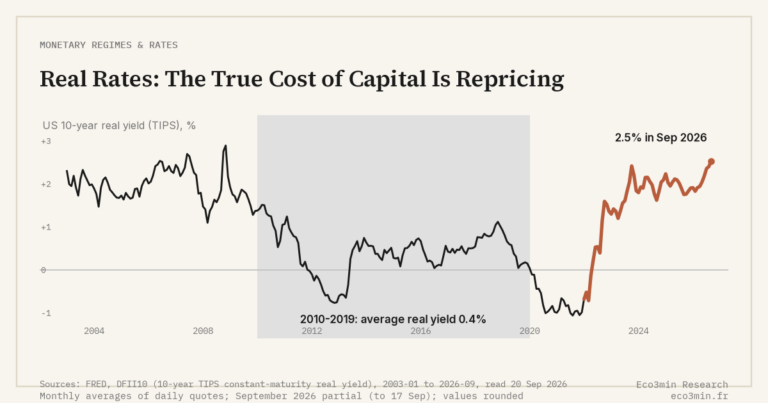
Regime 2000-2019: documented r-star decline. Contemporary estimates (HLW published from 2003) began signaling a secular r-star decline, attributed to several factors: demographic aging (rising savings supply from baby boomers approaching retirement), slowing productivity growth, post-2008 “safe asset shortage”, structurally lower investment rates in developed economies (Summers 2014 on “secular stagnation”). r-star was estimated around 0.5-1.0% by the end of this period.
Regime 2020-2022: acute controversy. The COVID shock then the 2021-2022 inflationary rebound led certain estimates (notably HLW) to signal transitorily very low or even negative r-star values — which appeared paradoxical while inflation was materializing massively and Fed Funds was approaching its restrictive peak. This controversy triggered several methodological revisions (notably HLW in 2022-2024) and an academic reassessment of the assumptions underlying the model. A parameter this central, revised several times over, says a great deal about what keeps schools of economic thought apart.
Regime 2023-2026: convergence toward 1.0-1.5%. Major contemporary estimates (revised HLW, Lubik-Matthes, Fed staff, median SEP dot plot) converge within a 0.7-1.5% range, with a center of gravity at 1.0-1.2%. This convergence is partial: the range remains wide by historical standards, and the debate is now shifting toward the future trajectory of r-star (structural rebound toward pre-2000 levels under the effect of public deleveraging or the AI revolution, or extended stability).
4. Why the Debate Matters: Implications for Reading the Current Fed Funds
The practical stake of the r-star debate materializes in reading the ongoing Fed Funds cycle. Several concrete implications emerge.
First implication: the level of restrictive stance of the Fed Funds depends materially on the retained r-star estimate. At the Fed Funds range of 3.50-3.75% held since December 2025, and taking π* = 2% as the nominal component of the long-run neutral rate — the same convention the dot plot’s longer-run column applies — the gap to r-star + π* varies significantly. With r-star = 0.7% (low estimate), nominal neutral Fed Funds stands at 2.7%, a gap of +80 to +105 bp — modestly restrictive policy. With r-star = 1.125% (implicit FOMC median), nominal neutral Fed Funds stands at 3.125%, a gap of +37.5 to +62.5 bp. With r-star = 1.5% (Lubik-Matthes estimate), nominal neutral Fed Funds stands at 3.5%, a gap of 0 to +25 bp — neutral policy.
This reading anchors on target inflation, not realized inflation, and the choice is not neutral. With core PCE at 3.4% in May 2026 — the highest since October 2023, released by the Bureau of Economic Analysis on 25 June 2026 — the nominal neutral rate computed on current inflation lands between 4.1% and 4.9% depending on r-star, above the observed Fed Funds in all three scenarios. The two conventions therefore carry opposite signs: restrictive on the long-run reference, accommodative on the current one. The distance between them measures exactly the distance between realized inflation and the target.
The diagnostic gap between the two bounding estimates thus reaches 80 bp of stance — that is, the difference between “modestly restrictive policy” and “neutral policy”. This gap directly conditions how the cycle’s landing level is read in market analyses.
Second implication: the calibration of the Taylor Rule critically depends on r-star. As detailed in r-star in the Taylor Rule, with inflation at mandate and zero output gap, the Taylor prescription reduces to r-star + 2%. So 2.7% (r-star = 0.7%) to 3.5% (r-star = 1.5%), an 80-basis-point prescription amplitude on the r-star parameter alone.
Third implication: the interpretation of the dot plot SEP rests on reading the longer-run column. When the dot plot signals in June 2026 a longer-run Fed Funds at 3.125%, it implies r-star = 1.125% (with π* = 2%). But the intra-FOMC dispersion on this parameter (2.50-3.75%, individual r-star 0.50-1.75%) signals that internal FOMC consensus is less consolidated than the median appears to suggest.
Fourth implication: the landing level for the Fed Funds depends directly on the retained r-star level. Under a low r-star estimate, the implied landing point sits around 2.7-3.0%; under a high estimate, around 3.5-4.0%. That dispersion materializes the uncertainty on the terminal level, without available data allowing the debate to be settled. The June 2026 SEP moved the reference point: the median for end-2026 rose from 3.4% to 3.8%, with nine of eighteen participants penciling in at least one increase and one a cut, while the 2026 core PCE projection was revised up from 2.7% to 3.3%. For the specific unfolding of the 2024-2026 cycle and the arguments in play on its probable landing level, see r-star and the 2024-2026 terminal rate.
For the full perspective of the Fed Funds within its analytical ecosystem — where r-star is one of several structuring parameters — see the FEDFUNDS hub article of the cluster.
- r-star, the real natural rate of equilibrium, is the hidden central parameter of all Fed monetary policy analysis: its value — unobservable — determines whether the nominal Fed Funds is modestly restrictive or already neutral.
- Five competing institutional estimates coexist in May 2026: HLW (1.2%), Lubik-Matthes (1.5%), Bauer-Rudebusch (0.8-1.1%), Fed staff (1.0-1.2%), implicit FOMC via dot plot SEP longer-run (1.125% median at the June 2026 SEP, 0.50-1.75% dispersed). Observed maximum gap: 80 to 120 basis points.
- Historical regimes have shifted successively: 2.5-4.0% pre-Volcker, 2.0-3.0% under Greenspan, 0.5-1.0% post-2008, partial convergence 0.7-1.5% since 2023.
- The r-star estimation gap produces a diagnostic range for the Fed stance from “modestly restrictive” to “neutral” — an 80 bp difference that directly conditions how the cycle’s terminal level is read.
Last updated — 30 July 2026
Disclaimer – Financial Information: The analyses, commentary, and content published on eco3min.fr are provided for informational and educational purposes only. They do not constitute investment advice or a solicitation to buy or sell financial instruments. Past performance is not indicative of future results. All investment decisions involve risk and are the sole responsibility of the reader.
Read next
Full pillar →Real Rates: The True Cost of Capital Is Repricing
Why real rates are reasserting themselves as markets' anchor and how to recalibrate investment and financing decisions facing…
Real Interest Rates: The Quiet Signal Reshaping Markets
Real interest rates: why their persistence in positive territory in 2026 is reshaping the rules for bonds, equities,…
OAT-Bund Spread: A Quiet Gauge of French Sovereign Risk
OAT-Bund spread: how this yield gap has become a key signal on French sovereign risk, fiscal policy and…