Flat vs Progressive Capital Tax: Where the Breakeven Sits

Capital income in many systems can be taxed two ways, a flat rate or, by election, a progressive schedule. The choice is not a matter of taste but of arithmetic: for any taxpayer there is a marginal bracket above which one stops being cheaper than the other.
Most explainers stop at “the flat rate is simpler.” This piece reads where the two curves cross and what moves that crossing, with no recommendation: a breakeven is an observation, not an instruction.
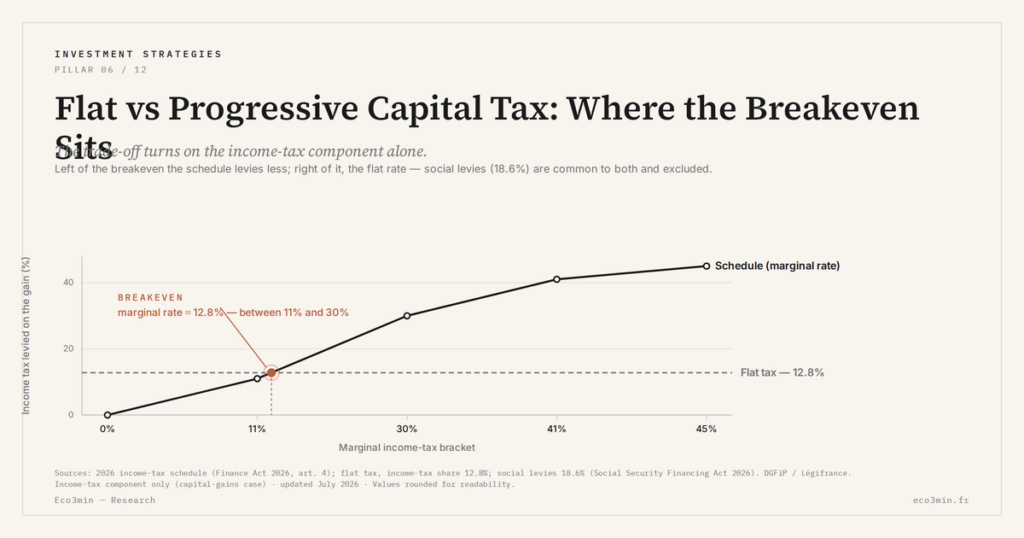
Between a flat capital-income rate and a progressive schedule, the trade-off turns on the income-tax component alone: a fixed flat rate on one side, the marginal bracket on the other.
- In France’s case, the flat tax levies 12.8% income tax regardless of bracket, against the marginal rate under the schedule; the breakeven sits near the boundary between the 11% and 30% brackets.
- Social levies, at 18.6% on most gains since 2026, are due under both regimes: they sit outside the trade-off and do not move the threshold.
- France’s 2026 finance act removed the irrevocable character of the progressive-schedule election, changing the decision logic from one year to the next.
Capital income in many systems can be taxed two ways: a flat rate or, by election, a progressive schedule. The choice is not a matter of taste but of arithmetic, for any taxpayer there is a marginal bracket above which one stops being cheaper than the other. That breakeven depends on the marginal rate, the income mix and any allowance. Most explainers stop at “the flat rate is simpler.” Using France’s flat tax and its progressive-schedule option as a worked example, this piece computes the crossing point and makes it legible, situation by situation. Strictly descriptive, “here is where the calculation flips,” never “choose this,” the breakeven is an observation, not an instruction, and it is among the most regulator-safe ways to compare two tax regimes. It isolates one of a wrapper’s three levers, tax timing as a lever, by pausing on its most arithmetic dimension.
1. Two regimes, an arithmetic choice
The flat tax applies by default. In France, since 1 January 2026, its all-in rate reaches 31.4%, broken down into 12.8% income tax and 18.6% social levies. It is withheld at source, with no filing step, and it ignores the taxpayer’s marginal bracket: the same 12.8% income tax hits the gains whether one sits in the 11% bracket or the 45% one. The principle is general beyond France: a flat capital-income rate trades simplicity and bracket-independence for the loss of progressivity’s allowances. Whichever tier applies, a realised loss only counts if the repurchase respects a separate rule, the one at work in how wash sale rules affect tax loss strategies.
The progressive-schedule option works the other way. It subjects capital income to the ordinary income-tax schedule, hence to the household’s marginal bracket, but it reopens two doors the flat rate closes: a 40% allowance on dividends from companies subject to corporate tax, and the partial deductibility of one social-contribution component, worth 6.8 points. The election is made at filing and is global: it applies to all of the year’s capital income, with no cherry-picking. Background: the tax timing of retirement accounts.
The decisive point is that the trade-off bears on a single tier. Social levies are due in both cases, at the same 18.6% on most gains: they drop out of the calculation, because they do not depend on the regime chosen. The breakeven therefore turns on the income-tax component alone, a fixed 12.8% on one side, the marginal bracket on the other. That comparison, and it alone, decides which of the two cost curves runs below the other. The same logic recurs in any system offering a flat-or-progressive election on capital income, with the local rates and allowances changing the position of the crossing but not its existence. Moving the crossing itself, by legislation rather than by election, produces a market response of its own, the one recorded in the market impact of capital gains tax rate changes.
2. Where the calculation flips, by marginal bracket
The crossing reads simply, bracket by bracket. For a taxpayer who is not liable or sits in the 0% band, the schedule levies no income tax on these gains, against 12.8% under the flat rate: the schedule is then cheaper. For the 11% bracket, the schedule takes 11% income tax against 12.8% flat: the schedule stays marginally more favourable on this component, before even counting the dividend allowance. It is in this lower zone that electing the schedule lightens the bill.
The flip occurs moving up the schedule. For the 30% bracket, the 30% marginal rate clearly exceeds the 12.8% flat rate on the income-tax component: the flat rate becomes the cheaper option, and the gap widens for the 41% and 45% brackets. The 40% dividend allowance and the deductible contribution cushion the schedule without reversing it: for income made up mostly of capital gains rather than dividends, the 40% allowance does not apply, and the flat rate wins all the more clearly.
An order of magnitude fixes the idea, on the income-tax component alone and excluding social levies. On 10,000 euros of realised capital gains, the flat rate takes 1,280 euros of income tax (12.8%), whatever the bracket. Under the schedule, a taxpayer in the 11% bracket pays 1,100 euros, slightly less; one in the 30% bracket pays 3,000 euros, more than double. On 10,000 euros of eligible dividends, the schedule first applies the 40% allowance, cutting the base to 6,000 euros: the 30% bracket then takes 1,800 euros, still above the flat rate’s 1,280 euros, but the gap narrows. These figures name no option to choose: they show only that the direction of the crossing depends on both the bracket and the nature of the income, dividend or capital gain. This question is examined in our analysis of REIT dividend taxation and the 199A deduction.
In a first approximation, the breakeven therefore sits around the boundary between the 11% and 30% brackets. The phrasing is deliberately cautious: it describes a zone, not a single point, because the exact position of the crossing depends on the nature of the income at stake. A household whose capital income is mostly allowance-eligible dividends will see its threshold shift relative to one realising mostly capital gains. The breakeven is not a universal constant; it is a point recomputed for each situation.
3. What moves the threshold
Three variables deform the crossing point. The first is the income mix. The 40% allowance applies only to dividends from companies subject to corporate tax, not to capital gains or interest: the higher the share of eligible dividends, the more ground the schedule gains, because the allowance shrinks the base taxed at the marginal bracket. Conversely, on income dominated by capital gains, the schedule loses that cushion and the flat rate prevails sooner. Breakeven points of this kind are the microeconomic counterpart of the revenue-maximising tax rate debated since Laffer.
The second is the partial deductibility of the social contribution. Electing the schedule allows 6.8 points of contribution to be deducted from the following year’s taxable income, which the flat rate forbids. That deductibility is itself worth more at a higher marginal bracket. It therefore runs against the previous reasoning, restoring some appeal to the schedule for high brackets, without sufficing to overturn the flat rate’s advantage above 30%.
The third is timing. France’s 2026 finance act removed the irrevocable character of the schedule election: a taxpayer can now reverse an election that proves unfavourable, under the conditions set out. This change does not move the breakeven itself, but it alters the decision logic over time, by reducing the cost of an election error. The flat-or-progressive trade-off sits within the wider reading of investments and the macro regime, where taxation is one variable, not the only one.
- The flat-or-progressive trade-off bears only on the income-tax component: a fixed flat rate against the marginal bracket under the schedule.
- Social levies, at 18.6% on most gains since 2026 in France, are due under both regimes and do not move the breakeven.
- The crossing point is not universal: it is recomputed according to the share of allowance-eligible dividends and the share of capital gains.
- Since 2026 the French schedule election is no longer irrevocable, which lowers the cost of an unfavourable decision.
4. What the breakeven does not say
A crossing point describes an arithmetic, not a course of action. Knowing that the flat rate becomes cheaper above a certain bracket does not say which option to retain: the calculation ignores elements specific to each household, the full set of other income taxed under the schedule, the effect of the global election on heterogeneous capital income, or the situation in following years. The breakeven lights up one variable; it does not decide for the taxpayer.
This reading by tax rate differs from another, which concerns the container itself. The choice of flat or progressive regime operates on income already held inside a given wrapper; whether the holding-period clock behind that wrapper matters belongs to a separate question, set out in the timing behind the clock. The flat-or-progressive breakeven addresses only the variable tier of taxation, once the wrapper is chosen and the social floor settled.
One reading this calculation makes possible without settling it remains: for a given income mix, at which bracket does a taxpayer see the two curves cross? The answer is recomputed case by case, and it is precisely because it depends on the situation that the flat rate does not reduce to “31.4%, simple.” The headline figure is a starting point; the crossing point belongs to each household.
Last updated — 29 August 2026
Disclaimer – Financial Information: The analyses, commentary, and content published on eco3min.fr are provided for informational and educational purposes only. They do not constitute investment advice or a solicitation to buy or sell financial instruments. Past performance is not indicative of future results. All investment decisions involve risk and are the sole responsibility of the reader.
Read next
Full pillar →Beneficiary Designations, the Step-Up in Basis, and the 10-Year Rule: How US Accounts Transfer at Death
At death, most US financial accounts pass outside the will, straight to a named beneficiary, under tax rules…
The Fee Stack in Variable Annuities: M&E Charges, Riders, and Subaccount Costs
A variable annuity does not carry one fee, but a stack of them. Mortality and expense charges, subaccount…
The Conventional 401(k)-Match-First Funding Order: Where It Comes From, How It Works
The question of what order to fund accounts in usually draws a fixed list, presented as a rule…