How REIT Distributions Are Taxed: Ordinary Income, Return of Capital, and the 199A Deduction

A REIT distribution is not a stock dividend with a lower tax rate. Most of it is ordinary income, taxed at the holder’s marginal rate, split on the 1099-DIV into ordinary income, capital gain, and return of capital. The 199A deduction softens the ordinary portion.
That distinction, routinely missed, drives the after-tax return. This article describes how a REIT distribution is taxed, box by box, as an observation rather than advice.
Most REIT distributions are ordinary income, not qualified dividends, so they are taxed at the marginal rate. The 199A deduction and return of capital soften the bill.
- REIT payouts split into three buckets on the 1099-DIV: ordinary income (Box 1a), capital gains (Box 2a), and return of capital (Box 3, not taxed but reducing basis).
- Historically around 70 percent is ordinary income, taxed at rates up to 37 percent, well above the qualified-dividend rate.
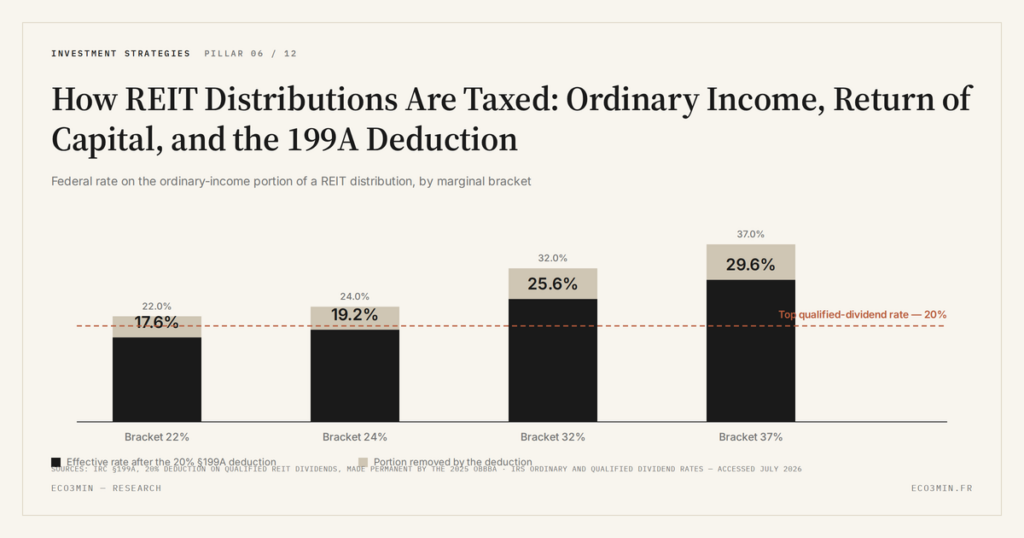
- Section 199A lets individuals deduct 20 percent of qualified REIT dividends, cutting the top effective rate to roughly 29.6 percent, and is permanent as of 2025.
The first thing to understand about REIT taxation is what it is not. Because REIT payouts arrive as periodic distributions, many investors assume they are taxed like the qualified dividends of an ordinary corporation, at the lower long-term capital-gains rate. They are not. A REIT dividend is not a qualified dividend: it is ordinary income first. A REIT avoids entity-level tax by distributing at least 90 percent of its taxable income, which shifts the full tax burden onto the shareholder, and most of that burden lands as ordinary income. This page describes the mechanics of that taxation, the tax extension of paper property and the rate cycle. It is the companion to the container question, covered in the satellite on which account to hold a REIT in: that page weighs where to hold the shares, this one decomposes how each distributed dollar is taxed.
A REIT dividend is not a qualified dividend
The 1099-DIV that a REIT holder receives has two parts to Box 1. Box 1a reports total ordinary dividends; Box 1b, a subset of Box 1a, reports qualified dividends, which are taxed at the lower long-term capital-gains rate. For most corporations, the bulk of the dividend is qualified. For REITs, the reverse holds: their distributions are generally automatically excluded from qualified status, because they come from rental income the REIT itself did not pay corporate tax on. A small qualified slice can appear when a REIT earns income through a taxable REIT subsidiary or holds stock in other corporations, but it is the exception, not the rule.
The reason is structural, not incidental. Qualified-dividend status is a reward for income that has already borne corporate tax; a REIT, by design, pays little or no corporate tax because it distributes its income instead. The favorable rate would double-count a tax the REIT never paid, so the law excludes most REIT dividends from it. Understanding this removes the surprise: the ordinary-income treatment is not an oversight but the direct consequence of the pass-through structure that gives REITs their high payouts in the first place.
The practical consequence is a rate gap. A qualified dividend from a blue-chip corporation might be taxed at 15 or 20 percent; the ordinary portion of a REIT distribution is taxed at the holder’s full marginal rate, up to 37 percent for top earners. This is the single most consequential fact about REIT taxation, and the one the stock-dividend analogy hides. It is also why the choice of account matters so much, the subject of the companion satellite on the asset-location question for REITs.
The three buckets on the 1099-DIV
A REIT distribution is not taxed as a single item; it is split into three categories, each with its own treatment, and the split is set by the REIT each year. Ordinary income, in Box 1a, is the largest bucket, historically around 70 percent of payouts per Nareit data, and is taxed at the marginal rate. Capital gains distributions, in Box 2a, arise when the REIT sells property at a profit; they are taxed at long-term capital-gains rates of 0, 15, or 20 percent regardless of how long the investor has held the shares, though a portion tied to depreciated real estate can be unrecaptured Section 1250 gain, taxed at up to 25 percent. Related framing: how the timing shapes the tax outcome.
Return of capital, in Box 3, is the subtlest of the three. It is not taxed in the year it is received; instead it reduces the investor’s cost basis in the shares, deferring the tax until they are sold, when it enlarges the taxable gain. Return of capital is common for REITs precisely because their taxable income is depressed by large non-cash depreciation charges, even as the underlying property may be appreciating. It is not, in itself, a warning sign. The reader who wants the yield-level consequences of this decomposition will find them in the satellite on REIT yield and total return.
All of this reaches the tax return through the same form. The REIT, or the broker, issues the 1099-DIV early in the year; the investor carries the ordinary dividends to Schedule B and onto the 1040, the capital-gains distributions to Schedule D, and tracks the return of capital privately to adjust the cost basis for the eventual sale. Because the split is set by the REIT and can change from year to year, the same holding can produce a different tax profile in consecutive years, so the categories, not just the headline distribution, are what the holder must read.
The Section 199A deduction
Since 2018, a fourth number on the 1099-DIV has mattered: Box 5, Section 199A dividends. It allows an individual to deduct 20 percent of qualified REIT dividends from taxable income, which lowers the top effective federal rate on the ordinary portion from 37 percent to roughly 29.6 percent. A crucial distinction: Box 5 is a deduction from income, while Box 1b is a lower rate; they are different mechanisms, and the 199A deduction applies to the ordinary REIT dividends that are not qualified. Originally set to expire at the end of 2025, the deduction was made permanent by 2025 legislation, removing the uncertainty that had hung over REIT tax planning. Worth reading alongside: our reading “Choosing investments in the light of the macro cycle”.
A worked illustration, bounded to its purpose and describing no real security or future path, fixes the magnitude. Take an investor in the top bracket receiving a distribution that is entirely ordinary income. Without 199A, that income is taxed at 37 percent; with the 20 percent deduction, the effective rate falls to about 29.6 percent, a saving of roughly seven points. On a large distribution that difference compounds year after year, which is why the permanence of the deduction, rather than its annual renewal, changed the calculus for long-horizon holders.
The deduction is a genuine relief, but a partial one: it trims the ordinary rate rather than converting it to the qualified rate, so a REIT’s ordinary income still costs more after tax than a qualified dividend. And it is available only in a taxable account, because a tax-advantaged account taxes every withdrawal as ordinary income with no 199A relief. That interaction, between the deduction and the account, is exactly the trade-off examined in the asset-location satellite, and it is why the two questions, how a distribution is taxed and where the shares sit, have to be read together.
Taxable timing and cross-border holders
Two further layers complete the picture. High earners may owe the 3.8 percent net investment income tax on REIT distributions in a taxable account, on top of the marginal rate and any state tax. And non-US holders face a separate regime entirely: US REIT ordinary dividends are generally subject to a 30 percent withholding tax at source, which a tax treaty between the holder’s country and the United States can reduce or eliminate. For a cross-border investor, the treaty rate, not the 1099-DIV, sets the outcome. The broader comparison of flat and progressive capital-tax regimes that frames these choices is developed in the cluster on the breakeven between flat and progressive capital tax, and the way a tax-deferred account’s value shifts with the rate regime in the regime-dependent value of tax deferral.
Treating a REIT distribution like a stock dividend is the most common error. Most REIT dividends are not qualified: they are ordinary income, taxed at the marginal rate up to 37 percent, not at the 15 or 20 percent qualified-dividend rate. The Section 199A deduction trims the ordinary rate to roughly 29.6 percent at the top, and return of capital defers part of the tax, but neither turns a REIT distribution into a qualified dividend.
Taxation is therefore not a footnote to a REIT’s yield; it is a first-order determinant of what the holder keeps, and the only one set by the investor’s own bracket and account rather than by the REIT. Two investors in the same REIT, paid the same distribution, keep very different amounts after tax, depending on their marginal rate, the ordinary-capital-return split of that year’s payout, and whether the shares sit in a taxable or tax-advantaged account. Reading the yield without reading its taxation is reading half the return. The REIT sets the split between ordinary income, capital gain, and return of capital; the holder’s bracket, account, and residence set the rate applied to each. Neither alone determines the outcome, which is why the distribution and its container have to be read as one. Predictable though the rules are, they are never neutral on what the investor ultimately keeps, and the gap between the advertised yield and the retained yield is where that neutrality breaks. This article has mapped the half the REIT does not control. A parallel read: our guide to REIT vehicles.
Last updated — 26 July 2026
Disclaimer – Financial Information: The analyses, commentary, and content published on eco3min.fr are provided for informational and educational purposes only. They do not constitute investment advice or a solicitation to buy or sell financial instruments. Past performance is not indicative of future results. All investment decisions involve risk and are the sole responsibility of the reader.
Read next
Full pillar →Beneficiary Designations, the Step-Up in Basis, and the 10-Year Rule: How US Accounts Transfer at Death
At death, most US financial accounts pass outside the will, straight to a named beneficiary, under tax rules…
The Fee Stack in Variable Annuities: M&E Charges, Riders, and Subaccount Costs
A variable annuity does not carry one fee, but a stack of them. Mortality and expense charges, subaccount…
The Conventional 401(k)-Match-First Funding Order: Where It Comes From, How It Works
The question of what order to fund accounts in usually draws a fixed list, presented as a rule…