Tax-Deferred Retirement Accounts: The Two-Sided Bet Behind the Deduction

A traditional 401(k) or IRA does not erase the tax on deductible contributions; it defers it from working years to retirement, in exchange for locking the balance until age 59.5. Its net value turns on three regime variables the sales pitch rarely names.
Behind the headline of a tax cut sits a bet with three unknowns: the gap between today’s marginal bracket and tomorrow’s, the rate regime that prices the deferral, and sequencing risk as the withdrawal deadline nears.
A traditional retirement account trades a deduction today for ordinary-income tax later and a liquidity lock: a tax bet, not a gift, whose net value is read through the regime.
- The deduction is a cash-flow advance: the government recovers the tax at withdrawal, on the pre-tax balance, at the retiree’s bracket.
- Traditional defers and bets on a lower future bracket; Roth pays tax now and bets on a higher one. The choice is a timing bet, not a ranking.
- Net value hinges on the bracket gap, the rate regime and sequencing risk, not on the single line labeled “tax saved” this year.
A traditional 401(k) or IRA is marketed as a tax cut. It is closer to an exchange across time. The upfront deduction does not erase the tax on the money contributed; it defers it to withdrawal, at whatever ordinary-income bracket applies once the saver has become a retiree. In between, the balance compounds sheltered from annual taxation but stays locked until age 59.5. The lock is not a flaw in the product: it is the price of the shelter, the condition attached to the deferral.
This reading changes the question. It moves the focus from “how much will I save” to “under what conditions is this deferral worth anything”. And the answer is not on the account statement: it depends on three regime variables. The gap between today’s marginal bracket and tomorrow’s sets most of the gain. The rate regime determines what deferring the tax actually earns. And sequencing risk, the order in which returns arrive near the deadline, can erase part of the benefit at the worst possible moment. All three concern a future no one knows, which rules out any verdict and calls for a reading by frames rather than by recipes.
This article lays out the anatomy of the vehicle: the pre-tax contribution, ordinary-income treatment at exit, required minimum distributions and the early-withdrawal penalty. It hands each piece to a companion. The entry mechanics are unpacked in what the pre-tax deduction actually saves. The exit doors and their respective taxation are mapped in how each withdrawal door is taxed. The pay-now-or-later choice, worked as a conditional grid, is built in the traditional-versus-Roth timing bet. The present article stays at the level of the frame: it makes the bet legible without settling it.
An account balance instead of a pension promise
The tax-deferred account does not make sense outside its structural context. For most of the twentieth century, the private-sector retirement default in the United States was the defined-benefit pension: the employer promised a stream of income and bore the risk of funding it. The defined-contribution account inverted that arrangement. Instead of a promise, the worker receives a balance and a set of choices, and carries the market and longevity risk directly. This shift is the backdrop against which every feature of a 401(k) or IRA reads.
The consequence is a transfer of risk from the collective to the household, rarely named as such. A defined-benefit pension pooled investment and longevity risk across a group; a defined-contribution account leaves the saver exposed to market risk during accumulation and to sequencing risk as the deadline approaches. This is neither good nor bad in itself, but it changes the nature of the commitment: the account does not promise an income, it builds a balance whose final value stays subject to the regimes it passes through. The historical mechanics of that transition, from ERISA to auto-enrollment, are traced in the shift from pensions to defined contribution, which the present article treats as background rather than subject.
Read through this lens, the account is a capitalization vehicle, not a cash reserve. It is not judged by an instantaneous yield but as a long-horizon commitment whose value depends on the macro-financial environment crossed during the saving phase. That is the logic governing the whole allocation corridor, set out in reading investment vehicles across rate cycles: a long wrapper is not evaluated on a headline return, but on the rate, tax and growth regime in which it operates. The demographic strain on pay-as-you-go public systems only sharpens households’ attention to what their own balance will be worth.
The scale of the shift is structural, not marginal. The defined-contribution account has become the backbone of private-sector retirement provision in the United States, displacing the pension as the default over roughly a generation. That dominance means the retirement outcome of a large share of households now rests on decisions each of them makes individually: how much to contribute, how to invest, when and how to withdraw. The account did not just change a financial product; it redistributed a responsibility. Every feature examined below, the deduction, the lock, the exit doors, is a fragment of that larger transfer, and reads more clearly once the transfer is kept in view.
This is also why the account cannot be judged by its tax label alone. A pension was assessed by the income it promised; a defined-contribution balance has to be assessed by the process that builds it and the regimes that shape it. The saver is, in effect, running a small endowment with a fixed drawdown date. The questions that matter for any endowment, the return earned, the taxes owed, the timing of inflows and outflows, are exactly the questions that matter here, and none of them is settled by the deduction that opens the account.
One vehicle, several wrappers: the pre-tax architecture
The US tax-deferred account is not a single product but a family sharing one mechanism. The workplace 401(k), funded by salary deferrals and often an employer match, is the default vehicle for most private-sector workers. The traditional IRA, opened individually, extends the same pre-tax logic to those without a workplace plan or beyond its limits. Both defer tax on contributions and earnings until withdrawal, when distributions are taxed as ordinary income. The meta-frame that situates these vehicles among all sheltered accounts is set out in how investment wrappers actually work, which the present article treats as its conceptual base rather than re-arguing.
The 2026 contribution limits, set by the IRS in Notice 2025-67, mark the scale of the shelter. An employee can defer up to $24,500 into a 401(k), rising to $32,500 with the age-50 catch-up of $8,000, and to $35,750 for those aged 60 to 63 under the SECURE 2.0 super catch-up of $11,250. The traditional and Roth IRA limit is $7,500, or $8,600 with the $1,100 catch-up after 50. Combined employee-and-employer contributions to a 401(k) are capped at $72,000. Beginning in 2026, catch-up contributions must be made on a Roth basis for anyone whose prior-year wages with the plan sponsor exceeded $150,000, an example of how the rules keep shifting under the same architecture.
This architecture carries a direct consequence for how the account is read. The vehicles share the deferral mechanism but differ in funding, access rules and the details of withdrawal, and a Roth account inverts the entire tax timing. Knowing which vehicle and which tax treatment one is dealing with is the prerequisite of any analysis: there is no single “retirement-account tax rule”, only rules by vehicle, by contribution type and by exit door. A saver may well hold several at once, with interlocking rules, which is why any statement about “the tax on a 401(k)” has to specify which balance it refers to.
The wrapper adds a second layer, distinct from the tax treatment. The same pre-tax dollars can sit inside an employer 401(k) or an individual IRA, and the choice between them shapes cost, menu and creditor protection without changing the tax code much. The rollover moves a balance from a former employer’s plan into an IRA without triggering tax, bridging the two. That distinction is handled separately in the employer wrapper versus the individual one.
The upfront deduction: a cash-flow advance, not a saving
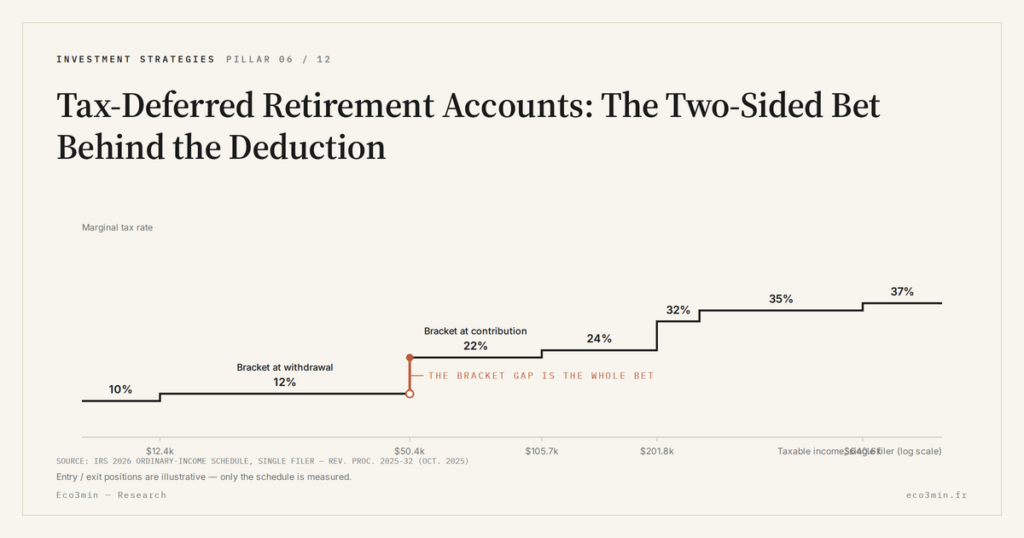
The headline appeal of a traditional account is that contributions reduce taxable income today. The mechanism is easy to state and easy to misread. Contributing pre-tax lowers the year’s taxable income, and the immediate tax saved equals the amount contributed times the household’s marginal bracket. At a 24% bracket, a $5,000 contribution cuts the tax bill by $1,200; at 32%, by $1,600. Because the federal schedule runs through brackets of 10, 12, 22, 24, 32, 35 and 37%, the same contribution earns a different amount depending on income.
The point the pitch leaves in shadow is that this saving is not permanent, it is provisional. At withdrawal, the government recovers the tax on the pre-tax balance, at the bracket then in force. The deduction does not erase an expense; it moves a tax bill through time. The real gain is not the saving in the contribution year but the difference between the tax avoided on the way in and the tax paid on the way out. If the exit bracket equals the entry bracket, the advantage collapses to the cash-flow effect alone: having let a sum that would otherwise have funded a tax bill compound, sheltered, over the saving years. The bracket-by-bracket arithmetic is unpacked in the pre-tax deduction broken down by bracket.
The mechanics are clearer when drawn out. Without a traditional account, the worker pays tax on the income earned, then invests the net remainder in a taxable account, where the fruits of saving are taxed in turn. With one, the worker invests the gross, pre-tax sum, which compounds in full during the saving phase, and returns part of its value to the government only at the end. The difference between the two paths is not an exemption, which does not exist, but the fact of putting a larger base to work for longer. It is a pure matter of tax timing, and its size grows with the holding period and the real return earned. For more detail: the trade-offs across tax levers.
This reading carries an implication the pitch never draws: the value of the deferral rises with the horizon and shrinks if the saving phase is short. A contribution made a few years before retirement gets a brief deferral, hence a limited cash-flow effect, and then rests almost entirely on the bracket gap. A contribution made twenty or thirty years out mobilizes the power of time. The deduction therefore does not mean the same thing at every stage of life, a nuance the headline “tax saved” percentage hides entirely. Its value against the wider set of sheltered accounts is developed in the value of tax deferral under each rate regime.
Treating the deduction as a permanent tax saving. It is a cash-flow advance: the tax is recovered at withdrawal on the pre-tax balance. The net gain is measured only by comparing the entry bracket with the exit bracket.
The exit: how each withdrawal door is taxed
At the deadline, the bet the deduction opened is settled, and the door chosen changes the arithmetic. A lump-sum distribution from a traditional account is taxed as ordinary income in full, which can push that year’s bracket up. Required minimum distributions then force a schedule: under SECURE 2.0, RMDs begin at age 73, rising to 75 in 2033, obliging retirees to draw down and pay tax on a set fraction each year whether they need the income or not. The timing of withdrawals is therefore not an administrative detail but a lever over the effective tax rate of the whole operation.
Annuitizing offers a different route. Converting the balance into a lifetime income stream spreads the tax across years and, in a non-qualified annuity, uses an exclusion ratio to separate the taxable earnings from the tax-free return of principal. A self-directed drawdown keeps flexibility but leaves the retiree to manage the sequence of withdrawals and the market risk. Each door and its tax mechanics are mapped in the taxation of each withdrawal door in detail, which hands the income-management trade-off, annuity versus self-directed drawdown, to a dedicated companion.
A persistent misconception deserves dismantling at the level of principle. Some savers believe a traditional balance is taxed twice, once as income and once on its growth. It is not. On a fully pre-tax account, the contributions were never taxed on the way in, and the earnings were never taxed while compounding; both are taxed once, as ordinary income, at withdrawal. What feels like a double burden is simply the deferred settlement of taxes that were postponed, not duplicated. The distinction matters because the whole case for the account rests on when the tax is paid, not on how many times.
This is where reading through the regime pays off. The bet opened at contribution is won or lost here, at the retiree’s marginal bracket. A saver who deferred at 32% during working years and withdraws at 22% captures the bracket gap on top of the deferral effect. Conversely, a large lump sum can lift the year into a higher bracket, the very outcome that spreading withdrawals is designed to smooth. Withdrawal behavior is thus one of the determinants of the after-tax return of the entire arrangement, not a formality settled at the end.
The exit also interacts with income the account does not control. Withdrawals stack on top of Social Security, pension income and taxable investment income, so the marginal bracket that settles the bet is a household figure, not an account figure. A retiree with several income sources may find that RMDs push a portion of Social Security into taxation or lift the household into a higher bracket in a given year. This is why the sequence of withdrawals, and the choice among the exit doors, is read as a multi-year optimization rather than a single event, though the detailed arithmetic belongs to the dedicated exit article rather than to this frame.
The liquidity lock: the price of the shelter, not a flaw
The most debated feature of a traditional account is its inaccessibility. As a rule, the balance stays locked until age 59.5; withdrawing earlier triggers a 10% penalty on top of ordinary income tax. This is often presented as a drawback; it is more accurately read as the counterpart of the tax advantage. The deferral is granted precisely because the money is committed over a long horizon consistent with the retirement objective. Removing the lock would mean asking for the advantage without the counterpart: the lock is not a malfunction, it is the very structure of the exchange.
The lock is not absolute, however. A set of narrow exceptions waives the penalty under defined conditions: the Rule of 55 for employees who separate from service in or after the year they turn 55, substantially equal periodic payments under Section 72(t), certain hardship categories, and a first-home IRA withdrawal. Each carries its own conditions and its own residual cost, and they differ sharply from one another. The full map of these narrow doors out before 59.5 shows that “locked until retirement” spans exits whose real cost ranges widely.
The counterpart of the lock is also what protects the balance from its owner. Committed savings escape the short-term trades dictated by market mood; they resist the temptation to sell at the bottom. This effect, often overlooked, echoes the holding-period logic found on other long-horizon vehicles and analyzed by the upstream frame on the mechanics of investment wrappers by horizon. The lock is therefore double-edged: a liquidity cost on one side, an investment discipline on the other.
Reading the account through the regime: three variables statements omit
The net value of a traditional account is not on the “tax saved” line of the contribution year. It is built on three regime variables that interact and that no illustration can fix in advance, because they concern an unknown future. Naming them already shifts the gaze from promise to trade-off.
The bracket gap, the primary driver of net value
The central determinant of the tax gain is the difference between the working-life bracket and the retirement bracket. Because the deduction earns at the entry rate and costs at the exit rate, a favorable gap, an exit bracket below the entry bracket, captures a permanent gain on top of the deferral effect. A zero gap reduces the advantage to deferral alone; an adverse gap, the case of a retiree whose income exceeds working-life income, can turn deferral into an added cost.
Retirement income tends on average to fall relative to working income, which statistically favors the mechanism without guaranteeing any individual outcome. But the gap is not a given: it depends on the career path, the balance accumulated, future statutory brackets and the interaction with Social Security and RMDs, all unknown at the time of contribution. It is precisely this uncertainty that rules out any verdict and structures the whole traditional-versus-Roth question, developed in the conditional grid of the timing bet.
Deferring a tax has a value that depends on the rate regime. When real yields are high, letting a sum that would otherwise have funded a tax bill compound sheltered produces more: the deferral is worth a great deal, to the saver’s benefit. When real rates are low or negative, the value of deferral shrinks, because the committed base compounds little. The account does not escape the macro-financial regime: its relative tax generosity depends on the rate environment through which the saving phase runs.
This link has a consequence rarely spelled out in marketing. Two savers with the same tax profile, one who accumulated in a regime of high real rates and one in a regime of low real rates, do not draw the same value from the same deferral. Comparing wrappers therefore has to fold in the regime crossed, not just the headline rates on offer. The point is not to predict which regime lies ahead, but to recognize that the account’s worth is contingent on it.
Sequencing risk and the glide path
The third variable is temporal. A long-horizon portfolio’s outcome depends not only on its average return but on the order in which returns arrive, especially near the deadline. A market drop just before withdrawal, when the balance is at its peak, cuts deeper than the same drop twenty years earlier on a smaller base: that is sequencing risk. Two savers with identical average returns can end up with very different balances depending on when the bad years fell.
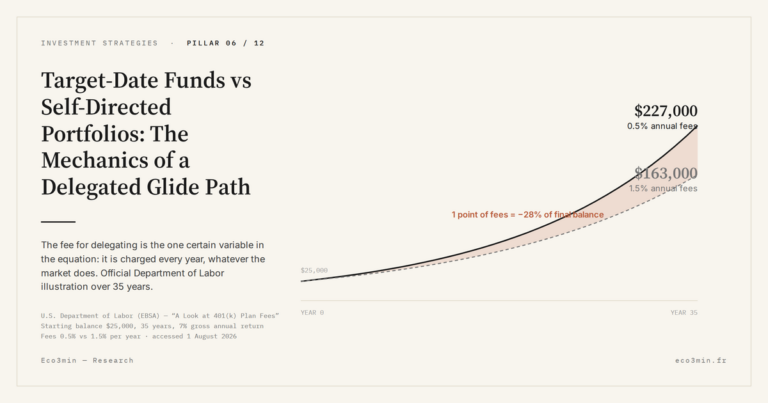
To dampen it, target-date and glide-path strategies raise exposure to volatile assets when the deadline is distant and reduce it as retirement approaches, shifting toward steadier holdings. The glide path does not remove market risk; it reshapes when the portfolio is most exposed to it, concentrating that exposure far from the deadline, where time can still repair a bad sequence.
The point of naming these three variables lies in their interaction, which escapes any fixed simulation. It can be illustrated without predicting anything. A saver whose bracket falls sharply between working life and retirement, who accumulated in a favorable real-rate regime and whose return sequence spared the final years before the exit, stacks all three effects the same way. Another, with a flat bracket, having saved in a low real-rate regime and hit by a market drop just before the deadline, sees the three combine in reverse. Between these extremes lies the whole space of real situations, and it is that space, not a single scenario, that an honest analysis describes. Companion research: the vehicles and arithmetic of retirement.
The rate regime since 2010, or why the value of deferral changed
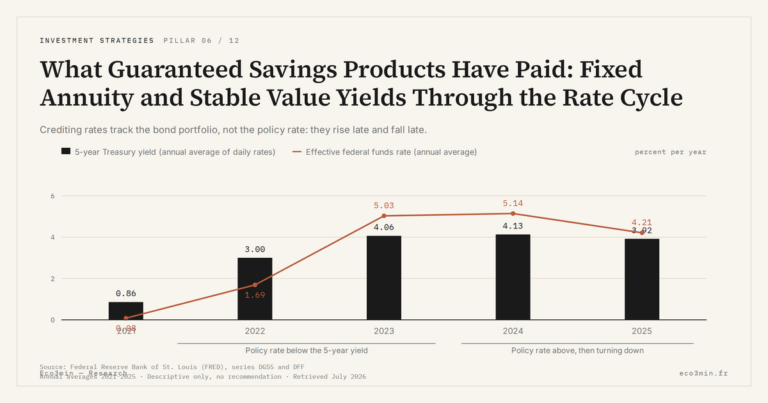
The value of deferral is not a constant: it moves with the rate regime, and the past decade illustrates the point plainly. From the aftermath of the 2008 financial crisis into the early 2020s, the environment was one of low policy rates and real rates often near zero, negative on some maturities. In that regime, committed savings compounded weakly in real terms, so the cash-flow effect of deferral, taken alone, stayed modest. A traditional account’s relative generosity then owed less to the return on the deferral than to the expected bracket gap between working life and retirement.
The return of inflation in 2021 and 2022, and the monetary tightening cycle that followed, flipped that regime. Higher nominal and, gradually, real rates restored value to compounding a pre-tax sum sheltered. The same deferral mechanism therefore does not carry the same value depending on the decade in which the saving phase unfolds. This dependence on the regime is exactly what separates a reading by cycle from a reading by brochure, and what justifies treating a tax-deferred account as a long-horizon vehicle rather than a fixed deduction line.
From this follows a distinction marketing almost always erases: between the nominal tax advantage, displayed on the way in, and the real, regime-adjusted value of the account. The nominal advantage is visible and immediate, the tax saved this year. The real value folds in the inflation that erodes the purchasing power of the committed balance, the real return earned while it is locked, and the tax recovered at exit in future dollars. Two accounts identical on paper can diverge widely in real value across the regimes they cross. An analytical outlet has to hold that distinction, or the reading stays captive to the most visible and least meaningful figure.
The same logic reframes a common intuition about inflation. Savers often assume that higher inflation is unambiguously good for a leveraged, tax-deferred position, since nominal balances swell. But inflation cuts both ways here: it lifts nominal returns while eroding the real purchasing power of the eventual withdrawal, and it can push future statutory brackets and thresholds around in ways that change the exit tax. What matters for the account is the real rate, not the nominal one, and the real rate is a property of the regime, not of the product. This is the through-line that ties a retirement wrapper back to the macro cycle rather than to a marketing sheet.
The sequence of decisions, from first contribution to last withdrawal
Read as a whole, a tax-deferred account is not a single decision but a series of choices spread over decades, each altering the net return of the whole. At entry, the choice between traditional and Roth sets the direction of the bet: pre-tax bets on a lower future bracket; after-tax bets on a higher one or on rising statutory rates. During accumulation, the glide-path profile determines exposure to sequencing risk. At exit, the choice among lump sum, annuity and phased withdrawals steers the marginal bracket across several years.
This sequence explains why the account resists any binary answer. The same balance can be advantageous or costly depending on how these successive choices chain together and which regimes are crossed. The role of an analytical outlet is not to name the right combination, impossible to know in advance, but to make each decision node legible. The companion articles each take one node: the entry, the exit, the edge cases, the wrapper. The present article links them into one frame, that of a vehicle whose value is built over time and read through the regime.
Traditional or Roth: the bet at the heart of US retirement saving
The traditional-versus-Roth choice is the timing question at the center of US retirement saving, and it rarely gets a mechanical answer, because most responses decide for the reader. The choice is not about a better account but about one bet: pay tax now, with Roth, or later, with traditional. Contribute pre-tax and defer, betting the retirement bracket is lower; or contribute after-tax and let qualified withdrawals come out tax-free, betting the bracket is higher, or that future statutory rates rise.
No version of the bet has a universal winner. A saver in a high bracket during working years with a long horizon draws more, mechanically, from the traditional deduction; a saver in a low bracket now, or one expecting higher future rates, values the Roth’s tax-free exit more. A Roth conversion makes the bet explicit, crystallizing tax today in exchange for a tax-free balance. The full conditional grid, without a verdict, is built in the tax-timing bet worked through mechanically, which hands the sheltered-versus-taxable comparison to a separate companion.
Two features sharpen the bet without resolving it. First, Roth accounts escape required minimum distributions during the owner’s lifetime, which changes the drawdown arithmetic and the estate picture, whereas traditional balances are forced out on the RMD schedule. Second, the deferral choice is not all-or-nothing: many savers split contributions between pre-tax and Roth, hedging the bracket bet rather than committing to one side. This tax diversification is not a way of winning the bet but of narrowing the range of outcomes, an admission that the future bracket path is unknowable. The mechanics of that split belong to the companion article; the point here is that even the entry decision is a spectrum, not a switch. Adjacent reading: the asset-location question for REIT dividends.
The wrapper decides cost and access, not the tax
A final layer, often confused with the previous one, separates two technical wrappers of the same pre-tax logic. A workplace 401(k) offers a curated fund menu, an employer match that amounts to additional compensation up to a limit, and ERISA creditor protection, but often carries plan-level fees and a limited lineup. An IRA opens an effectively unlimited investment universe with tighter fee control, but no match and weaker federal creditor protection. The rollover moves a balance from a former employer’s plan into an IRA without triggering tax, bridging the two.
The wrapper does not change the tax treatment of the pre-tax dollars: the deduction, the ordinary-income treatment at exit and the penalty exceptions are largely the same. What it changes is cost, menu, protection and the match. The match in particular is not a market return but deferred compensation, which is why leaving it on the table has a cost of its own. Separating what the wrapper decides from what the tax code decides is the object of the comparison between the 401(k) and the IRA, which contrasts the two sheltered accounts with each other rather than against a taxable one.
A traditional account is not a tax cut but a deferral: its net value is decided at the retiree’s bracket, not the worker’s.
A legible bet, not a verdict
A tax-deferred retirement account becomes legible once the reading through the deduction alone is refused. It is a two-sided vehicle: a tax advantage on the way in, a recovery on the way out, separated by a liquidity lock and a sheltered compounding phase. Its net value is not written on the statement but in three regime variables no one knows in advance: the bracket gap between working life and retirement, the rate regime that prices the deferral, and sequencing risk as the deadline nears.
This anatomy does not indicate whether to hold a traditional account, because the answer depends on personal parameters and an uncertain future. What it provides is the frame that lets each reader work the question. The companion articles unpack every mechanism, from entry to exit. They all sit within one logic, that of allocation strategies read through the market regime, where a vehicle is never separated from the macro-financial cycle in which it operates.
What remains is a methodological invitation rather than advice. Faced with a vehicle whose value is built over decades and depends on unknown variables, the useful posture is not to seek a definitive answer, which does not exist, but to know which questions to ask: what bracket gap is plausible given one’s trajectory; what rate regime the saving phase crosses; how sensitive the balance is to sequencing near the deadline. A tax-deferred account rewards clarity on these three points far more than fascination with the headline deduction. It is to that clarity, not to a verdict, that this frame intends to contribute.
Last updated — 25 July 2026
Disclaimer – Financial Information: The analyses, commentary, and content published on eco3min.fr are provided for informational and educational purposes only. They do not constitute investment advice or a solicitation to buy or sell financial instruments. Past performance is not indicative of future results. All investment decisions involve risk and are the sole responsibility of the reader.
Read next
Full pillar →The Fee Stack in Variable Annuities: M&E Charges, Riders, and Subaccount Costs
A variable annuity does not carry one fee, but a stack of them. Mortality and expense charges, subaccount…
The Conventional 401(k)-Match-First Funding Order: Where It Comes From, How It Works
The question of what order to fund accounts in usually draws a fixed list, presented as a rule…
Roth IRA vs Traditional 401(k): Two Shelters, Two Clocks, Two Tax Treatments
A Roth IRA and a traditional 401(k) are both tax-sheltered, but they are not two flavors of one…