FX Carry Trade: The Quiet Drift Reshaping Risk
FX carry trade is back as rate differentials between EM and developed currencies have reopened since late 2023. Political volatility, less predictable central banks and nervous capital flows make the equilibrium far more fragile than 2016-2019.

FX carry trade: how the return of rate differentials is reshaping risks and opportunities for investors and corporates.
TL;DR
The FX carry trade is back as rate differentials reopened from late 2023 — but on a far more fragile footing than in 2016–2019.
- Between high-yielders (Mexican peso, Brazilian real, Indonesian rupiah) and still-low-real-rate funders (yen, euro, Swiss franc), the incentive to redeploy the strategy is strong.
- Political volatility, less predictable central banks and more nervous capital flows make the equilibrium more unstable than in the prior cycle.
- The market still fixates on the classic yen carry, while the real recomposition now plays out in emerging-market currencies tied to the U.S. via trade and value chains.
To understand why the carry trade has returned to centre stage, the picture must also be tied to the yield curve and duration trade-offs. The same monetary normalization that reconfigured financial markets in 2025 has reopened FX spreads that attract leverage — in an environment dominated by the dollar’s role in global flows.
What is shifting quietly: most market participants still focus on the classic yen carry, while the real recomposition is now playing out in emerging-market currencies tied to the United States via trade or value chains. This focus mismatch leaves room for more refined strategies — and also for more expensive errors. Related question: how the carry trade affects emerging market currencies.
Key trends to monitor
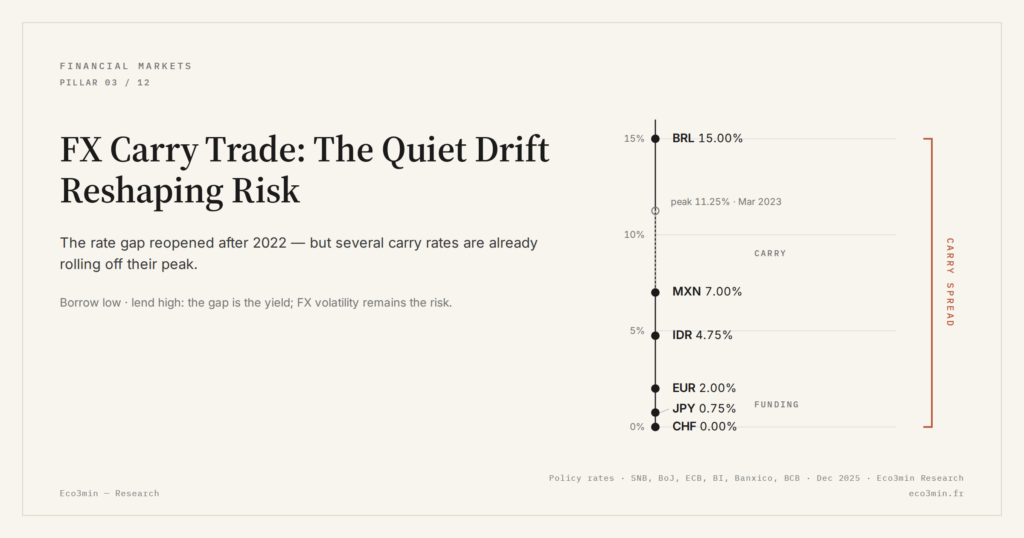
- Policy rate differentials: in December 2025, several emerging-market central banks held policy rates around 8-12%, against ≈3-4% in the euro area and ≈4-4.5% in the United States (central bank data, 2025) → carry attractive but risky.
- Implied FX volatility: 3-month vol on EUR/USD remains moderate (≈6-7%), but exceeds 12-14% on certain EM pairs, eroding part of the carry → net yield far less “guaranteed” than headline figures suggest.
- Flows into emerging-market currencies: after massive outflows in 2022, portfolio flows into local-currency EM debt have turned positive again since mid-2024, on the order of several tens of billions of dollars per year → fuel for the carry trade.
- Political risk: heavy electoral cycles across Latin America and Asia through 2025-2026, with platforms at times hostile to foreign capital → less stable currency risk premium.
- Less predictable central banks: some monetary authorities surprised the market in 2025 with aggressive rate cuts when consensus expected caution → a major hazard for mechanically applied carry strategies.
Detailed analysis
The FX carry trade rests on a simple mechanism: borrow in a low-yielding currency and invest in a higher-yielding one — drawing on the rate and exchange-rate regimes set out in our Currencies and Forex framework — in the expectation that the exchange rate stays stable or moves slightly in favour of the position. Between 2010 and 2019, with rates near zero across developed markets (Fed and ECB between 0 and 1% most of the time, per official data), the strategy was constrained: the yield differential barely compensated the volatility.
Since 2022, the inflation shock forced the Fed, the ECB and other central banks to raise policy rates sharply (up to ≈5-5.5% in the United States in 2023, ≈4% in the euro area in 2024). Emerging markets often moved faster, with some reaching 13-14% in 2022 before beginning to ease. The result in 2025: spreads remain wide. An investor borrowing in euro to buy Mexican peso-denominated sovereign bonds captures a spread of several hundred basis points.
Part of the consensus reads this return of carry as broadly “normal” in a world where inflation gradually stabilizes around 2-3% in developed economies (2025-2027 projections). The central assumption is that the gradual decline in policy rates will proceed without disruption, slowly compressing carry yields without a major FX shock. The reading proposed here diverges on one key point: the new correlation between monetary policy surprises and FX flows. With markets far more sensitive to the slightest deviation by central banks, the probability of a violent repositioning on carry currencies rises sharply — even if the macro scenario remains “soft”.
One notable point: this risk does not come only from emerging markets. If the Bank of Japan normalizes rates faster than expected between 2025 and 2026, the unwind of the yen carry — already discussed in the analysis of yen leverage — could trigger a draft on other carry strategies. Investors might then retreat onto high-yielding EM pairs, increasing their vulnerability in a reversal.
Concrete impacts: what is shifting now
What many participants are looking for here is whether there is still time to enter carry currencies, or whether locking in gains makes more sense. The relevant question is not so much whether these currencies will rise or fall, but whether a portfolio can absorb a 10-20% drawdown over a few days on a leveraged position.
- For individual investors: patterns observed across retail-focused FX participants have historically kept single-currency EM exposures small relative to total assets, with pre-defined exit thresholds used to mechanically cap drawdowns. Portfolios without such pre-defined exits suffered larger and slower-recovering losses across the 2013, 2018 and 2020 unwinds.
- For exporting and importing corporates: reliance on classic forward hedging alone has proved incomplete. Active management of hedge maturities and amounts has been observed to reduce drawdowns, particularly where flows are denominated in high-yielding currencies. Companies exposed to USD and EUR flows can compare their setup against the analysis of the new dollar equilibrium when calibrating hedges.
- For corporate treasurers: a recurring observation across 2024-2025 has been that hedging policies turned into directional bets when carry was assumed to “pay” for FX risk. When volatility climbed, that logic collapsed.
- Allocation patterns observed: in retail-focused publications, FX carry positions are typically described as satellite, low-share components of broader diversified setups, with the bulk of capital held in unleveraged core assets and a smaller risk-bearing sleeve. The exact proportions vary considerably by profile and jurisdiction.
Micro-trends that matter
- Real rate spread: the difference between nominal rates and 2-3 year inflation expectations. A country with a 9% policy rate and 7% expected inflation effectively offers only ≈2% of real carry.
- Sovereign CDS spreads: attractive carry coupled with CDS at 300-400 basis points signals credit and currency risk that can erase the yield in a stress episode.
- Realized FX volatility: when realized 6-month volatility consistently exceeds implied vol, markets have been underpricing risk → standard carry models become less reliable.
- EM bond ETF flows: large inflows or outflows over a few days (several billion dollars) often precede violent FX moves, particularly in less liquid currencies.
- Local-actor hedging: when domestic corporates start hedging massively against the appreciation of their own currency, it is often a sign that the move is mature.
Likely medium-term scenarios
Scenario 1 — Profitable but bumpy carry (high probability): rates ease gradually through 2026, differentials narrow but remain positive. Carry currencies still offer 3-5% net annual yield after volatility, conditional on absorbing several 5-10% corrections. Key indicators to track: central bank statements, inflation trajectory and confidence indices.
Scenario 2 — Brutal unwind (non-negligible probability): external shock (political crisis, banking stress, surge in risk aversion) triggering a flight to safe-haven currencies and the dollar. EM currencies lose 15-25% in a few weeks. Heavily leveraged carry strategies are forced to liquidate, as observed in episodes such as 2013 or 2020. KPIs to monitor: sovereign credit spreads, equity VIX, sudden rises in FX volatility. More context: the assumptions that mislead investors on the dollar and currencies.
Scenario 3 — Smooth but deceptive normalization (moderate probability): rate differentials close faster than expected, gross carry compresses below 2-3%. Many strategies continue by inertia, but net yields turn marginal once volatility and hedging costs are factored in. The risk here is the illusion of safety, more than a crash.
It is not the systemic-crash scenario that dominates today, but markets are not fully pricing the possibility of a succession of mini-shocks, each capable of erasing several months of carry.
Variables that could invalidate this reading: a much faster decline in EM rates than expected, a more pronounced global slowdown (with durably lower inflation), or conversely a resurgence of inflation forcing central banks to maintain rate spreads longer than expected, again altering the risk/return trade-off.
Key points for investors
- FX carry trade is observed as a satellite strategy in most retail-focused frameworks, rather than as a portfolio core.
- Realized and implied volatility warrant systematic measurement before judging a rate spread “attractive”.
- At least three indicators warrant monitoring: real rate differentials, sovereign credit spreads, and capital flows (ETFs, local-currency bonds).
Frequently asked questions about FX carry trade
Is the FX carry trade still relevant in 2025?
Yes, but with a more sophisticated reading. Rate differentials still offer yield, but volatility and political risk reduce the safety margin. Our explainer on the carry trade sets out how this works. Carry behaves as a risky position, not as an “automatic” yield.
What allocation patterns are observed in carry-using portfolios?
Across retail-focused publications, FX carry is typically described as a small satellite component of broader diversified setups, sized so that a complete loss of the position does not jeopardize long-term objectives. Specific sizing varies by profile, jurisdiction and risk tolerance.
Are emerging-market or developed-market currencies more often associated with carry?
Emerging markets generally offer higher carry but with materially higher FX and liquidity risk. Some “peripheral” developed currencies can offer a more balanced trade-off, but the calibration depends on the rate cycle and political risk.
How is the risk of a brutal unwind typically mitigated?
By avoiding excessive leverage, diversifying currency pairs, and setting clear exit levels (stop-loss or automatic size reduction). Tracking volatility and credit spreads helps identify early warning signals.
3 takeaways
- The FX carry trade is no longer a passive yield: without strict leverage management, a single stress episode can erase a year of returns.
- Real rate differentials, not nominal ones, sit at the core of the trade — and warrant comparison against realized FX volatility.
- For corporates and investors alike, FX remains a risk to hedge before it becomes a yield source — and the next session may already shift the picture again.
Last updated — 12 July 2026
Disclaimer – Financial Information: The analyses, commentary, and content published on eco3min.fr are provided for informational and educational purposes only. They do not constitute investment advice or a solicitation to buy or sell financial instruments. Past performance is not indicative of future results. All investment decisions involve risk and are the sole responsibility of the reader.
Read next
Full pillar →Euro Below Parity in 2022: What Parity Means
In September 2022, the euro fell below parity with the dollar, to around 0.95, a low not seen…
Eurozone Fragmentation: Sovereign Spreads and the Euro
The euro is issued by a monetary union without a complete fiscal union: nineteen sovereign debts coexist under…
The Euro’s Energy Import Bill: the Gas Shock and the Currency
In 2022, the surge in gas prices turned the euro area's historic current-account surplus into a deficit and…