Gold in a Portfolio: Real Diversifier or Directional Bet in Disguise?

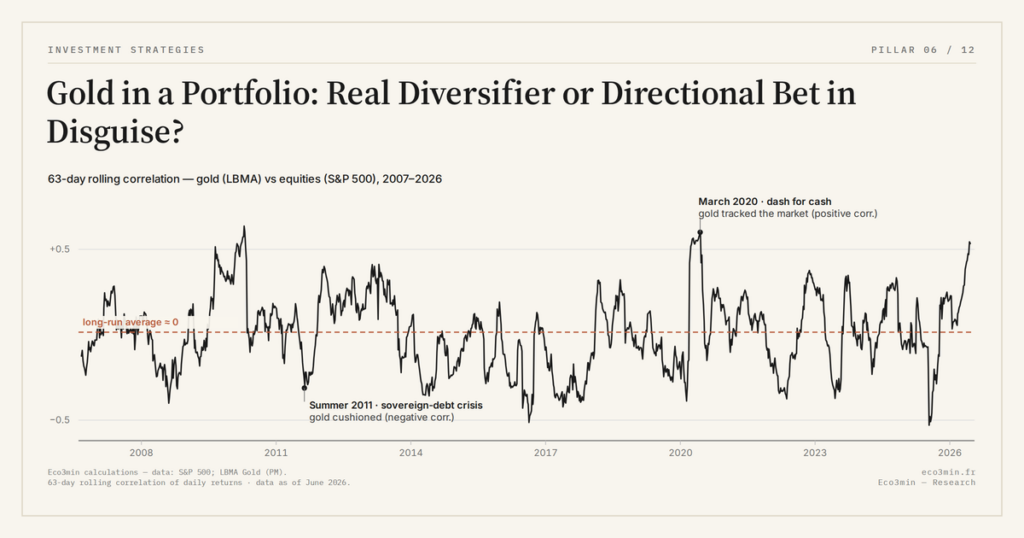
Gold’s correlation to equities is low on average, which makes it look like a diversifier. But that average is unstable: in some regimes gold cushioned the falls, in others it dropped alongside the market.
TL;DR
Gold's rolling correlation to equities swings between clearly negative and distinctly positive by regime, so its low long-run average hides whether it cushions a crash or falls alongside it.
- Gold cushioned in stress accompanied by falling real rates and working liquidity: the 2009-to-2011 post-crisis recovery, the 2011 European sovereign-debt crisis, and the Q4 2018 correction, when it advanced as equities fell.
- It tracked the market in two unfavourable regimes of very different duration: the brief March 2020 dash for cash, when it fell with everything before rebounding toward records, and the durable 2022 rise in real rates, which kept it correlated for quarters.
This piece separates the regimes where gold genuinely decorrelated from a portfolio from those where it behaved as a directional bet on the real rate and the dollar — without asking whether anyone should hold it.
Gold is often cast as a diversifier: an asset whose moves do not track equities, and which therefore cushions a portfolio. The reality is more nuanced. Gold’s correlation to equities is indeed low on average — but that average hides sharp instability. In some stress episodes, gold rose while equities fell, fully playing its shock-absorber role. In others — notably the forced selling of March 2020 — it dropped alongside everything else, as investors sold whatever was liquid to raise cash. A diversifier that fails at the worst moment is not quite a diversifier. This piece separates the regimes where gold genuinely decorrelated from a portfolio from those where it behaved as a directional bet. The question is not “should you hold it,” but “what did it do, and when.” See also: the end of reliable commodity diversification.
A low correlation, but a misleading average
Over the long run, the correlation between gold and equities is close to zero, sometimes slightly negative. That statistic is what the word “diversifier” summarises: an asset that, on average, does not move with the equity portfolio. The trouble is that this average aggregates very different regimes. The rolling correlation of gold to equities does not stay around zero: it swings between clearly negative phases and distinctly positive ones, depending on what governs the market at the time. Reducing gold to its average correlation confuses a distribution with its centre of gravity — and misses what actually determines its behaviour, namely gold as a holding by regime.
That instability is not random noise. It follows the cluster’s logic: what moves gold up or down is first the real rate and the dollar. When those forces push gold opposite to equities, gold diversifies; when they push it the same way, or when liquidity overrides everything else, gold stops diversifying. The observed correlation is therefore not a fixed property of gold: it is the variable result of the prevailing macro regime.
Concretely, the rolling correlation of gold to equities — measured over moving windows of a few months — has covered a wide range over the decades. It has been clearly negative in some phases, gold rising as equities fell; it has turned distinctly positive in others, the two moving together. This mobility is precisely what the average correlation, computed over the whole period, erases. A single figure to describe a behaviour that changes sign by regime is not wrong: it is simply silent on what matters most, namely the moment when you need it.
The regimes where gold cushioned
In several episodes, gold fully played its shock-absorber role. During the 2011 European sovereign-debt crisis, it climbed toward highs while European risk assets suffered. In the fourth quarter of 2018, when equities corrected sharply, gold advanced. In the 2009-to-2011 recovery that followed the financial crisis, collapsed real rates supported the metal while markets rebuilt. The common thread of these phases: stress accompanied by falling or very low real rates, and liquidity that kept functioning. In those conditions, gold did what one expects of a diversifier.
This behaviour is no mystery. When a shock lowers growth expectations and pushes central banks to cut rates, the real yield falls, gold’s cost to hold eases, and the metal becomes attractive just as equities break down. The observed decorrelation then flows directly from the real-rate driver — it is not an intrinsic virtue of gold, but the consequence of a favourable regime.
One episode deserves a caveat, however, because it foreshadows what follows. In the autumn of 2008, at the height of the financial crisis, gold first fell with equities for several weeks, caught by the same need for liquidity that struck every asset, before recovering sharply as real rates collapsed. So even in a crisis where gold ultimately played its role well, it went through an initial phase of positive correlation. That sequence — a liquidity break, then a recovery driven by real rates — is exactly what replayed, in fast-forward, in March 2020.
When gold tracked the market
Other regimes tell the opposite story. The clearest case is the March 2020 panic: for about ten days, gold fell alongside equities, because investors were selling whatever was liquid — gold included — to raise cash and cover margin calls. The diversifier failed precisely at the acute moment, before rebounding toward records in the following months. This kind of dash-for-cash episode, where correlations converge toward one, goes beyond the real-rate read: it is the subject of a dedicated analysis of what happens when stocks and bonds fall together.
The other unfavourable configuration is more structural. When the real rate rises durably — as in 2022 — the same force weighing on equities and bonds weighs on gold too: the rising real yield raises its cost to hold. In that regime, gold does not diversify, because it takes the same shock as the rest of the portfolio. It then behaves as a directional bet on the real rate, not as a hedge. It is the exact reverse of the favourable regime: what made gold a cushion when rates fell makes it a correlated asset when they rise.
These two unfavourable regimes do not resemble each other in duration. The dash for cash is brutal but brief: it lasts a few days to a few weeks, and the correlation then returns toward its usual levels once the panic passes. The rising-real-rate regime is slower and more durable: it can keep gold correlated to equities for entire quarters, as long as the central bank tightens. Conflating the two leads to symmetrical reading errors: taking a passing liquidity break for a structural breakdown, or conversely attributing to a mere bout of panic what stems from an entrenched rate regime.
A conditional diversifier, not a structural one
The synthesis fits in one sentence: gold diversifies in some regimes and tracks the market in others, and it is the real-rate regime — backed by liquidity — that decides. Presenting gold as a diversifier “in itself” generalises an average that does not hold regime by regime. The honest read is conditional: gold cushions when the real rate falls in a liquid market, and it follows the decline when the real rate rises or when liquidity dries up. This logic extends building for the macro cycle, and applies all the more to silver’s distinct risk profile, more volatile still. To place the present moment in this frame, one can refer to the current macro regime.
The consequence for portfolio construction is descriptive, not prescriptive: gold’s contribution to diversification cannot be treated as a constant. It varies with the regime, and reasoning that assumes a stable decorrelation overstates the cushioning in unfavourable regimes. This does not disqualify gold as a component; it simply invites reading its correlation as a state variable, dependent on the real rate and on liquidity, rather than as a fixed characteristic built into the asset.
What the unstable correlation implies
Three observations, without prescription. First, gold’s low average correlation to equities hides sharp instability: it alternates between negative and positive phases by regime. Second, gold cushioned the falls in stress accompanied by falling real rates and functioning liquidity, and it tracked the market in dashes for cash and in rising-real-rate regimes. Third, its quality as a diversifier is conditional on the regime, not structural: describing it as a given confuses an average with a property.
Taking gold’s low average correlation to equities as a stable property leads to believing it protects in all circumstances. Yet that correlation is unstable: in dashes for cash and rising-real-rate regimes, gold fell alongside the market. A conditional diversifier does not cushion every crisis, only the regimes that favour it.
Frequently asked questions
On average, its correlation to equities is low, sometimes slightly negative. But that average hides a very unstable rolling correlation, which moves from clearly negative to distinctly positive by regime. Gold is not permanently decorrelated: it is in some regimes, not in others.
Does gold protect during crashes?
It depends on the type of crash. In stress accompanied by falling real rates and functioning liquidity, gold often cushioned. In dashes for cash, as in March 2020, it fell with the rest before rebounding. The protection is not automatic.
Why did gold fall in March 2020?
Because investors were selling whatever was liquid, gold included, to raise cash and cover margin calls. In these dashes for cash, correlations between assets converge toward one, and gold’s diversifier role temporarily fades. The metal then rebounded toward records.
Does gold diversify a portfolio in all circumstances?
No. Its quality as a diversifier is conditional on the regime: gold cushions when the real rate falls in a liquid market, and it follows the decline when the real rate rises or when liquidity dries up. Describing its diversification as structural generalises an unstable average.
Does gold’s correlation to equities change over time?
Yes, sharply. Measured over moving windows, it alternates between clearly negative phases and distinctly positive ones depending on the macro regime. It is this mobility that the average correlation, computed over a long period, hides — and it is what determines gold’s actual behaviour under stress.
Last updated — 10 July 2026
Disclaimer – Financial Information: The analyses, commentary, and content published on eco3min.fr are provided for informational and educational purposes only. They do not constitute investment advice or a solicitation to buy or sell financial instruments. Past performance is not indicative of future results. All investment decisions involve risk and are the sole responsibility of the reader.
Read next
Full pillar →Beneficiary Designations, the Step-Up in Basis, and the 10-Year Rule: How US Accounts Transfer at Death
At death, most US financial accounts pass outside the will, straight to a named beneficiary, under tax rules…
The Fee Stack in Variable Annuities: M&E Charges, Riders, and Subaccount Costs
A variable annuity does not carry one fee, but a stack of them. Mortality and expense charges, subaccount…
The Conventional 401(k)-Match-First Funding Order: Where It Comes From, How It Works
The question of what order to fund accounts in usually draws a fixed list, presented as a rule…