
Gold’s Role Across the Real-Rate Regime

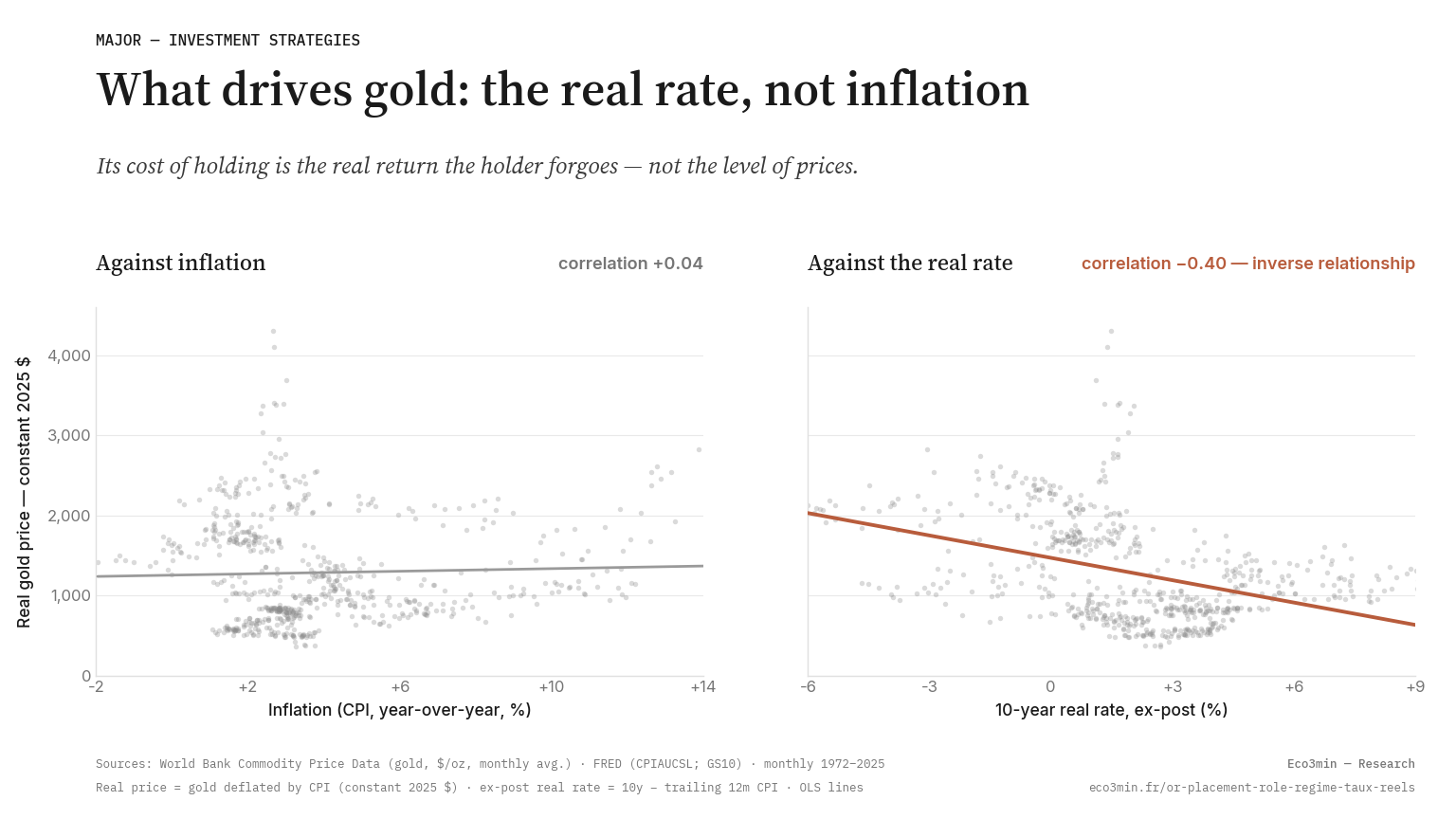
Gold pays no coupon and no dividend: its role in a portfolio is set first by the real interest rate, which measures what the holder gives up. This holding cost, not inflation alone, governs the metal across regimes.
TL;DR
Across the TIPS era, swings in the ten-year real yield and the dollar explain most of gold's medium-term moves, while realised inflation adds little once the real rate is in.
- Gold pays no coupon, so its benchmark is the real return it forgoes: the ten-year real rate, tracked by the Fed as series DFII10.
- The 1999–2001 bottom and the 2011 peak near 1,900 dollars in intraday terms, 1,772 on the monthly average, bracket one regime of falling real rates, just as 1980 and 2013 bracket its rising-rate opposite.
- A second driver sits on top: gold trades in dollars and moves inversely to the currency, and the Fed's broad dollar index marks the strong-dollar stretches that weigh on the metal.
This cluster reads gold as a holding governed by the real-rate regime, with the dollar as a second driver, and describes how it behaves regime by regime, without ever recommending that anyone own it.
An asset that pays nothing: why gold is a special case in a portfolio
Most assets in a portfolio produce a flow. A stock pays dividends, a bond pays coupons, a property pays rent. Gold pays none of these. An ounce held for ten years is still an ounce: it does not compound, distributes nothing, and even costs something to keep, whether as custody fees on a vault or management fees on a listed vehicle. This feature, usually treated as a curiosity, is in fact the central fact that determines gold’s place in an allocation.
An asset that pays no yield is not free to own. Holding gold ties up capital that could have been placed elsewhere, in something that pays. The natural benchmark is not just any asset, but the one closest to a safe, inflation-linked store of value: the sovereign real-yield bond, archetypically the US Treasury Inflation-Protected Security (TIPS). The real return that instrument offers is precisely what the gold holder forgoes. That is the opportunity cost, and it has a name in the data: the ten-year real interest rate, tracked by the Federal Reserve under the series DFII10.
It is worth defining a real rate. In its simplest form, inherited from Irving Fisher, it is the nominal interest rate minus inflation. But the relevant inflation is the expected kind, not what has already happened: a holder weighs what they anticipate, not what has occurred. This separates the ex ante real rate, built on expected inflation, from the ex post real rate, computed once realised inflation is known. TIPS have the advantage of making that real yield directly legible in the market, without estimating expectations: the price of the indexed bond already embeds the inflation premium.
This reasoning sets the reading frame for the whole cluster. Before examining how the gold price forms in the market, one has to understand what it costs to keep it: that is the subject of the satellite on gold’s cost to hold, which develops the mechanics of opportunity cost. This article sets the frame; each satellite exploits one consequence. The whole sits within allocation strategies read through the macro regime, whose guiding idea is simple: the relevant holding depends less on intrinsic qualities than on the economic regime one is in.
That regime dependence sets gold apart from a productive asset from the outset. The value of a stock rests, ultimately, on future earnings; that of a bond, on contractual flows. Gold has neither. Its valuation rests entirely on what holders are willing to pay to carry it, at a given moment, given what they forgo earning elsewhere. When the real return available on safe assets is high, that sacrifice is heavy; when it is low or negative, it fades. Everything that follows flows from that switch.
It helps to place gold among the other so-called “real” assets, those meant to resist monetary erosion. Real estate produces rent and, in part, tracks prices over time, but it carries its own credit and cycle risk. Industrial commodities depend on real economic demand, not money alone. Inflation-linked bonds deliver a contractual real return, at the price of sensitivity to the real rate. Gold stands apart in its purity: no flow, no dominant industrial use, no counterparty. It is precisely that absence that makes it a thermometer of opportunity cost — and a baffling asset for anyone seeking intrinsic value.
It is just as clarifying to state what gold is not. It is not a productive asset: it generates no profit or interest, and creates no new wealth simply by being held. It is not a transaction currency in the everyday sense: one does not settle daily expenses in gold, and its liquidity, deep as it is in markets, lacks the convenience of a bank account. And it is not an indexed bond: it pays no contractual real return, whereas a TIPS mechanically delivers an inflation-adjusted coupon. Gold is, more simply, a store of value with no counterparty and no promise, which makes it both robust to credit risk and entirely dependent on opportunity cost for its price behaviour.
Gold: a long history of rate regimes
Placing gold over the long run shows why reading it through inflation alone fails. Until 1971, the metal had no free market price: under the Bretton Woods system, the ounce was fixed at 35 dollars and the dollar’s convertibility into gold organised the international monetary order. On 15 August 1971, President Nixon suspended that convertibility, closing what became known as the “gold window.” From then on, gold floated, and its behaviour became legible across successive monetary regimes.
The 1970s were a decade of high inflation and often negative real rates: nominal returns failed to keep pace with rising prices. Holding gold then cost nothing in forgone yield, and the metal climbed spectacularly, peaking at 850 dollars an ounce at the London fixing of 21 January 1980, the highest in the history of the fixing, against a 675-dollar monthly average for the month (World Bank). That peak is often cited as proof that gold “hedges inflation.” It mainly proves that gold thrives when the real return fades.
The 1980 reversal confirms it by contradiction. Appointed to lead the Federal Reserve in 1979, Paul Volcker raised policy rates to levels that drove real rates to record highs. The lag matters: measured ex post, the ten-year yield less realised twelve-month inflation, the real rate did not clear 8% until June 1983, then stayed above it for fourteen months, through March 1985, peaking at 9.4% in August 1983. Inflation was receding by then, while gold’s opportunity cost was reaching its high. The metal began a long decline that ran for nearly two decades, tracking the entire disinflation and positive-real-rate stretch of the 1980s and 1990s: from a 675-dollar monthly average in January 1980 to 315 in June 1982, gold lost 53% in two and a half years. Over twenty years, a gold holder bore an almost continuous opportunity cost while income assets captured high real returns.
The next cycle flips the scenery. From the early 2000s, the secular decline in real rates — monetary easing, a lower potential growth rate, then the 2008 financial crisis — gave gold a favourable footing again. The failure of Lehman Brothers in September 2008 and the unconventional monetary policies that followed compressed real returns, and the metal climbed to a peak near 1,900 dollars an ounce intraday in September 2011, a month whose average came in at 1,772. Here again, the decisive variable is not inflation — which stayed moderate — but the collapse in the real return available elsewhere.
The hinge between these two long cycles is worth pausing on. Gold bottomed around the turn of the millennium, after two decades in which positive real returns made income assets the obvious choice and left the metal unloved. What turned the tide was not a sudden inflation scare but a steady erosion of real yields, accelerated later by crisis-era policy. The bottom of 1999-2001 and the peak of 2011 bracket a single regime — falling real rates — just as 1980 and 2013 bracket its opposite.
The 2013 episode closes the demonstration. When the Federal Reserve signalled, from May 2013, that it would taper its asset purchases, real yields rose sharply, and gold lost 27.5% December on December, its steepest annual drop since the end of Bretton Woods, ahead of 1975 (−24.5%) and 1981 (−23.8%). No inflation surge nor sudden disinflation explains it: only a rise in opportunity cost, triggered by a simple shift in monetary stance. Seen from the holder, this sequence of regimes — 1971, 1980, 2011, 2013 — tells a coherent story once read through the real rate, and a string of contradictions read through inflation.
The 2015-2019 stretch completes the picture. With moderate real rates and a broadly firm dollar, gold drifted without a clear trend, swinging within a relatively narrow band. Neither plainly supportive nor plainly adverse: the absence of a strong impulse on the real return translated into the absence of a clear direction for the metal. That episode, less dramatic than the peaks and crashes, illustrates a useful truth: gold only “does” something when the real-rate regime moves decisively; absent a move, it tends to drift.
This half-century crossing yields one regularity. Each time, the metal’s turning point coincided not with a peak or trough in inflation, but with a reversal in the real return: 1980 and 2013 are real-rate highs and bearish pivots for gold; 2011 and 2020 are real-rate lows and peaks for the metal. Inflation is present in the background, but it is the real-rate response that commands the move. This reading, set here on the long history, is taken up more analytically in the sections that follow.
The real rate, not inflation, as the hinge of gold’s role
The popular narrative assigns gold a single, permanent function: protecting against inflation. The line is so widespread that it is rarely tested against the data. When it is, it proves partial. Gold did surge in the 1970s, when US inflation at times topped 13%. But between 1980 and 1982, with inflation still high, the metal collapsed, shedding most of the gains it had accumulated. If inflation alone drove the gold price, those two episodes would be contradictory. They are not, once the right variable is introduced.
The factor that separates these periods is not the level of inflation, but the real rate. In the 1970s, inflation eroded nominal returns faster than they rose: real rates were nil or negative, and holding gold cost nothing. From 1979, the tightening led by Paul Volcker drove real rates to record highs, and gold’s opportunity cost became prohibitive; the metal broke down despite still-high inflation. Inflation explained the first half of the story; the real rate explains the whole.
This reading has found empirical confirmation since the late 1990s. With the Treasury’s first TIPS auction on 29 January 1997, a ten-year note, real rates became directly observable in the market, and Federal Reserve series allow their path to be tracked. Over this period, the gold price tracks the path of US real rates and the dollar far more closely than realised inflation. The relationship is inverse: when the ten-year real yield falls, gold tends to rise; when it climbs back, gold struggles. This mechanism, which this cluster reads from the standpoint of a holding, is the subject of a dedicated analysis of how the gold price forms in the commodities pillar, to which this article delegates price formation proper.
How tight is the link in practice? Over the TIPS era, moves in the ten-year real yield and broad swings in the dollar account for a large share of gold’s medium-term variation, while realised inflation adds little once the real rate is included. The relationship is statistical, not deterministic: it explains the direction and much of the amplitude of multi-year moves, not the day-to-day. That is enough to make the metal legible without pretending it is mechanical — a distinction the next sections lean on.
The link between the real rate and the real price of gold is not, moreover, a recent discovery. Academic work from the late 1980s — notably Robert Barsky and Lawrence Summers, “Gibson’s Paradox and the Gold Standard”, Journal of Political Economy, June 1988 – already tied the real price of the metal to the real interest rate, in a framework where gold, a yieldless asset, sees its demand vary inversely with the real return on competing assets. Theory and observation converge: it is the carry cost, set by the real rate, that is the hinge. In the same vein: our analysis of real gold prices since 1971.
Two horizons deserve to be distinguished. In the short and medium term, it is the change in the real rate that dominates gold’s behaviour, as we will see regime by regime. Over the very long run, another regularity is layered on: the gold price relative to the general price level — its real price — tends to fluctuate around averages rather than drift indefinitely, which has nourished the idea of a “golden constant,” a relatively stable purchasing power for the metal over centuries-long horizons. This long-run property and the medium-term sensitivity to the real rate do not contradict each other: the first describes a distant anchor, the second the deviations around it. The formal empirical test of that stability, like the decomposition of the gold-inflation link, belongs to dedicated analyses to which this cluster delegates the statistical demonstration. A closer look: the Eco3min framework on conditional protection.
The nuance is not academic. It changes what gold brings, or fails to bring, to a portfolio depending on where the cycle stands. Claiming that gold “hedges inflation” leads to expecting systematic protection that does not exist. Recasting the question as “in which real-rate regimes has gold protected?” restores the observed reality: protection that depends on the regime of rates, not a permanent insurance. That is the subject of a specific satellite, which separates the configurations where the metal genuinely cushioned a portfolio from those where it disappointed.
Part of the consensus nonetheless still frames gold as an inflation hedge by construction. The divergence this analysis carries is not an opinion on the metal’s value, but a precision of mechanism: it is not the price level that governs gold, but the real return the holder forgoes. As long as that distinction stays implicit, gold looks alternately magical and disappointing. Once it is set, its behaviour becomes legible again.
Believing gold mechanically protects against inflation leads to expecting permanent insurance. That reading ignores the real rate: gold broke down between 1980 and 1982 while inflation stayed high, because real rates had jumped. It is not the price level that governs gold, but the real return the holder forgoes.
The dollar, gold’s second driver
The real rate does not, on its own, account for gold’s moves. A second factor sits on top of it: the dollar. Gold trades in dollars on international markets, and it keeps a historically inverse relationship with the US currency. When the greenback weakens against other currencies, dollar-denominated gold tends to appreciate, and vice versa. The two drivers are not independent — a cycle of rising US real rates often comes with a strong dollar — but they are not the same thing, and at times they pull in opposite directions.
The logic of that inverse relationship is partly mechanical: a weaker dollar makes the metal cheaper for holders in other currency zones, which supports demand expressed in dollars. But it also reflects a common substrate: gold is often sought as an alternative store of value when confidence in the dominant reserve currency erodes. The Federal Reserve publishes a broad dollar index, which tracks the currency’s value against a basket of trading partners; spells of a structurally strong dollar show up there as environments generally adverse to gold.
Two caveats keep this from becoming a mechanical rule. The inverse gold-dollar link is a tendency, not an identity: there are stretches where both rise together, typically when a global stress bid lifts the dollar as a funding currency and gold as a refuge at once. And because rising US real rates and a strong dollar usually travel together, isolating the dollar’s own contribution from the real rate’s is rarely clean. The point is not to assign fixed weights, but to keep both forces in view, since reading either alone leaves recurring “surprises” unexplained.
This monetary dimension is especially sharp for a non-dollar holder. For a euro-based investor, the gold price has two layers: the dollar quote, then the conversion into euros. The same gold price can produce very different returns depending on the reference currency. Over some periods, gold set records in euros without setting them in dollars, simply because the euro was weakening against the dollar at the same time; and the reverse has happened too. A non-dollar holder therefore carries, like it or not, a currency exposure layered onto the metal exposure.
For the euro-based holder, the practical upshot is that two questions hide inside one: how the metal behaves in dollars, and how the euro behaves against the dollar. A favourable gold regime can be muted by a strengthening euro, or a flat gold market can deliver gains in euros when the dollar firms. The currency layer is neither noise nor edge by default; it is a second exposure that the dollar quote conceals, and whose sign depends on a different macro driver than the one that moves gold itself.
That overlay is structural enough to warrant a separate satellite, on gold priced in dollars and what currency adds to the position for a euro-based holder. The mechanics of the international gold-dollar arbitrage, by contrast, belong to price-formation fundamentals and are treated elsewhere on the site; this cluster keeps the consequence for allocation, not the detail of the market mechanism.
Holding both drivers in mind — real rate and dollar — avoids a common shortcut: pinning every gold move on a one-off narrative, geopolitical or emotional. International tensions, banking crises or central-bank buying do play a part, but they almost always sit within a real-rate and dollar context that amplifies or dampens their effect. The two-axis read offers a more stable lens than the run of the news.
The reading used here rests on two axes: the direction of the ten-year real interest rate (rising or falling) and the path of the dollar (strengthening or easing). Crossing these two variables defines four environments in which gold’s historical behaviour differs markedly. The frame is descriptive: it orders past episodes, it does not project a future path.
Reading gold regime by regime
Combining the real rate and the dollar produces a simple reading frame: depending on whether the real return rises or falls, and whether the dollar strengthens or eases, gold sits in a supportive or an adverse environment. Rather than a single narrative, the frame describes a sequence of regimes, each tied to an observed behaviour of the metal. The aim is not to predict the next move, but to understand why episodes that look alike — high inflation, market stress — produced opposite results.
The falling-real-rate regime
When real rates decline, and all the more when they turn negative, gold’s holding cost fades. The clearest episode is 2020-2022: facing the pandemic shock, the Federal Reserve cut policy rates and inflation accelerated, pushing ten-year real yields well into negative territory. Holding gold no longer cost anything in forgone return, and investment demand rose sharply, carrying the price above 2,000 dollars an ounce for the first time intraday in August 2020, a month that still averaged 1,969 dollars: the monthly average itself only cleared that mark in December 2023. The same mechanism, on a smaller scale, had accompanied the post-2008 easing that took the metal toward its 2011 peak.
The pivot into that regime can predate the obvious trigger. Real yields had already been grinding lower through 2019 as the Federal Reserve paused and then cut, and gold had begun to firm before the pandemic struck — a reminder that the metal responds to the direction of the real rate, not to the headline that later gets the credit. The 2020 surge extended a move the rate regime had already set in motion.
This is the regime where gold “works” in the sense the public means. But note what triggers it: not inflation in itself, but the fact that real returns fail to respond, either because the central bank holds rates low, or because inflation surprises higher faster than policy adjusts. It is the combination — inflation with a compressed real return — that creates the footing, not inflation alone.
The rising-real-rate regime
The reverse configuration is adverse. When the central bank raises rates faster than inflation, real returns climb and the forgone yield on gold grows heavier. The historical precedent remains the early-1980s Volcker shock; the 2013 episode, triggered by the prospect of the Federal Reserve’s taper, offers a more recent and briefer version. In both cases, gold fell not because inflation was receding, but because the real return offered by safe assets was rising.
The tightening the Federal Reserve began in 2022 illustrates the same logic, with one notable complication. The rapid rate rise pushed ten-year real yields back into clearly positive territory after a decade of repression. By the simple frame, gold should have fallen. It first stalled, then behaved unexpectedly — a point examined further below, because it puts the frame to the test.
The speed of the 2013 move is itself instructive. Gold did not erode gently as real yields drifted up; it gapped lower within weeks once the taper was signalled, with one of the sharpest declines on record that spring. That abruptness underlines a feature of a yieldless asset: when the opportunity cost reprices quickly, so does gold, because nothing anchors it to a stream of cash flows that would cushion the adjustment.
The dollar’s role in each regime
The dollar modulates both regimes. A cycle of rising US real rates often comes with a strong dollar, which weighs doubly on gold for a dollar-denominated holder. But when real rates stabilise and the dollar eases, gold can appreciate even without marked monetary loosening. Conversely, a very strong dollar can cap gold even as real rates fall. The single-factor read fails in these friction zones; the two-axis frame makes them intelligible. This real-rate driver is not unique to gold: long bonds, and the vehicles that track them, obey it too — it is the same driver as bond ETFs of long duration, analysed in the neighbouring cluster of the same sub-pillar.
Mixed regimes and friction zones
The two axes do not always align. Real rates may fall while the dollar strengthens, or the reverse; these mixed regimes are the hardest to read and the richest in lessons. In such a configuration, the net effect on gold depends on the relative strength of each driver, and that is precisely where single-factor reads go wrong. A commentator watching only inflation, or only the dollar, will often conclude there is an “anomaly”; the two-axis frame turns it into a predictable special case. Recognising these friction zones, rather than ignoring them, is what separates an analytical frame from a slogan. More on this: how dollar and gold compare.
This two-axis frame does not provide an entry or exit signal, and that is not its purpose. It describes regularities observed in past data, while recalling that the relationship between gold, real rates and the dollar is neither mechanical nor stable over time. Coefficients vary, exceptions exist, and one of the most recent episodes puts the frame squarely to the test.
Why gold has no calculable fair value
One difficulty specific to gold deserves to be stated plainly, because it explains the awkwardness of the standard models. Valuing a stock means discounting future earnings; valuing a bond, discounting contractual flows. In both cases there is a theoretical “fair value,” computable from flows and a discount rate. Gold offers no flows. There is therefore, strictly speaking, no fair value of gold in the sense of financial analysis: there is nothing to discount.
That absence is not a flaw, it is the very nature of the asset. The gold price is, at every instant, the result of an arbitrage between what it costs to carry — set by the real rate — and what holders, private and public, are willing to pay for that holding. The real rate sets the cost; the dollar and reserve flows shift demand. None of these terms is fixed, which makes gold elusive for anyone seeking a fundamental anchor, and perfectly legible for anyone willing to reason in opportunity cost.
This property has a concrete consequence for the holder. Lacking a fair value, gold cannot be judged “expensive” or “cheap” in absolute terms; it can only be so relative to the prevailing regime of real rates and the dollar. A high price in an environment of deeply negative real returns does not mean the same thing as a high price while real returns are positive. It is this second configuration, observed recently, that is the most instructive anomaly of the current cycle.
This is why debates about whether gold is “in a bubble” tend to talk past each other. A bubble presupposes a fundamental value the price has detached from; with no such value to detach from, the word loses its usual meaning. The disciplined question is not whether gold is overvalued in the abstract, but whether the prevailing real-rate and dollar regime is consistent with the level — and, when it is not, what else is doing the work. The recent period is exactly such a case.
Gold in a regime-aware allocation
Everything above converges on a simple idea, which is also that of the sub-pillar this cluster sits within: the role of a holding is judged not in absolute terms but relative to the macroeconomic regime. Gold is a textbook case. In a regime of compressed real rates, it has historically offered decorrelated and sometimes protective behaviour; in a regime of rising real rates, it has weighed on a portfolio instead of cushioning it. The same asset has therefore played opposite roles depending on where the cycle stands, without its nature changing.
This logic does not yield an allocation rule, and cannot. It rather invites substituting one question for another: not “is gold a good holding?” but “what regime are we in, and what has gold done in comparable regimes?”. The first question calls for a normative answer that neither this cluster nor any media outlet can give; the second calls for a description, verifiable on past data, that informs without deciding. That is the difference between understanding an instrument and receiving an instruction — the spirit of choosing holdings across the rate cycle.
None of this licenses a target weight, and that restraint is deliberate. What the regime lens offers is a vocabulary for the debate rather than an answer to it: it lets a reader place a given moment on the two axes and ask what comparable moments produced, which is a question of evidence, not of advice. The boundary matters because the same data that illuminate behaviour would, if pushed one step further into prescription, cross from journalism into something a media outlet is not.
It also explains why gold periodically returns to the centre of the allocation debate. When a regime of high real rates gives way to a regime of compression — monetary easing, an inflation surprise, a search for alternative reserves — the question of gold’s place resurfaces, not as fashion, but because the cost of holding it has changed. Reading that change of regime is the real issue; the rest of the cluster works through its facets, from holding cost to vehicles, from the white metals to diversification.
Expressing the exposure: vehicles and precious metals
Holding “gold” covers very different realities depending on the chosen vehicle. A physically backed vehicle replicates the metal price, less custody fees: its behaviour closely follows the one described by the regime frame. A gold miner, by contrast, is a company, with extraction costs, debt, a management team and a share price tied to the equity market. Its value depends on the gold price, but with operational leverage and an equity beta the metal does not have.
That distinction shifts the regime profile. In a stress phase where gold rises but equities fall, physical metal and miners can diverge sharply, the latter suffering the broad market decline. The gap between physical gold or miners is the subject of a dedicated satellite, which describes the two profiles without crowning one “better”: relevance depends on the regime and the objective, never on a product ranking. This article simply notes that the choice of vehicle is a decision distinct from exposure to the metal itself.
A concrete regime case makes the gap tangible: in a downturn driven by falling real yields, a physically backed holding can rise while a basket of miners, dragged by the broad equity decline, lags or falls outright — even though both are “gold.” The vehicle, not just the metal, decides what the position does in that regime.
Beyond the physical-vs-miners pair, the chosen vehicle carries differences in liquidity, fees and taxation that change the net return actually received, independently of the metal price. A higher carry cost mechanically reinforces the weight of the opportunity cost already imposed by the real rate: carrying gold through a costly vehicle adds a layer to the forgone yield. These technical differences, treated in the dedicated satellite, are a reminder that exposure to gold is never quite abstract: it runs through an instrument whose own characteristics matter.
Gold does not exhaust the precious-metals category either. Silver and platinum have a dual nature, both monetary and industrial, which makes them more volatile than gold and more sensitive to the economic cycle. The gold/silver ratio — how many ounces of silver one ounce of gold is worth — has long served as a regime gauge: over thirty years it fell to 34.7 in April 2011 and rose to 111.5 in April 2020, for a median of 67 and a latest reading of 67 in August 2026. The place of silver, platinum and the gold/silver ratio as holdings distinct from gold is treated in a specific satellite. Here too, the analysis stays descriptive: the point is to situate risk profiles, not to rank assets.
This caution is not merely a regulatory requirement. It follows from the cluster’s logic: if the role of a holding depends on the regime, then no vehicle and no metal is superior in the absolute. Physical and miners, gold and silver, do not rank once and for all; they behave differently depending on the real-rate and dollar configuration. Describing those differences has analytical value; turning them into a recommendation would have another, which is not a media outlet’s.
Gold as a diversifier: a conditional role
The argument most often advanced for gold in a portfolio is its diversification role: an asset whose moves would not track equities, and which would therefore cushion the whole in a market downturn. The reality is more nuanced. The correlation between gold and equities is indeed low on average over the long run — but that average hides sharp instability. The correlation is not a constant; it shifts with the regime. Background: the behaviour of vehicles through the cycle.
In some stress episodes, gold fully played its shock-absorber role, rising while equities fell. In others, it fell along with everything else. The most striking illustration remains the forced selling of March 2020: at the height of the pandemic panic, investors liquidated what was liquid, gold included, to raise cash, and the metal fell with equities before rebounding vigorously in the following weeks. A diversifier that fails at the precise moment diversification would be most useful is not quite a diversifier.
Two distinct mechanisms sit behind that instability. In a slow, fundamentals-driven equity decline, gold often rises as real yields fall and a flight to quality builds — the textbook diversifier case. In a violent liquidity scramble, by contrast, the first thing investors reach for is whatever can be liquidated at a clearing price, and gold’s very liquidity turns against it for a few sessions. The diversification it offers is therefore real but state-dependent: strongest in measured stress, weakest in the disorderly kind, which is often when it is wanted most.
The statistical lesson is that an average correlation says almost nothing useful about a diversifier. What matters is the conditional correlation: how the asset behaves precisely in the regimes where diversification is sought, that is, market stress phases. And that is exactly where gold’s correlation is most unstable, swinging between protective decorrelation and a temporary alignment with risk assets. Judging gold on its average correlation is like judging an umbrella on annual rainfall rather than on its behaviour on the day of the downpour. A fuller treatment appears in the regime-dependent commodity hedge.
The relevant question is therefore not “does gold diversify?” in the absolute, but “in which regimes did it diversify, and in which did it behave as a directional bet on the real rate and the dollar?”. That is the subject of the satellite that closes the cluster by questioning gold’s status between diversifier or directional bet. This caveat extends the article’s thesis directly: if gold’s role depends on the regime, its ability to decorrelate from a portfolio depends on it too.
What could qualify this reading
An honest analysis must lay out what could invalidate it. The real-rate-dollar frame describes most of the observable history well, but it met a serious test in recent years. From 2022, the Federal Reserve raised rates aggressively, taking ten-year real yields back into clearly positive territory. The simple model would have predicted constrained, even falling, gold. Yet the metal held up better than expected, then set record after record: a 2,690-dollar monthly average in October 2024, 4,309 in December 2025 and 5,020 in February 2026, before easing back to 4,411 in August 2026. Across that whole stretch the ex-post real rate stayed positive, between +0.3% and +2.0%.
That gap between model and observation has a widely cited explanation: rising gold purchases by central banks, especially in emerging economies, and a broader move to diversify reserves away from the dollar. These institutional flows belong to gold price formation — its role as a monetary reserve and an anti-dollar signal — and are analysed in detail in the commodities pillar, to which this cluster delegates that dimension. For the investor reasoning in terms of a holding, the lesson is twofold: gold’s sensitivity to the real rate remains a robust frame over the long run, but it can be temporarily dominated by structural demand forces.
Several variables would change the reading. A reversal in central-bank buying would make the real rate paramount again. A liquidity shock, like March 2020, could briefly decouple gold from its usual drivers. A monetary policy more restrictive or more accommodative than expected would shift the whole set of regimes. Acknowledging these limits does not weaken the frame: it specifies its domain of validity. The real rate and the dollar explain most of gold’s behaviour over time, without claiming to account for every short-term move.
This reservation also invites modesty about what the frame can and cannot do. It orders the past and clarifies mechanisms; it supplies neither a price target nor a calendar. The current regime — positive real rates, yet sustained institutional demand — shows that several forces can coexist at any moment, and that the dominant one is only legible with hindsight. That is precisely why the cluster describes observed behaviour rather than forecasts.
One open question the analysis does not settle: does the recent episode reflect a merely temporary dominance of institutional demand, or a more durable shift, in which reserve flows take precedence over the real rate in price formation? Both readings coexist. If the first prevails, the real-rate-dollar frame will regain its primacy once official buying slows. If the second is confirmed, the international monetary factor will need a heavier weight in the reading of the metal. This cluster keeps the frame as its reference while flagging that uncertainty explicitly — the honest posture facing a regime still in progress.
Gold is not an inflation hedge but an asset whose holding cost is the real rate and whose role depends on the regime.
A compass, not a recipe
Reading gold through the real-rate regime does not say whether to hold it, or how much. It says what the metal has done, and when. When the real return forgone is high, carrying gold is costly and the metal struggles; when that return fades or turns negative, the cost disappears and gold finds a favourable footing, which the dollar can amplify or counter. This frame restores coherence where the inflation-hedge narrative left contradictions. The same rate-regime lens applied to insurance wrappers is set out in the intra-wrapper guaranteed-versus-market mapping.
Several paths remain possible at any moment, and the relationship between gold, real rates and the dollar is nothing like a physical law. Reserve buying, liquidity shocks or a change of monetary regime can temporarily alter its reach. But the frame offers what the myth did not: a reason to understand why gold rises or falls, rather than a promise of what it will do. It is, in the proper sense, a compass — a reading instrument, not a route.
- Gold pays no yield: its holding cost is the real interest rate, that is, the real return the holder forgoes.
- The discriminating factor in gold’s behaviour is not inflation but the real rate; the dollar acts as a second driver, especially visible for a non-dollar holder.
- Gold’s role — protection, diversification — is conditional on the regime: it cushioned some shocks and disappointed in others, as in the forced selling of March 2020.
- In recent years, central-bank buying has at times dominated the real-rate sensitivity, without invalidating it over the long run.
Last updated — 22 September 2026
Disclaimer – Financial and Legal Information: The analyses, commentary, and content published on eco3min.fr are provided for informational and educational purposes only. They do not constitute investment advice or a solicitation to buy or sell financial instruments. Past performance is not indicative of future results. All investment decisions involve risk and are the sole responsibility of the reader. Data, charts and calculated series are provided as is and may contain errors or lag behind their source: check any figure against the primary source cited before relying on it. Content describing laws, regulations or contracts reflects the law as of its publication date and does not constitute legal or tax advice; applying it to a specific situation requires a qualified legal or tax professional.
Read next
Full pillar →Target-Date Funds vs Self-Directed Portfolios: The Mechanics of a Delegated Glide Path
A target-date fund is sold as a simple, set-and-forget win. It is first something narrower: a delegated glide…
What Guaranteed Savings Products Have Paid: Fixed Annuity and Stable Value Yields Through the Rate Cycle
US guaranteed savings products credit a rate that trails the bond market rather than tracking it. Through the…
Beneficiary Designations, the Step-Up in Basis, and the 10-Year Rule: How US Accounts Transfer at Death
At death, most US financial accounts pass outside the will, straight to a named beneficiary, under tax rules…