When stocks and bonds fall together: the correlation that flips

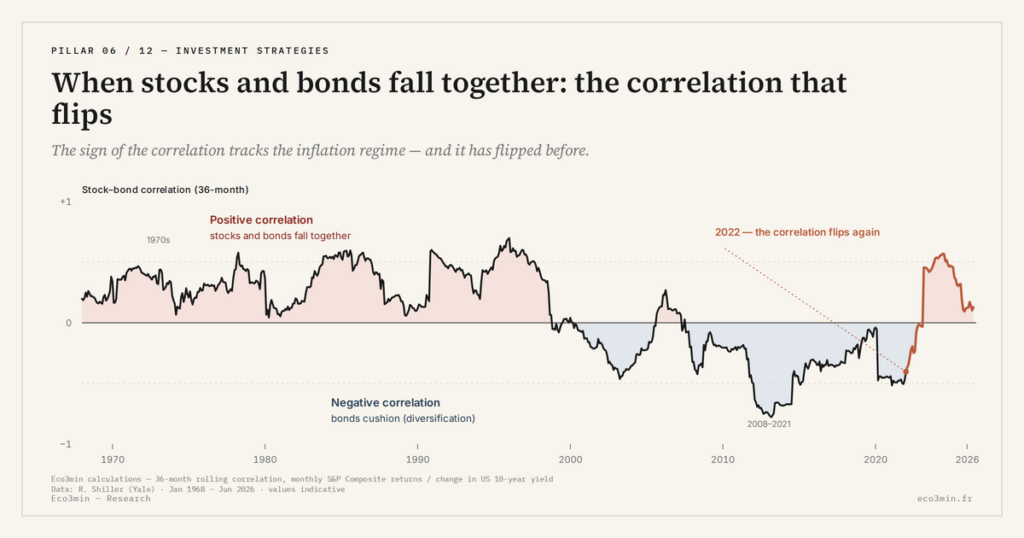
The negative stock-bond correlation is not a property of bonds but of a disinflationary regime — and it can flip. In an inflationary regime the two classes fall together, as in 2022.
TL;DR
Bonds cushion equities only while disinflation reigns: in 2022 the S&P 500 and long Treasuries fell together as rising real rates discounted both valuations through the same channel.
- The sign of the stock-bond correlation tracks the inflation regime: negative through the 1990–2020 disinflation, positive in the 1970s and again in 2022 (FRED data).
- A single channel links the two declines in an inflationary regime: the real rate discounts both future earnings and contractual bond flows, so both fall when it climbs.
- Federal Reserve research since the 2000s documents the sign-switch, confirming that 2022 was a re-emergence of 1970s behaviour rather than an anomaly.
Bonds’ diversifier status is conditional on the inflation regime. This page describes why the sign of the correlation flips, and in which regimes diversification has historically stopped working.
The notion that bonds always cushion a fall in equities rests on a negative correlation that is no law: it depends on the inflation regime. That dependence of the stocks-bonds link on the price environment structures our reading of a defence decaying past its cycle. In a disinflationary regime — most of 1990 to 2020 — stocks and bonds moved inversely, giving bonds their diversifier status. In an inflationary regime the relationship flips: 2022 made the point, when both fell at once, the S&P 500 and long Treasuries declining together as real rates climbed (FRED data). Academic work documents this sign-switch in the correlation with the inflation regime (Federal Reserve, several studies since the 2000s). This page describes why bond diversification is conditional, and in which regimes it has historically stopped working. It describes an observed mechanism; it states no allocation rule.
1. The negative correlation is not a law
Bond diversification rests on an implicit assumption: when equities fall, bonds rise, or at least do not fall. This negative correlation is so deeply embedded in portfolio practice that it is often treated as a permanent property of bonds. It is not. The correlation between stocks and bonds has no fixed sign; it changes with the macroeconomic regime, and particularly with the inflation regime. A parallel case is documented in commodities as a fading diversifier.
The generation of investors formed after 1990 nonetheless grew used to taking this negative correlation for granted, because it is precisely the regime that prevailed for most of their careers. For three decades, a shock adverse to equities was most often accompanied by a fall in rates — flight to quality, expectations of monetary support — that pushed bonds up. The bond sleeve cushioned, and the balanced portfolio kept its promise. But that regularity was no law of finance: it was the signature of a particular disinflationary regime.
Mistaking the property of a regime for a property of the asset is a costly misreading, because it reveals itself only when the regime changes — that is, at the worst moment, when the expected protection fails. Recognising that the correlation is conditional, not given, is the first step to reading correctly the role of a bond sleeve in a portfolio.
2. Why the inflation regime governs the sign
The mechanism lies in the nature of the dominant shock. In a disinflationary regime, the economy is mainly buffeted by growth shocks: a slowdown pushes equities down and, at the same time, pushes rates down — through expectations of monetary easing and flight to safe assets. Stocks and bonds then move inversely: the correlation is negative, and bonds play their cushioning role.
In an inflationary regime, the dominant shock changes nature: it is inflation, and the reaction of rates to inflation, that leads. An inflationary surge pushes rates up, which sends bonds down; and the same rise in rates, by raising the cost of capital and compressing valuations, also sends equities down. The two classes then fall together: the correlation turns positive, and bond diversification stops working. The sign of the correlation therefore follows the type of shock that dominates, itself governed by the inflation regime.
This dependence on the regime explains why the correlation cannot be treated as a stable parameter of a portfolio model. A model calibrated on three disinflationary decades embeds a negative correlation as a structural input; it underestimates the risk that a regime shift makes the losses converge. The correlation is a product of the regime, not a constant around which the regime fluctuates.
A single deep mechanism links the two declines in an inflationary regime: the real rate acts as a common denominator. An equity’s value is the present value of future earnings, discounted at a rate that embeds the real rate; a bond’s value is the present value of contractual flows, discounted at the same rate. When the real rate rises sharply, both denominators tighten at once, and both valuations fall together. The positive correlation is therefore no statistical coincidence: it reflects a common channel, the real rate, that strikes both classes simultaneously when it — and not growth — drives the move.
3. Historical markers: three regimes, two signs
Recent history provides three clear markers. In the 1970s and early 1980s, marked by high and volatile inflation, stocks and bonds often fell together: the rise in rates weighed on both classes at once. The correlation was positive, and the bond sleeve did not cushion — it aggravated. That was an inflationary regime, and bond diversification failed in it.
From the mid-1980s, and above all from the 1990s to 2020, inflation settled at a low and stable level. In this long disinflationary regime, the correlation turned negative: bonds rose when equities fell, and the classic balanced portfolio enjoyed its golden age. It is this period that forged the dominant intuition of an automatic bond diversification.
2022 marked an abrupt return of the inflationary configuration. Under high inflation and the climb in real rates, the S&P 500 and long Treasuries fell together (FRED data), inflicting on many balanced portfolios a double decline at the precise moment the bond sleeve was meant to protect. Federal Reserve work, conducted since the 2000s, documents this link between the inflation regime and the sign of the correlation, confirming that 2022 was not an anomaly but the re-emergence of a behaviour already observed.
The scale of the 2022 episode explains its resonance. The classic balanced portfolio, long presented as a prudent base, had one of its worst years in decades, both legs falling together. It was not diversification as a principle that failed, but the assumption that the stock-bond pair would stay decorrelated regardless of regime. The lesson is not that bonds stopped working, but that their diversifying property was always a function of the regime, mistaken for a constant during the three decades in which that regime held.
It is taken for granted that bonds always diversify an equity portfolio. But the negative correlation between the two classes is the signature of a disinflationary regime, not a property of bonds. In an inflationary regime — the 1970s, or 2022 — the two fall together, and the bond sleeve stops cushioning at the moment it is most expected to.
4. What conditionality changes for diversification
Recognising that the correlation depends on the regime does not lead to an allocation instruction, but to a more accurate reading of a bond sleeve’s role. In a disinflationary regime, that sleeve cushions growth shocks: its diversifying role operates. In an inflationary regime, it stops cushioning and can even amplify the fall, because equities and bonds then take the same rate shock. The diversifier is therefore not the bond as such, but the bond in a disinflationary regime.
This conditionality extends the thesis of the whole comparison: no bond holding behaves independently of the regime, and that holds right down to its role within a portfolio. Duration sets the amplitude of the reaction to rates, credit modulates sensitivity to the cycle, indexation bounds protection against inflation — and correlation, here, decides whether the bond sleeve cushions or amplifies. All these dimensions converge on the same grid: fixed income read by regime.
The practical marker is therefore not a target ratio, but the inflation regime itself: it conditions the sign of the correlation, and hence the effective role of the bond sleeve. Placing that regime — the level and trajectory of inflation, the reaction of rates — is a matter of tracking today’s inflation regime. Set within the broader frame of selecting holdings by the cycle, this reading makes the bond a regime-conditional diversifier rather than a permanent cushion — a distinction that only becomes visible at the moment the regime flips.
5. Frequently asked questions
Why did bonds fail to protect portfolios in 2022?
Because the 2022 shock was a rate shock tied to inflation, not a growth shock. In that configuration, the rise in real rates sent bonds down through their duration and equities down through compressed valuations, at the same time. The correlation, negative through three disinflationary decades, turned positive again — as in the 1970s — and the bond sleeve amplified the fall instead of cushioning it.
Can the negative stock-bond correlation come back?
Historically it returns when the regime becomes disinflationary again, that is, when growth shocks rather than inflation once more drive market moves. The sign of the correlation follows the inflation regime; it is neither permanently negative nor permanently positive, but conditional on the prevailing macroeconomic environment.
Does the inflation regime affect other diversifiers too?
The same conditionality applies beyond bonds: the behaviour of any diversifier is assessed within a regime, not in the abstract. An exposure that offsets equity drawdowns in one regime may move with them in another, which is why the regime — and not a fixed pairing — is the relevant frame for reading how assets combine.
Last updated — 10 July 2026
Disclaimer – Financial Information: The analyses, commentary, and content published on eco3min.fr are provided for informational and educational purposes only. They do not constitute investment advice or a solicitation to buy or sell financial instruments. Past performance is not indicative of future results. All investment decisions involve risk and are the sole responsibility of the reader.
Read next
Full pillar →Beneficiary Designations, the Step-Up in Basis, and the 10-Year Rule: How US Accounts Transfer at Death
At death, most US financial accounts pass outside the will, straight to a named beneficiary, under tax rules…
The Fee Stack in Variable Annuities: M&E Charges, Riders, and Subaccount Costs
A variable annuity does not carry one fee, but a stack of them. Mortality and expense charges, subaccount…
The Conventional 401(k)-Match-First Funding Order: Where It Comes From, How It Works
The question of what order to fund accounts in usually draws a fixed list, presented as a rule…