
Silver and Platinum as Holdings: Risk Profiles and the Gold/Silver Ratio by Regime

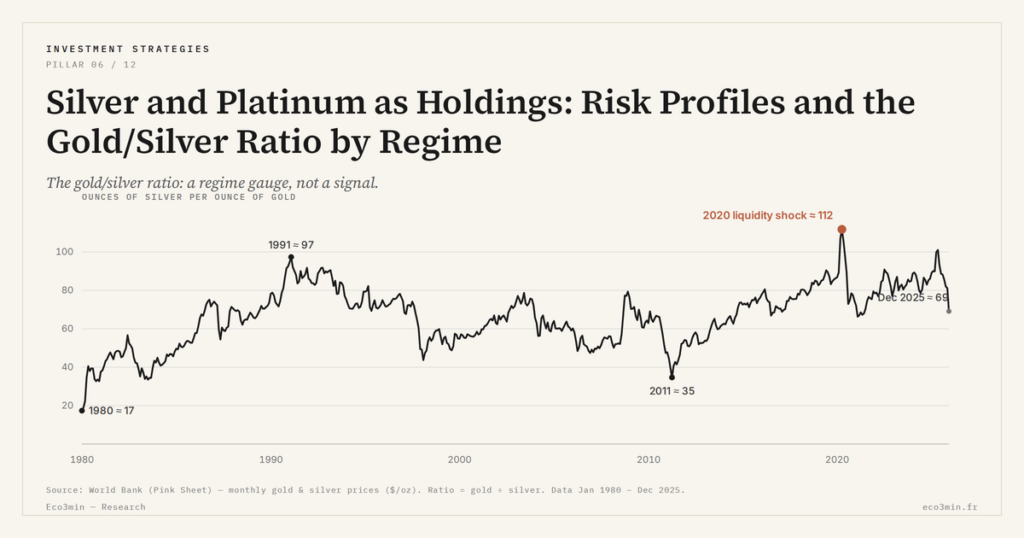
Silver and platinum are not cheaper gold: their dual nature, monetary and industrial, makes them more volatile and more sensitive to the economic cycle. The gold/silver ratio is a regime gauge, not a signal.
TL;DR
Silver still reacts to gold's real-rate forces because it once circulated as money under bimetallic standards, yet industry now drives close to 60% of its demand (58% in 2025, Silver Institute), making it sharper and more cyclical.
- The gold/silver ratio has run from about 35 to above 110 since 1985, after a low near 17 in January 1980; it hit its monthly record in April 2020, after the March liquidity shock, as silver's industrial demand softened, and eases in recoveries when that demand restarts.
- Platinum is more industrial still: about 70% of its mine supply comes from South Africa (USGS, 2025), ahead of Russia, and after decades quoted at a premium to gold it has traded at a discount every month since January 2015 as diesel declined.
- Palladium, long cheaper than platinum, became central to gasoline catalytic converters and saw spectacular price moves on concentrated supply; possible substitution between the two adds a variable foreign to gold's monetary logic.
This piece places silver and platinum as holdings distinct from gold, each with its own risk profile, and reads the gold/silver ratio as a regime gauge among the precious metals.
Gold is not the only precious metal one can hold, but it is the most monetary. Silver and platinum carry a dual nature: stores of value and industrial metals at once, consumed in electronics, solar and the auto sector. That duality makes them more volatile than gold and more sensitive to the economic cycle: silver can outpace gold in recoveries, then fall harder. The gold/silver ratio — how many ounces of silver one ounce of gold is worth — has long served as a regime gauge: it has swung from the low thirties to above one hundred in recent decades, and its extremes have often coincided with cycle turns. This piece places these two metals as holdings distinct from gold.
The dual nature of the white metals
What separates silver and platinum from gold comes down to one word: industry. Gold is almost purely monetary — jewellery, reserves, investment — with marginal industrial use. Silver and platinum, by contrast, are heavily consumed by the real economy: silver in electronics, solar panels and brazing; platinum in autocatalysts and certain industrial processes. A substantial share of their demand therefore depends on the economic cycle, not only on the real-rate regime that governs precious metals by regime.
That dual nature has a direct consequence for risk: silver is markedly more volatile than gold. Its market is narrower and less liquid, and the industrial component adds a sensitivity to cyclical demand on top of the monetary moves. The result is greater amplitude, up and down: silver tends to overshoot gold’s moves. The fine mechanics of that volatility — its sources, its scale, its structure — belong to a dedicated analysis of what drives silver’s volatility, and its trace can be seen in the silver price history. An order of magnitude is enough here: from January 2000 to August 2026, silver’s annualised volatility was 24.8%, against 12.9% for gold and 21.5% for platinum (Eco3min calculation on World Bank monthly prices).
The industrial share varies by metal, but it is substantial everywhere. For silver, industry absorbed 657 million ounces out of 1,131 in 2025, or 58% of demand (Silver Institute, World Silver Survey 2026): electronics, photovoltaics, electrical applications. The rest is split mainly between investment and jewellery. For platinum, the industrial component is more pronounced still. This demand structure explains why the white metals respond to two drivers at once: the monetary regime, like gold, and the cycle of real activity, unlike it. When both pull the same way, moves are amplified; when they diverge, the white metal can behave counter-intuitively. The wider context: how each regime reshuffles the leading vehicles.
Silver’s monetary side is not a marketing relic. For most of monetary history silver circulated as money alongside gold, under bimetallic standards, before being progressively demonetised in the late nineteenth century. That heritage is why it retains a monetary echo today, reacting to the same real-rate forces as gold even as industry has become its dominant source of demand. Platinum, by contrast, never served as money: its precious status is more recent and rests on scarcity and use, not on a monetary past.
The gold/silver ratio as a regime gauge
The gold/silver ratio measures how many ounces of silver match one ounce of gold in value. It is one of the oldest reference points in the precious-metals market. Over recent decades it has swung widely — from the low thirties to above one hundred — and its extremes are anything but random: they accompany regime turns. When the ratio climbs toward its highs, gold sharply outperforms silver; when it eases, the reverse.
The logic of these moves follows from silver’s dual nature. In stress or recession phases, silver’s industrial component weighs: real demand softens, silver breaks down, and gold — more monetary — holds up better; the ratio rises. In recovery or reflation phases, the reverse: industrial demand restarts, silver catches up and often overtakes gold, and the ratio falls. The ratio thus acts as a thermometer of the cycle within the precious metals. It describes a regime, it does not dictate an action: no threshold is an entry or exit signal, and history shows extremes that sometimes persist far beyond what intuition would suggest.
The ratio’s historical extremes give the measure of that amplitude. In January 1980, at the peak of the silver speculation, the ratio fell to about 17, a floor never seen since (the next low, about 35, came in April 2011). At the other end, it spiked in shocks: close to 100 in early 1991, above 110 in April 2020 after the March panic, a record in monthly averages. It climbed back toward 100 in spring 2025, before easing to 69 in December 2025 and 67 in August 2026. Between these bounds, it spent half the time since 1985 between 59 and 79. Knowing these extremes helps place a given level in the history of the regime — without thereby indicating what should happen next.
Platinum, a precious metal apart
Platinum holds a singular position. More industrial still than silver, it draws a large share of its demand from automotive catalytic converters, notably in diesel engines, and its supply is highly concentrated — South Africa provides about 70% of it (120 t out of 170 t mined in 2025, USGS estimate), ahead of Russia and Zimbabwe (20 t and 18 t). That geographic concentration makes it sensitive to supply disruptions, whether energy strains at mining sites or geopolitical risk.
Its price behaviour reflects this. Dearer than gold in 276 months out of 300 between 1990 and 2014, platinum has traded below it every month since January 2015, at 40% of the gold price in August 2026, as the decline of diesel weighed on its structural demand. Conversely, prospects tied to hydrogen and fuel cells feed a future-demand narrative. Platinum thus illustrates a truth of the segment: under the common label “precious metal” sit very different profiles, whose drivers do not reduce to the real rate. For the full framework, see how the real-rate regime moves gold.
Platinum does not travel alone, moreover: it belongs to a family, the platinum-group metals, of which palladium is the best-known member. Palladium, long cheaper than platinum, became central to catalytic converters for gasoline engines, and its price has seen spectacular moves tied to that demand and a concentrated supply. The possible substitution between platinum and palladium in some applications adds a variable specific to this segment, foreign to gold’s monetary logic.
What the precious-metals frontier adds
For a portfolio, silver and platinum are therefore not variants of gold but exposures with their own profile. Their industrial component ties them to the real economic cycle, which pulls them away from the purely monetary read that applies to gold. Adding these metals to the analysis amounts to diversifying within holdings in the precious space, without assuming they “do better”: they do differently. And whether silver, being more volatile, strengthens or weakens a portfolio’s diversification extends directly into silver’s role in a portfolio, examined in the satellite that closes the cluster.
One practical consequence is worth noting, without drawing a prescription from it: because silver and platinum are more volatile, a smaller exposure already delivers the amplitude of a larger gold position. Higher volatility is neither an advantage nor a flaw in itself; it simply shifts the relationship between the size of the position and the risk it carries. Reading these metals as holdings means factoring in that amplitude, alongside their dual exposure to the monetary and the industrial.
- Silver and platinum carry a dual monetary-industrial nature, which makes them more volatile and more sensitive to the economic cycle than gold.
- The gold/silver ratio — ounces of silver per ounce of gold — is a regime gauge: it has swung from the low thirties to above one hundred, its extremes accompanying cycle turns.
- That ratio describes a regime; it is not an entry or exit signal, and its extremes can persist for a long time.
- Platinum, heavily industrial with concentrated supply, follows its own drivers (the auto cycle, supply disruptions) that do not reduce to the real rate.
Frequently asked questions
Is silver more volatile than gold?
Yes, markedly. Its market is narrower and its demand carries a large industrial component, which adds cyclical sensitivity on top of the monetary moves. Silver tends to amplify gold’s swings, both up and down.
What is the gold/silver ratio?
It is the number of ounces of silver that equal one ounce of gold. It serves as a regime gauge within the precious metals: it rises when gold outperforms silver (often in stress) and falls the other way (often in recovery). It describes a regime, it does not dictate an action.
Is platinum a precious metal like gold?
It is classed among the precious metals, but its profile is far more industrial. Its demand depends largely on the auto sector and its supply is highly concentrated geographically, giving it price drivers distinct from gold’s.
Is silver a cheaper substitute for gold?
No. A lower unit price does not make silver an economical version of gold: its dual nature and higher volatility give it a distinct risk profile. Holding silver is not the same as holding gold at lower cost.
Do platinum and palladium track gold?
Not really. These platinum-group metals are mainly industrial — automotive catalytic converters — and their price depends more on the auto cycle and supply concentration than on the real-rate regime that governs gold. They share the “precious” label without sharing its drivers.
Last updated — 6 October 2026
Disclaimer – Financial and Legal Information: The analyses, commentary, and content published on eco3min.fr are provided for informational and educational purposes only. They do not constitute investment advice or a solicitation to buy or sell financial instruments. Past performance is not indicative of future results. All investment decisions involve risk and are the sole responsibility of the reader. Data, charts and calculated series are provided as is and may contain errors or lag behind their source: check any figure against the primary source cited before relying on it. Content describing laws, regulations or contracts reflects the law as of its publication date and does not constitute legal or tax advice; applying it to a specific situation requires a qualified legal or tax professional.
Read next
Full pillar →Gold’s Role Across the Real-Rate Regime
Over half a century, the real gold price has shown no relationship with inflation (correlation +0.04) but has…
Target-Date Funds vs Self-Directed Portfolios: The Mechanics of a Delegated Glide Path
A target-date fund is sold as a simple, set-and-forget win. It is first something narrower: a delegated glide…
What Guaranteed Savings Products Have Paid: Fixed Annuity and Stable Value Yields Through the Rate Cycle
US guaranteed savings products credit a rate that trails the bond market rather than tracking it. Through the…