Why the credited yield of guaranteed funds reprices with a lag

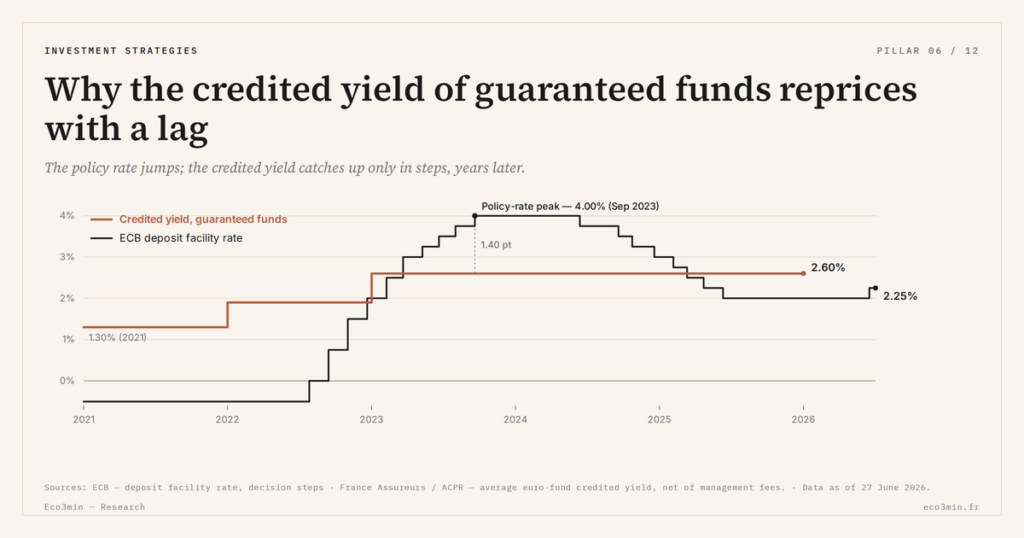
The credited yield of a guaranteed fund reprices several years behind market rates, because the insurer’s bond portfolio renews only a little at a time. Its average converges towards current rates step by step, never in one move.
TL;DR
A guaranteed fund's yield reaches current market rates in steps, never in one move: each year only a fraction of the bond portfolio matures and is reinvested at prevailing rates.
- The catch-up depends on flows as well as the stock: the return of inflows into guaranteed funds in 2025, after several years of outflows, gives insurers fresh cash to reinvest at current rates, feeding the average of later years.
- A posted credited rate is a backward-looking indicator: it summarises an inherited portfolio assembled well before and carries the mark of past rates, not present ones (about 1.3% in 2021, 1.9% in 2022, 2.6% from 2023 on industry data).
- Because each insurer holds a different vintage of bonds and renews at its own pace, two guaranteed funds can post markedly different yields in the same year, so a headline market average can mask wide differences beneath it.
- The lag works symmetrically: through the ECB's eight cuts from June 2024 to a 2% deposit rate by June 2025, and again when it raised the rate to 2.25% on 17 June 2026, the guaranteed fund felt no immediate effect, still digesting the previous cycle.
When rates jump, savers often notice that the yield on their guaranteed fund barely moves — then recovers, but only years later. That lag is not an anomaly: it follows from the speed at which the insurer’s bond portfolio turns over. Each year, only a fraction of the bonds mature and are replaced with securities at current rates. The portfolio’s average yield therefore converges towards new rates only gradually, as old low-coupon lines roll off. This is the exact opposite of a unit-linked holding, whose value takes in a rate move within the day. This article describes the temporal mechanics of that lag and what it implies for reading a credited rate when it is announced.
The renewal flow: convergence in steps
To understand the lag, one has to think in flows, not in snapshots. The yield a guaranteed fund credits is the average of the coupons its bond portfolio produces. But that portfolio is not frozen: each year, a portion of the securities matures, is repaid, and the proceeds are reinvested at prevailing conditions. In the same year, the insurer also places its new inflows. It is these flows — reinvested maturities and fresh contributions — that slowly shift the composition of the whole.
The arithmetic consequence is convergence in steps. As long as market rates are stable, the average barely moves. When they rise, each newly bought line pulls the average up, but with a weight proportional to its share of the portfolio — a modest fraction in the first year, accumulating thereafter. The average yield therefore reaches current rates neither in a single jump nor linearly, but through successive approaches that draw closer to the target without ever hitting it at once. The larger the initial gap between the old and the new rate regime, the longer full convergence takes.
One factor speeds up or slows that convergence: the size of new flows. When a guaranteed fund draws strong inflows, fresh money invested at current rates adds to the reinvested maturities, and the portfolio recomposes faster; the average then reaches market rates a little sooner. Conversely, a fund in net outflow, sometimes forced to sell securities to meet redemptions, sees its renewal dynamic hampered. The return of inflows into guaranteed funds in 2025, after several years of outflows, thus acts as a deferred support: it gives insurers cash to reinvest at current rates, which will feed the average of the following years. The speed of the catch-up depends as much on flows as on the stock alone.
This dynamic clearly sets the present article apart from the construction of the buffer. The stock of older bonds and the reserves explain why the yield is smoothed — why its path is flat. The renewal flow explains something else: why, when the rate regime changes, it takes years for the credited yield to carry the mark of it. One answers “why is it stable?”, the other “why is it slow to react?”. They are two facets of the same portfolio, but two mechanisms to keep distinct, lest they be conflated.
A recovery in yield deferred by several years
The recent sequence offers the clearest demonstration. Euro-area market rates rose sharply in 2022 and 2023, as the European Central Bank’s tightening took its deposit rate to 4% by autumn 2023. Through that phase, the average yield on guaranteed funds stayed well below: about 1.3% in 2021, 1.9% in 2022, before climbing to 2.6% in 2023 on industry data. It was only from 2023, and above all in 2024 and 2025 where that 2.6% level was carried over, that the imprint of the rate rise became fully visible in the credited yield. Related framing: Choosing between a 401(k) and an IRA.
In other words, between the moment the insurer could reinvest at higher rates and the moment the saver saw the effect on their contract, several financial years elapsed. That delay is not arbitrary: it is the time needed for maturities and inflows, reinvested at the new rates, to weigh enough in the portfolio to lift its average. The recovery in guaranteed-fund yields that many observed from 2024 was not a reflection of 2024 rates, but the deferred catch-up of the 2022-2023 rise.
The lag works symmetrically on the way down. When rates ease — as in the ECB’s eight cuts between June 2024 and June 2025, which brought the deposit rate back to 2% — the guaranteed fund does not drop straight away. Its portfolio remains stocked with well-paid bonds bought in the high phase, and it keeps crediting a yield above current rates until those securities mature. The same inertia that delays the rise delays the fall. And when the ECB raised its deposit rate again to 2.25% on 17 June 2026, the guaranteed fund once more felt no immediate effect: it was still digesting the previous cycle. At every inflection in the regime, the lag reconstitutes itself.
The exact opposite of a unit-linked holding
This behaviour makes full sense against that of a unit-linked holding. A market support — a bond fund or ETF held as a unit-linked support — has, from the saver’s standpoint, no portfolio to renew over time: it is marked continuously at market price. A rate move therefore passes through within the day, lifting the value when rates fall, cutting it when they rise. Where the guaranteed fund smooths and defers, the unit-linked holding records and returns at once. This contrast between deferral and immediacy is developed in the article on the immediate market read-through of unit-linked.
The result is an asymmetry of experience depending on the moment of observation. In the thick of a rate rise, a saver looking at their contract sees a unit-linked bond support down and a guaranteed fund steady: the guaranteed pocket looks protective. Two years later, in the easing phase, they see the opposite: the unit-linked holding has rebounded while the guaranteed fund, slow, has not yet captured everything. The same rate move produces two opposite narratives depending on the instant chosen to read it. This dependence on the moment of observation sits within the wider logic of reading the contract by rate regime, and more generally of reasoning about investments against the rate cycle.
Concluding that a guaranteed fund is “unresponsive” or “badly managed” because its yield did not follow the year’s rate rise is a faulty reading. The credited yield does not reflect the year’s current rates, but the average of a portfolio built over several years; it therefore carries the mark of past rates, not present ones. A yield that seems to lag current rates is the normal behaviour of a guaranteed fund, not a malfunction.
Reading a posted yield for what it actually says
The main practical implication is that a posted credited rate is a backward-looking indicator. When an insurer communicates its yield at the start of the year, that figure summarises the average performance of an inherited portfolio, much of which was assembled well before. It therefore reports only imperfectly on current rates, and still less on those to come. Reading that yield as a market signal would be a category error: it is more the photograph of an inheritance than the thermometer of the moment.
This backward-looking nature has a useful corollary. In a regime of durably higher rates, like the one opened since 2022, the lag mechanism now works in favour of the credited yield: the portfolio keeps taking in, year after year, better-paid securities, which supports the average even if market rates stabilise or ease slightly. Conversely, after a long stretch of low rates, that same mechanism had long kept yields under pressure. The lag is neither good nor bad in itself; it simply prolongs, over time, the effect of the prior rate regime.
A second, subtler corollary concerns dispersion between contracts. Because each insurer holds a different vintage of bonds and renews at its own pace, two guaranteed funds can post markedly different yields in the same year, even with similar underlying securities. A fund that grew quickly with fresh inflows reloads faster and reaches current rates sooner; an older, larger fund weighed down by low-coupon legacy lines lags more. The lag is therefore not uniform across the market: it depends on the history and the flows of each individual portfolio, which is one reason a headline market average can mask wide differences beneath it.
One dimension remains outside this mechanism: the level at which the yield caps, and the cost of the caution imposed by the capital guarantee. The lag explains the tempo of the reaction, not the height to which the yield can climb. That question — the price of caution: a capped yield — belongs to a different logic, that of the guarantee and its cost. The present article confines itself to establishing that a guaranteed fund’s yield always tells the story of yesterday’s rates, never that of today’s.
Last updated — 12 July 2026
Disclaimer – Financial Information: The analyses, commentary, and content published on eco3min.fr are provided for informational and educational purposes only. They do not constitute investment advice or a solicitation to buy or sell financial instruments. Past performance is not indicative of future results. All investment decisions involve risk and are the sole responsibility of the reader.
Read next
Full pillar →Beneficiary Designations, the Step-Up in Basis, and the 10-Year Rule: How US Accounts Transfer at Death
At death, most US financial accounts pass outside the will, straight to a named beneficiary, under tax rules…
The Fee Stack in Variable Annuities: M&E Charges, Riders, and Subaccount Costs
A variable annuity does not carry one fee, but a stack of them. Mortality and expense charges, subaccount…
The Conventional 401(k)-Match-First Funding Order: Where It Comes From, How It Works
The question of what order to fund accounts in usually draws a fixed list, presented as a rule…