401(k) vs IRA: The Employer Wrapper and the Individual One

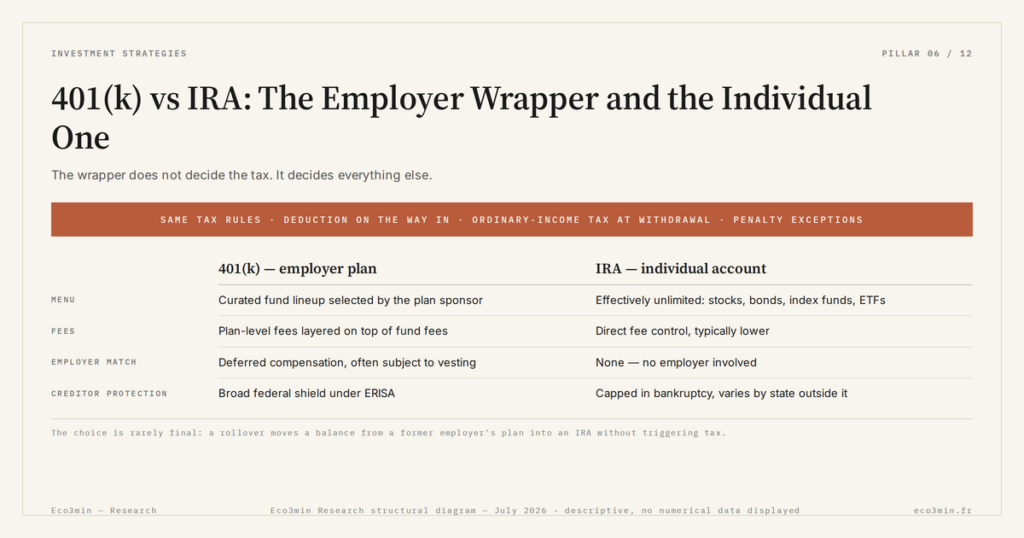
A 401(k) and an IRA follow the same tax rules, and a rollover moves a balance between them without triggering tax. What separates them is not the tax code but the wrapper: menu, fees, the match, and creditor protection.
The tax rules for the two accounts rhyme; the wrappers do not. The choice does not change the tax treatment, it changes what the balance can hold, what it costs and how it is protected.
The 401(k) and the IRA share the tax rules but differ as wrappers: menu, fees, the employer match and creditor protection.
- A 401(k) offers a curated fund menu, an employer match, and strong ERISA creditor protection, but often carries plan-level fees and a limited lineup.
- An IRA opens an effectively unlimited investment universe with tighter fee control, but no match and weaker federal creditor protection.
- The rollover bridges the two, moving a balance from a former plan into an IRA without triggering tax; the tax rules are largely the same on both sides.
The tax rules for a 401(k) and an IRA rhyme, and the rollover proves it: a balance can move from a former employer’s plan into an IRA without triggering tax, precisely because both are pre-tax vehicles governed by the same treatment. Starting from that fact separates two planes that marketing often blurs, the tax code, which is largely common, and the wrapper, which is not. The wrapper sits inside how the pre-tax account is structured without changing its tax, but it changes cost, menu, protection and the match. This article contrasts the two sheltered accounts with each other, and leaves the comparison with a taxable account to a dedicated companion.
The workplace 401(k) is defined by its institutional setting. The employer selects a fund lineup, so the investment universe is a curated menu rather than an open market: the participant chooses among the options the plan offers, which may be broad or narrow depending on the sponsor. The account’s signature feature is the employer match, a contribution the employer adds alongside the worker’s, up to a plan limit. The match is not a market return; it is deferred compensation, which is why leaving it unclaimed forfeits pay. A 401(k) also carries strong federal creditor protection under ERISA, shielding the balance in most bankruptcy and judgment situations.
These strengths come with constraints. Plan-level fees, layered on top of fund fees, can be higher than a self-directed account would incur, and the limited lineup may exclude the low-cost index funds a participant would otherwise choose. The 401(k) therefore trades openness for structure: an employer-curated menu, a valuable match, and robust protection, against higher costs and less choice. It is not better in the abstract; it suits a saver who values the match and the protection and accepts the plan’s menu and fees as the price.
The match itself has mechanics worth spelling out, because it is the wrapper’s most valuable and most misread feature. An employer typically matches contributions up to a percentage of salary, and that match is deferred compensation the worker earns by contributing, not an investment return. Many plans attach a vesting schedule: the matched amount becomes fully the employee’s only after a period of service, so leaving early can forfeit part of it. The match is therefore both an incentive to contribute and a tie to the employer. Read correctly, it is the one component of the 401(k) that has no equivalent in an IRA, and the reason the workplace plan is usually funded first up to the match before any other account is considered. Directly related: how each investment behaves by regime.
The IRA: an open universe and fee control
The individual retirement account inverts most of those terms. Opened at a brokerage rather than through an employer, it offers an effectively unlimited investment universe: individual stocks, bonds, and the full range of low-cost index funds and ETFs. That openness gives the saver direct control over fees, which matters over a multi-decade horizon. What the IRA lacks is the employer match, since there is no employer involved, and its federal creditor protection is weaker than a 401(k)’s, with bankruptcy protection capped and non-bankruptcy protection varying by state.
The trade-off is the mirror image of the 401(k)’s. The IRA rewards a self-directed saver who wants an open menu and tight fee control, and who has no match to forgo. It offers less protection and no employer contribution, but more freedom and, typically, lower cost. As with the workplace plan, there is no absolute winner: the IRA suits autonomy and cost discipline, the 401(k) suits the match and the shield, and the same tax rules sit underneath both.
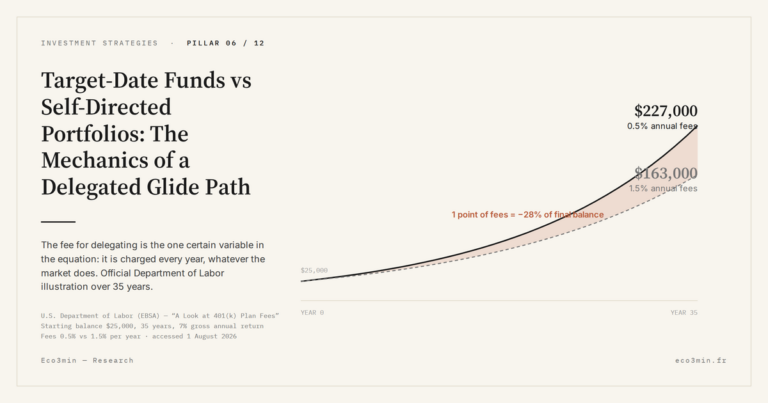
The fee difference deserves to be taken seriously, precisely because a retirement account runs for decades. Over a multi-decade horizon, a modest-looking annual fee difference compounds and ends up weighing on the final balance out of proportion to its nominal size. A low-cost IRA and a higher-fee 401(k), invested in comparable assets, do not reach the same amount at the deadline for the same gross performance. That compounding cost is the strongest argument for consolidating into an IRA once the match is captured, just as the match and the creditor shield are the strongest arguments for using the 401(k) while employed. The wrapper choice, read over the full horizon, is largely a choice about where fees and protection net out. For the broader picture: the moving parts behind a retirement figure.
Believing that choosing a 401(k) over an IRA changes the tax treatment. It does not: the deduction, the ordinary-income tax at withdrawal, and the penalty exceptions are largely the same. What the wrapper changes is the menu, the fees, the match and creditor protection, not the tax.
What the wrapper decides, what it does not
The essential distinction fits in one line: the wrapper does not decide the tax, it decides everything else. The tax treatment of a pre-tax account, the deduction on the way in, the ordinary-income tax at withdrawal, the early-withdrawal penalty and its exceptions, is largely common to the 401(k) and the IRA and does not depend on which one holds the balance. What the wrapper decides is a different set: the investment menu, the level of fees, the presence of an employer match, and the strength of creditor protection. Confusing these two planes leads to overstating the tax stakes of the wrapper choice, which are near zero, and understating its real stakes, which fall on net return and protection. Companion analysis: our framework for picking a brokerage.
That separation has a practical edge. Because the tax is the same, the wrapper choice turns on non-tax criteria: the value of an available match, sensitivity to fees over decades, the need for creditor protection, and the breadth of the menu. These weigh differently by situation and horizon, and it is at this level that the wrapper enters the wrapper inside the patrimonial trade-off, where it interacts with the broader choice among accounts. The wrapper is therefore not an administrative detail: it is a parameter of net return and protection, once the tax question is set aside.
Creditor protection is the criterion most often overlooked, because it only matters in adverse circumstances. A 401(k) held under ERISA enjoys broad federal protection from creditors and, in most cases, from bankruptcy, so the balance is shielded even when other assets are exposed. An IRA’s protection is narrower: federal bankruptcy law caps the sheltered amount, and protection outside bankruptcy depends on state law, which varies. For a saver with meaningful liability exposure, that difference can outweigh the fee advantage of an IRA, and it is invisible in any return calculation. It is a clear example of the wrapper deciding something real, the safety of the balance, that has nothing to do with the tax the two accounts share. Related coverage: our decoding of the 401(k) fund question.
The rollover, and where the taxable comparison begins
The rollover is what makes the two wrappers a spectrum rather than a fork. When a worker leaves an employer, the 401(k) balance can be rolled into an IRA without tax, converting a curated, protected, employer-linked account into an open, self-directed one. That mobility means the initial choice is rarely final: a saver can capture the match inside a 401(k) during employment and consolidate into an IRA afterward for the open menu and fee control. The rollover is the practical bridge that links the employer wrapper and the individual one, and it explains why the two are best read together rather than as rivals.
One boundary is worth marking. This article compares two sheltered accounts with each other; the different question of whether to hold savings in a sheltered account or a taxable one is handled separately, in sheltered versus taxable. The same wrapper logic recurs across other account pairs, as in PEA versus a taxable brokerage account, where the container again shapes cost and access without changing the underlying holdings. Recognizing that transversal logic keeps the wrapper choice in proportion, read by horizon as the frame on selecting a wrapper by horizon sets out.
The 401(k) and the IRA, then, share everything on the tax plane and diverge on nearly everything else. The workplace plan offers a match, curation and strong protection at the price of fees and a limited menu; the individual account offers an open universe and fee control without a match and with weaker protection. The choice does not change the tax, ever: it determines what the balance holds, what it costs, and how it is shielded, with the rollover standing ready to move the balance from one to the other. Separating the common tax rule from the variable wrapper is the key to reading the choice correctly.
Last updated — 26 July 2026
Disclaimer – Financial Information: The analyses, commentary, and content published on eco3min.fr are provided for informational and educational purposes only. They do not constitute investment advice or a solicitation to buy or sell financial instruments. Past performance is not indicative of future results. All investment decisions involve risk and are the sole responsibility of the reader.
Read next
Full pillar →Beneficiary Designations, the Step-Up in Basis, and the 10-Year Rule: How US Accounts Transfer at Death
At death, most US financial accounts pass outside the will, straight to a named beneficiary, under tax rules…
The Fee Stack in Variable Annuities: M&E Charges, Riders, and Subaccount Costs
A variable annuity does not carry one fee, but a stack of them. Mortality and expense charges, subaccount…
The Conventional 401(k)-Match-First Funding Order: Where It Comes From, How It Works
The question of what order to fund accounts in usually draws a fixed list, presented as a rule…