Unit-linked savings: market exposure inside the contract

Choosing a unit-linked holding exposes a pocket of the contract to the market with no buffer: no reserve, no smoothing, no guarantee. What drives its return and risk is not the insurance wrapper but the support it houses.
TL;DR
Held as a unit-linked support, a fund passes the market through unfiltered: a single year says little, since a short-window loss can become a long-window gain.
- A unit-linked holding carries no capital guarantee: its value is its support's market value, recalculated continuously, with no reserve or smoothing.
- Each family reacts to the rate regime on its own logic: bond supports move inversely to rates, equity supports more indirectly through the earnings cycle, non-listed property with an appraisal lag.
- Average net performance came in around 4.7% in 2025 on industry data, against 2.6% for guaranteed funds, after marked declines in 2022, so the figure changes sign with the regime.
- Time reframes the same exposure: over a short window a sharp loss can appear that a guaranteed fund never shows, while over a long one the support may recover and surpass it.
Choosing a unit-linked holding means accepting that this pocket of the contract moves with the market. Behind the label sit very different vehicles — equity funds, index ETFs, bond funds, listed property — held inside the insurance wrapper but stripped of any capital guarantee. The implication is direct: what drives a unit-linked holding’s return and risk is not the wrapper but its contents. A bond ETF held this way passes a rate rise through at once; an equity fund follows the cycle of earnings and multiples. The wrapper adds only a tax and inheritance layer. This article describes how the main families of unit-linked holdings behave across the rate regime, and why market exposure here is immediate where the guaranteed fund defers it. A parallel read: paying tax now or later with Roth.
The wrapper is neutral, the contents decide
The first misunderstanding to clear concerns the role of the wrapper. Many imagine that placing a support inside a life-insurance contract changes its behaviour — that a fund would somehow be more protected there. That is not the case for a unit-linked holding. The insurance wrapper brings a particular tax treatment, advantageous inheritance rules and a management framework; it does nothing to the market value of the support it contains. The same equity ETF, held as a unit-linked support or in a brokerage account, will follow exactly the same market path. The wrapper records the value, it does not smooth it.
From this follows a simple rule: for a unit-linked holding, risk and return are read at the level of the support, never at the level of the contract. That sets this pocket radically apart from the guaranteed fund, whose behaviour is shaped by the insurer through the bond stock and the reserves. The guaranteed fund has an institutional buffer; the unit-linked holding has none. It is precisely the coexistence of these two opposite logics within a single contract that structures the contract’s two pockets.
The absence of a capital guarantee is the direct corollary of this transparency to the market. Where the guaranteed fund secures the nominal through cautious management that caps its yield, the unit-linked holding fully exposes the capital: it can climb and it can fall, sometimes sharply. That exposure is not a flaw, it is the counterpart of an unbridled return potential. But it requires looking the contents in the face, because they — and they alone — determine the size of the moves the saver will feel.
This neutrality of the wrapper also explains the breadth of the unit-linked menu. A single contract can offer hundreds of supports, from the most cautious to the most speculative, and the saver builds the pocket on their own, in self-directed management, or delegates it to a managed mandate. But whatever the management mode, the underlying property does not change: the value of the pocket remains the sum of the market values of the chosen supports. Widening or narrowing the palette changes the risk profile, not the nature of the link to the market, which stays direct and continuous.
The main families of unit-linked support across the rate regime
If the contents decide, then there are as many possible behaviours as there are families of support. Three broad categories dominate, and each reacts to the rate regime on its own logic. The point here is not to survey them exhaustively — each belongs to dedicated content within the same universe — but to draw out the principle of reaction.
Bond supports first. A bond fund or ETF held as a unit-linked support sees its value move inversely to rates: when rates rise, the price of the bonds it holds falls, and the support’s value drops at once; when rates ease, the reverse. The sensitivity depends on the average maturity of the securities — long-dated supports react more violently than short ones. The detail of that sensitivity belongs to another subject, that of short versus long bond ETFs and their duration, treated elsewhere in the same field of analysis.
Equity supports next. Their link to the rate regime is more indirect but real: high rates weigh on valuations by raising the discount applied to future earnings and increasing the cost of capital, while lower rates tend to support multiples. But the path of an equity support also depends, often more, on the corporate earnings cycle, which can diverge from the rate cycle. An equity support is therefore not a simple function of rates: it combines several engines, of which the rate regime is only one. Read alongside: our reading of vehicles phase by phase.
Property supports last, whether listed real-estate companies or non-listed vehicles. The former take in rate-driven repricing quickly, like a market asset; the latter, valued by appraisal, pass it through with a lag specific to their methods. Real estate, even more than equities, went through a marked adjustment in the higher-rate regime opened since 2022. Here too, the precise behaviour of this family belongs to the content devoted to it; what matters here is that each of these families, once held as a unit-linked support, transmits its own behaviour unfiltered to the pocket concerned.
Immediacy, the opposite of the buffer
The trait common to all these families, and what sets them against the guaranteed fund, is immediacy. Where a guaranteed fund’s credited yield reprices with a lag, as the insurer’s portfolio renews, the value of a unit-linked holding takes in the market move within the day. This difference in tempo is not a nuance: it completely inverts the saver’s experience depending on the phase of the cycle.
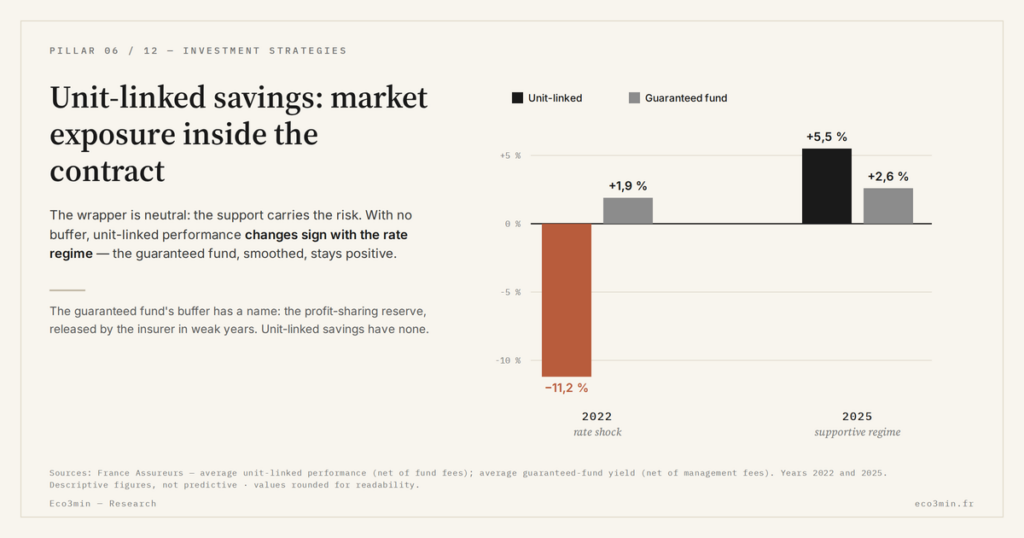
Recent figures illustrate it. In 2025, the average net performance of unit-linked holdings came in at about 4.7% on industry data, against 2.6% for guaranteed funds. Read in isolation, the comparison seems to argue for unit-linked. But it is misleading, because it photographs a single favourable year. In 2022, when rates jumped and both equity and bond markets fell, these same supports recorded marked declines, where the guaranteed fund still posted a positive yield. A unit-linked holding’s performance is not a stable attribute: it changes sign with the regime, because it returns the market with no damping. A companion piece: our study on life-insurance vehicles and rates.
That immediacy has a concrete translation in the saver’s experience: a unit-linked holding’s value is visible and variable at any time, where a guaranteed fund’s yield is only struck once a year. The exposed pocket therefore displays its volatility, while the guaranteed pocket shows only a smoothed annual figure. This difference in visibility often leads savers to overrate the risk of the unit-linked holding, because it is in plain sight, and to underrate that of the guaranteed fund, because it is hidden — when the two pockets simply carry risks of different nature, one of the market, the other real and of reinvestment.
Time changes how this exposure is experienced. Over a short window, a unit-linked holding can show a sharp loss that a guaranteed fund would never display; over a long one, the same support may recover and surpass it, having captured market growth the buffered pocket smooths away. The exposure is identical throughout; what shifts is the window through which it is read. This is why a single year, favourable or adverse, says little about a unit-linked support: its character is a function of the cycle it spans, not of any one snapshot within it.
This is why a unit-linked holding should not be read as “the pocket that pays more”, but as “the pocket that follows the market”. It amplifies the experience of the rate regime and the asset cycle, in both directions: it benefits fully from supportive phases and suffers fully in adverse ones. Placing this behaviour back in the overall logic means reasoning about contents across the cycle — that is, judging not the wrapper, but the support and the moment.
- A unit-linked holding offers no capital guarantee: its value is the market value of its support, recalculated continuously, with no reserve or smoothing.
- A unit-linked holding’s risk and return are read at the level of the support, not the contract: the insurance wrapper adds only a tax and inheritance layer.
- Each family of support reacts to the rate regime on its own logic: inverse to rates for bonds, more indirect for equities, with an appraisal lag for non-listed property.
- Unit-linked net performance (about 4.7% in 2025 on industry data) is not a stable attribute: it changes sign with the regime, as the 2022 decline showed.
The unit-linked holding thus closes the founding contrast of the contract: a pocket that follows the market directly against a pocket that damps it. One question this article does not address remains: why the same support held in a life-insurance contract, an equity savings plan or a brokerage account does not produce the same after-tax result. That interaction between a support and its wrapper — where the wrapper does not change the contents but alters their tax treatment — belongs to a separate analysis. What matters here is that, in a unit-linked holding, it is the contents that speak, and the rate regime that decides the tone.
Last updated — 12 July 2026
Disclaimer – Financial Information: The analyses, commentary, and content published on eco3min.fr are provided for informational and educational purposes only. They do not constitute investment advice or a solicitation to buy or sell financial instruments. Past performance is not indicative of future results. All investment decisions involve risk and are the sole responsibility of the reader.
Read next
Full pillar →Beneficiary Designations, the Step-Up in Basis, and the 10-Year Rule: How US Accounts Transfer at Death
At death, most US financial accounts pass outside the will, straight to a named beneficiary, under tax rules…
The Fee Stack in Variable Annuities: M&E Charges, Riders, and Subaccount Costs
A variable annuity does not carry one fee, but a stack of them. Mortality and expense charges, subaccount…
The Conventional 401(k)-Match-First Funding Order: Where It Comes From, How It Works
The question of what order to fund accounts in usually draws a fixed list, presented as a rule…