Inflation and Equities: Why Sector Dispersion Persists
Inflation does not affect all equities equally. Differentiated effects across sectors and margins explain a growing share of the dispersion observed within equity indices.

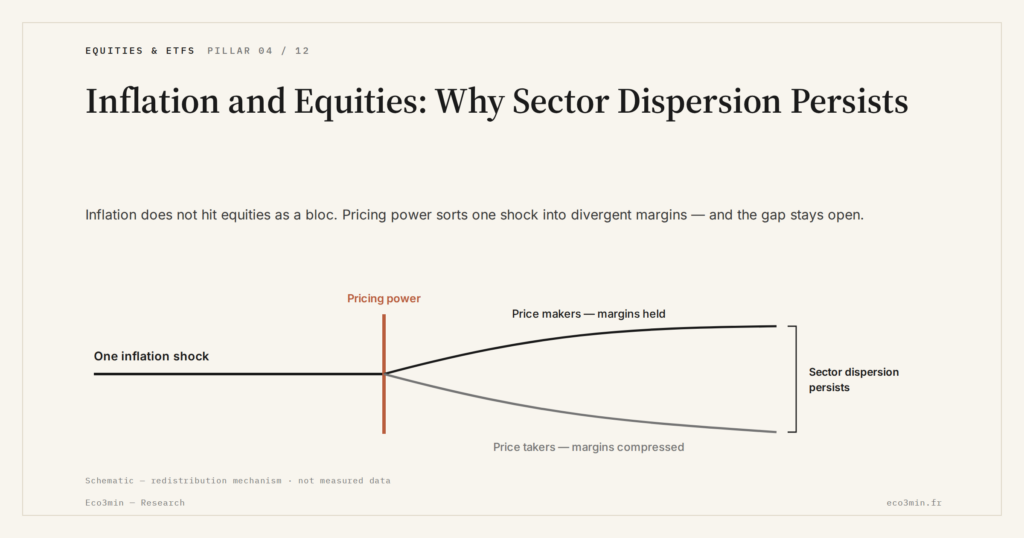
Inflation does not affect all equities equally. Analysis of differentiated effects across sectors and margins.
TL;DR
Inflation acts as a pricing-power test: between 2022 and 2024 differentiated sectors held operating margins near 25–30% while price-takers exposed to standardized inputs lost several points. For context: the Eco3min framework on how index stability can mask growing risk.
- Companies able to raise prices without destroying demand absorb cost increases, while those in highly competitive sectors face rapid margin compression.
- Inflation composition matters more than its level: demand-driven inflation lets some firms outpace unit costs, whereas energy, wage or commodity inflation hits firms that cannot pass it through.
Since the post-pandemic normalization, inflation has returned as a structuring variable for equity markets. It is often framed as a homogeneous, inherently negative shock. In practice, however, its effects are deeply differentiated. Some companies manage to preserve their margins; others see them contract rapidly. This divergence explains a growing share of the sector dispersion observed within indices. This pattern is contextualised in the Eco3min framework on the gap between equity markets and the real economy.
Pricing Power: The Decisive Factor
Inflation first acts as a test of market power. Companies able to adjust prices without destroying demand absorb cost increases more easily. By contrast, those operating in highly competitive sectors experience rapid margin compression.
Between 2022 and 2024, against a US inflation backdrop oscillating between ≈3% and ≈5%, operating margins in highly differentiated sectors (software, business services, healthcare) remained close to their historical levels, around ≈25–30%. Over the same period, sectors exposed to standardized inputs and price competition saw their margins decline by several percentage points.
This microeconomic mechanism explains why inflation does not penalize “the market” but redistributes performance across companies. This sector reading fits into the broader framework of the divergence between markets and the real economy analyzed in the cluster’s pillar article.
This redistribution operates primarily through margins and pricing power, which determine companies’ ability to convert an inflationary environment into a sustainable earnings trajectory.
Cost Inflation Versus Revenue Inflation
Part of the consensus equates inflation with eroding profitability. This view assumes costs rise faster than revenues. The relationship, however, is neither automatic nor uniform.
When inflation is driven by demand or by sector-specific supply constraints, some companies can raise prices faster than unit costs. Conversely, inflation concentrated in energy, wages or commodities weighs directly on the margins of sectors unable to pass these increases through.
The imbalance lies less in the overall level of inflation than in its composition. This nuance is often missing from broad macro readings.
Rates, Inflation and Implicit Sector Arbitrage
Inflation never acts alone. It interacts with interest rates and the cost of capital. Persistent inflation tends to keep nominal rates elevated, which penalizes companies with distant cash flows and high capital intensity. Worth reading alongside: what each inflation type rewards.
In 2025, with US real rates stabilized around ≈1.5–2%, companies whose value rests on near-term, recurring cash flows held up better than those dependent on long-term growth promises. Inflation then acts as a temporal filter: it favors business models robust over the short term.
To place this arbitrage within a broader reading, it is useful to understand the structure of equity markets and how indices amplify these sector gaps.
A Discreet but Central Timing Signal
This topic has gained renewed importance since late 2025. Inflation is neither collapsing nor accelerating further. This intermediate regime amplifies performance gaps, since it triggers neither a brutal shock nor a rapid normalization of costs.
In this context, markets arbitrate less on the broad macro trajectory than on companies’ microeconomic ability to absorb a durably higher price environment.
What Consensus Underestimates
Dominant projections often assume that gradual disinflation will suffice to narrow sector gaps. This assumption rests on rapid transmission to costs and wages.
An alternative reading highlights a different risk: moderate but persistent inflation, combined with wage pressures, could extend the divergence between “price makers” and “price takers.” In that scenario, performance dispersion would remain elevated, even absent any further macro shock.
What Could Invalidate This Reading
Several factors could narrow these gaps. A rapid decline in inflation, a negative demand shock or stricter price regulation would alter some companies’ ability to preserve margins. Markets also watch the trajectory of wage costs, which condition the durability of pricing power.
Observable Economic Implications
For companies, inflation acts as a business-model revealer. For markets, it amplifies dispersion within sectors and within indices. The structural reading is developed in this analysis of trade wars equity sectors. For households, it fuels the sense of disconnect between aggregate equity performance and daily economic experience.
Inflation neither favors nor penalizes “equities” as a bloc. It redistributes.
- Inflation acts as a test of pricing power, revealing margin gaps across companies.
- Inflation composition matters more than its overall level for sector performance.
- A regime of moderate but persistent inflation sustains performance dispersion within indices.
Last updated — 12 July 2026
Disclaimer – Financial Information: The analyses, commentary, and content published on eco3min.fr are provided for informational and educational purposes only. They do not constitute investment advice or a solicitation to buy or sell financial instruments. Past performance is not indicative of future results. All investment decisions involve risk and are the sole responsibility of the reader.
Read next
Full pillar →Reading Earnings Surprises: Cash Flow, Margins, Guidance
How to analyze an earnings surprise beyond the simple beat or miss: cash flow, margins, guidance, and weak…
Equal-Weight ETFs: The Quiet Signal Behind Rising Indices
Equal-weight ETFs reveal the true health of the equity market behind mega-cap-driven indices. Their gap with cap-weighted ETFs…
Smart Beta ETFs: The Hidden Risk Behind Factor Performance
Smart beta ETFs now hold ~15-20% of global equity ETF assets. Stacking factor exposures often rebuilds hidden concentration…