Why Inflation Resists Monetary Tightening
Inflation can persist despite monetary tightening because of wage inertia, indexation mechanisms and transmission lags that propagate through the price chain over years rather than months.

Inflation can persist despite tightening because of nominal inertia and lagged transmission.
TL;DR
Inflation lags monetary tightening by design: nominal inertia, wage indexation and margin recomposition stretch disinflation across years rather than months.
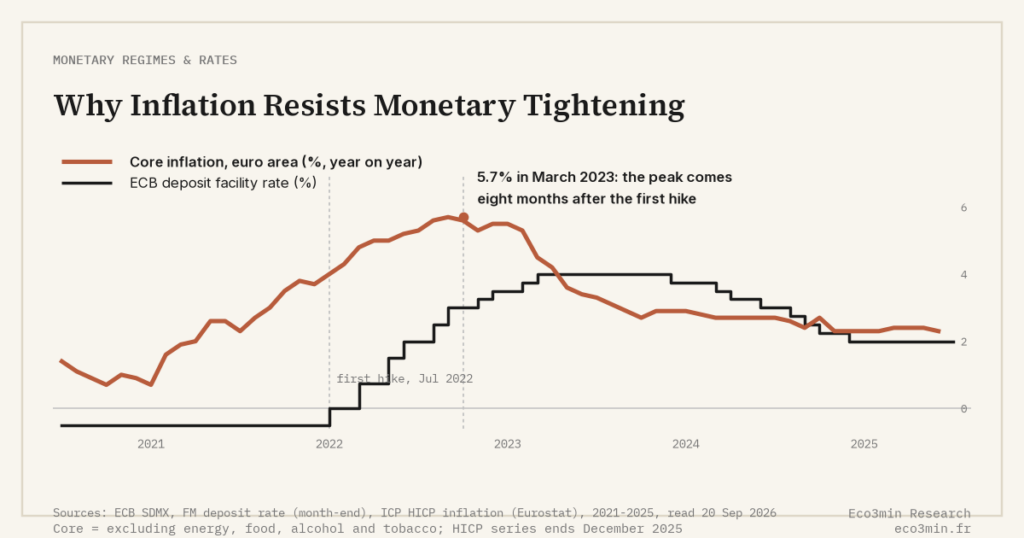
- The ECB took rates from -0.5% to 4.0% over fourteen months from July 2022, yet euro-area core inflation only peaked at 5.7% in March 2023, eight months into the cycle (Eurostat).
- Three mechanisms keep prices elevated: multi-year wage bargaining, automatic wage-and-benefit indexation in countries such as Belgium and Luxembourg, and a margin-then-wage sequence Eurostat data trace across 2022-2025.
- By early 2026 headline euro-area inflation sat around 2.3-2.5%, still above the 2% target, as rigid components like services, rents and sheltered-sector wages resisted tightening longer than energy and food (Eurostat).
Monetary tightening does not always trigger an immediate retreat in inflation. This resistance is often read as a central bank failure. Yet it stems from nominal inertia, transmission lags and indexation mechanisms. Monetary effects accumulate gradually along the price chain.
Why prices do not fall when rates rise
The notion that a rate hike should bring prices down rests on incomplete reasoning. Monetary policy does not act directly on prices — it acts on demand, which in turn shapes prices with a lag. The transmission channel runs through credit, investment and consumption before reaching price formation. Each step absorbs time. Our breakdown of the timing gap between rates and earnings reads the same dynamic in context.
The euro area went through this sequence in striking fashion. The ECB began raising rates in July 2022, moving from -0.5% to 4.0% in fourteen months. Yet core inflation (excluding energy and food) only peaked in March 2023 — eight months after tightening began — at 5.7% according to Eurostat. This lag did not signal a policy failure but the time needed for tightening to travel along the transmission chain. This dissociation between curve signals and market trajectories is examined in our study on the possibility of rising markets despite an inverted curve.
What keeps inflation aloft
Several mechanisms contribute to inflation persistence despite tightening. The first is wage inertia. The price and wage chains that delay nominal adjustment operate on annual or multi-year bargaining cycles. Wage increases negotiated in 2023 and 2024 to offset past inflation continue to feed through into production costs in 2025 and 2026.
The second mechanism is automatic indexation. In several European countries (Belgium, Luxembourg, certain sectors in France and Italy), wages or social benefits are mechanically adjusted to past inflation. This mechanism turns a one-off shock into a persistent dynamic: yesterday’s inflation feeds today’s costs, which in turn fuel tomorrow’s prices.
The third factor is margin recomposition. According to Eurostat data (national accounts Q3 2025), euro area unit profits had contributed positively to inflation in 2022-2023 before normalising progressively in 2024-2025. This sequence — margin-driven inflation followed by wage-driven inflation — mechanically extends the duration of the inflationary episode. Real-side constraints, notably on energy and certain commodities, also continue to feed production costs independently of the monetary cycle. The breakdown Commodities, inflation and monetary policy shows how these constraints can prolong inflation even during a tightening phase.
The “last mile” toward the 2% target
In early 2026, headline euro area inflation hovered around 2.3-2.5% (Eurostat data), close to but still above the 2% target. This “last mile” is the hardest to cover. The most rigid components of inflation — services, rents, wages in sheltered sectors — resist tightening longer than the volatile components (energy, food) that had driven the initial inflation surge.
The stabilising or destabilising role of expectations becomes critical in this phase. If economic agents maintain the conviction that inflation will return to 2%, pricing and wage behaviour adjusts gradually in that direction. If doubt sets in, upward expectations can self-sustain inflation above target.
Concluding that monetary policy has failed because inflation remains above 2% after two years of tightening. Full transmission to prices is measured in years, not months. Early 2026 inflation still reflects pricing and wage decisions taken before the full effect of tightening reached the real economy.
Inflation persistence in the face of tightening is not a mystery — it is the expected consequence of monetary transmission operating through successive and lagged stages. The irreducible time of monetary propagation implies that disinflationary effects accumulate progressively. The patience displayed by central banks in this phase does not signal inaction but recognition of this structural temporality.
Last updated — 20 September 2026
Disclaimer – Financial Information: The analyses, commentary, and content published on eco3min.fr are provided for informational and educational purposes only. They do not constitute investment advice or a solicitation to buy or sell financial instruments. Past performance is not indicative of future results. All investment decisions involve risk and are the sole responsibility of the reader.
Read next
Full pillar →Real Rates: The True Cost of Capital Is Repricing
Why real rates are reasserting themselves as markets' anchor and how to recalibrate investment and financing decisions facing…
Real Interest Rates: The Quiet Signal Reshaping Markets
Real interest rates: why their persistence in positive territory in 2026 is reshaping the rules for bonds, equities,…
OAT-Bund Spread: A Quiet Gauge of French Sovereign Risk
OAT-Bund spread: how this yield gap has become a key signal on French sovereign risk, fiscal policy and…