Listed versus unlisted real estate: REITs, SIIC and the lag

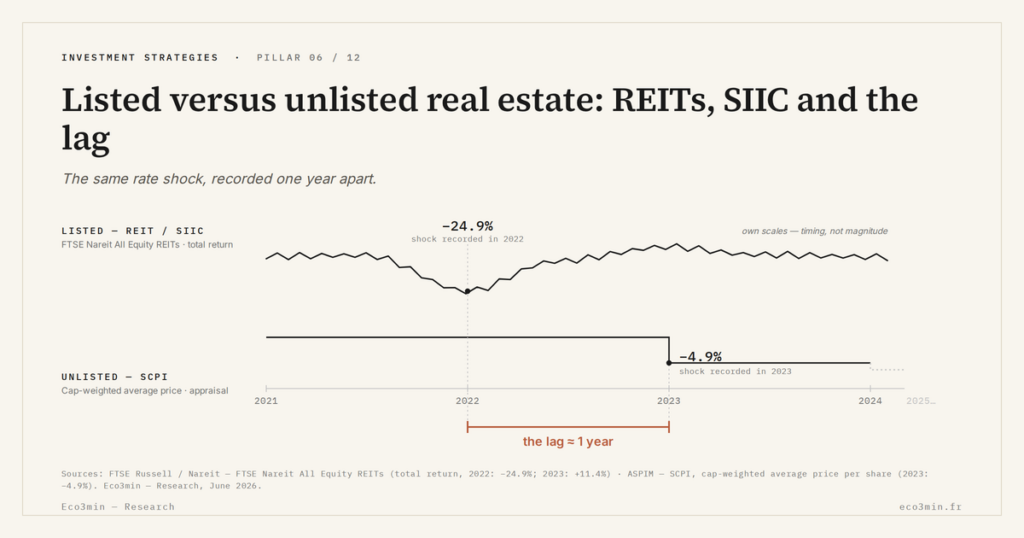
Listed and unlisted property vehicles own similar buildings but run on different clocks. A listed REIT prices the rate shock in days; an appraisal-based fund such as an SCPI smooths the same shock across quarters. Neither removes the shock — they only differ on when it is recorded.
TL;DR
Over a full rate cycle, a listed REIT and a comparable unlisted fund reach the same destination; what differs is the path: jagged and front-loaded, or a delayed staircase.
- Across a complete tightening-and-easing cycle, both vehicles record broadly the same cumulative move in their assets: the listed one in a front-loaded, jagged line, the unlisted one in a smoother, delayed staircase.
- In 2022 the FTSE Nareit All Equity REITs index fell 24.9%, its worst since 2008; the same shock reached a comparable unlisted fund only from 2023, the lag making its stable displayed value a deferral rather than immunity.
This article sets listed against unlisted on the ground of the rate cycle, as an observation of two timing regimes, without favoring either structure or implying an allocation choice.
Listed and unlisted property vehicles own similar buildings but run on different clocks. A listed REIT — like a French SIIC — prices the rate shock in days: the quote can fall before a single appraisal moves. An unlisted, appraisal-based fund such as an SCPI smooths the same shock across quarters, so its reported value lags. Neither the REIT’s visible volatility nor the SCPI’s smoothing removes the shock; they only distribute when it is recorded. This is where the two sides of the cluster meet, and where the lag becomes the whole story: in 2022 listed REITs had already repriced while comparable unlisted funds only adjusted through 2023 and 2024. The article sets listed against unlisted on the ground of paper property and rates, as an observation of two timing regimes, without favoring either structure.
Same buildings, two wrappers
The starting point is essential: an office REIT and an office SCPI can hold the same kind of assets, leased to the same kind of tenants, exposed to the same cap-rate cycle. The difference is not in the bricks but in the legal wrapper that holds them, and in the way that wrapper sets the price of the fraction the holder owns. That wrapper, and it alone, determines the calendar on which the shock is recorded.
The unlisted vehicle is valued by appraisal. Its share price derives from a reported value struck off periodic property appraisals, and it moves within a regulated band around that value. There is no continuous quote: the displayed value is smooth by construction, refreshed in steps at the pace of appraisal campaigns. The listed REIT is the opposite — a company whose shares trade continuously on the exchange, where the quote discounts expected rents at a rate tied to the bond market. The instant rates rise, the quote falls, without waiting for any appraiser to revise a number. A closer look: the direct-versus-vehicle view of property.
Everything else follows from that difference of wrapper. The same building, held in an unlisted fund, has its contribution to the share price recorded late, in steps; held in a listed REIT, it has its contribution to the quote repriced immediately, continuously. The gap in behavior between the two vehicles does not reflect a disagreement over the real value of the walls; it reflects a difference in the calendar on which that value is written down.
The wrapper changes more than the calendar. A listed REIT is a publicly traded company: one owns shares that trade continuously, with corporate governance, a market capitalization, and an exposure to market sentiment that goes beyond the value of the buildings alone. An unlisted fund is held as units over a generally longer horizon, with entry and exit running through subscription and redemption rather than an order book. These structural differences carry distinct tax regimes, holding terms, and horizons that fall outside this article’s focus on behavior through the rate cycle. But they are a reminder that choosing between listed and unlisted is never only choosing a recording clock: it is choosing an entire legal form, with its own constraints.
Two clocks on the same rate shock
The 2022-2023 tightening gave the cleanest demonstration of this divergence of pace. On the listed side, the adjustment was immediate: in 2022, the FTSE Nareit All Equity REITs index fell 24.9% on the year, its worst since 2008, the market having repriced the entire cap-rate shock in real time. By 2023 the same index was rebounding by more than 11%, the listed adjustment already digested.
On the unlisted side, the same shock was recorded only from 2023. A French SCPI’s mean share price fell 4.9% over 2023 — the year listed REITs had already rebounded — and went on adjusting through 2024 and 2025. The calendar gap is the central argument: 2022 for the listed market, 2023 through 2025 for the unlisted one, on a single shared rate shock. It is not that one suffered more than the other; it is that one recorded the shock a year before the other. The same variable, the cap rate pushed by the cycle, governs both vehicles; only the speed of recording differs. More on this: the rotation of vehicles over the cycle.
This lag produces a symmetric illusion depending on which vehicle one watches. The REIT holder, seeing the quote collapse in 2022, may believe the listed structure more fragile than the unlisted fund whose share stayed flat; they are mistaken — the unlisted markdown was merely deferred. Conversely, the unlisted holder may believe the structure protected in 2022; mistaken too, since the shock arrives, in steps, through 2023 and after. The stability of the unlisted side during the shock is not immunity; it is a deferral. A deferral has a price, and it is paid the moment a holder needs out early, on the market where locked-up fund stakes change hands.
What each structure does to the holder’s experience
Beyond the calendar, the two structures do not offer the same experience of ownership. The listed REIT exposes the holder to daily price volatility, sometimes violent, and to an exit price that can drift durably from net asset value, at a discount or a premium. In exchange, it offers permanent liquidity: the share trades any second the market is open. The unlisted fund hides the volatility — the displayed value moves little, and in steps — but its liquidity is conditional: in a down phase, when redemptions exceed inflows, queues form. That liquidity dimension, structurally different between the two vehicles, is developed in the satellite on the vehicle’s structure and liquidity risk, which this article extends here through the listed-versus-unlisted lens. Background: our comparison of non-traded property funds and direct rentals.
The trade-off is therefore an exchange between two discomforts. The REIT holder accepts seeing, every day, a price that can diverge from the value of the walls, in exchange for the certainty of being able to exit. The unlisted holder accepts not always being able to exit when they wish, in exchange for a stable displayed value. Neither structure removes the cycle risk; they present it in two forms, one loud and immediate, the other quiet and deferred. How each behaves specifically in a recession, beyond the rate cycle alone, is treated separately in a FAQ on behavior in a downturn.
Choosing a clock, not a level of risk
The consequence is that pitting listed against unlisted in terms of riskier or less risky is a false debate. The two vehicles carry the same cycle risk, because they hold the same kind of assets exposed to the same variable. What sets them apart is not the level of risk but the timing of its recording: the listed REIT writes the shock down in real time, the unlisted fund defers it. Reading one’s volatility as weakness and the other’s calm as strength is to confuse the date of the recording with the severity of the event. For context: how REITs reprice as rates move.
Over a full cycle, the two clocks tend to converge on the same destination, because they track the same underlying value; what differs is the path. A listed REIT and a comparable unlisted fund holding similar assets, observed across a complete tightening-and-easing cycle, should record broadly the same cumulative move in the value of their walls — the listed one in a jagged, front-loaded line, the unlisted one in a smoother, delayed staircase. The destination is shared; the experience of getting there is not. This is why the choice between them is best framed as a choice of path — of when, and how visibly, the holder is asked to absorb the cycle — rather than as a choice between more and less risk. Worth reading alongside: our decoding of the REIT question.
This underlying equivalence, beneath a difference of form, is the heart of the cluster. It forbids ranking one vehicle above the other on the sole basis of how they behaved during a rate shock. Placing this structural choice in a reading by the prevailing macro regime — where each clock plays differently depending on the phase of the cycle — belongs to the sub-pillar on situating an asset by the cycle. The comparison hardens further when credit leverage is added to either structure, which the satellite on leverage, listed or not examines.
- A listed REIT and an unlisted fund can hold the same walls; what sets them apart is the legal wrapper, which fixes the calendar on which the rate shock is recorded.
- The listed vehicle reprices the shock in real time (FTSE Nareit -24.9% in 2022); the unlisted one smooths it through appraisal (share price -4.9% in 2023): two clocks, one mechanism.
- The listed structure trades visible volatility for permanent liquidity; the unlisted structure trades a stable displayed value for conditional liquidity.
- Pitting listed against unlisted in terms of risk level is a false debate: both carry the same cycle risk, differing only in the timing of its recording.
Last updated — 23 July 2026
Disclaimer – Financial Information: The analyses, commentary, and content published on eco3min.fr are provided for informational and educational purposes only. They do not constitute investment advice or a solicitation to buy or sell financial instruments. Past performance is not indicative of future results. All investment decisions involve risk and are the sole responsibility of the reader.
Read next
Full pillar →Beneficiary Designations, the Step-Up in Basis, and the 10-Year Rule: How US Accounts Transfer at Death
At death, most US financial accounts pass outside the will, straight to a named beneficiary, under tax rules…
The Fee Stack in Variable Annuities: M&E Charges, Riders, and Subaccount Costs
A variable annuity does not carry one fee, but a stack of them. Mortality and expense charges, subaccount…
The Conventional 401(k)-Match-First Funding Order: Where It Comes From, How It Works
The question of what order to fund accounts in usually draws a fixed list, presented as a rule…