Private Real Estate Funds vs Direct Rental Property: Pooled Exposure or Landlord Economics

A private real estate fund and a directly owned rental hold similar buildings but run on opposite economics. One is a professionally managed, pooled share bought for a modest sum; the other is a controlled asset to finance, lease, and maintain yourself. The choice is decided line by line.
It does not turn on the headline yield, but on a series of concrete trade-offs: entry cost, fees, delegation, redemption terms. This article compares them, and names no winner.
Same underlying property, two opposite mechanics: a private real estate fund share is bought cheaply and managed for you; a direct rental gives control but imposes the landlord’s job.
- Non-traded funds historically carried upfront loads near 8 to 10 percent, comparable to the closing and agent costs of buying a rental directly.
- Their liquidity is windowed, not guaranteed: in 2022 and 2023, Blackstone’s roughly 70 billion dollar BREIT gated redemptions for about fifteen months, honoring only a fraction of exit requests.
- Leverage is open to both; guaranteed exit liquidity is open to neither.
Comparing a private real estate fund with a directly owned rental means comparing two ways to hold the same bricks. The fund share gives a fraction of a pooled, professionally managed portfolio; the direct rental gives control of a single asset, but imposes its job. Same bricks, two jobs: owning a share, or being the landlord. This comparison is distinct from the one that pits listed REITs against physical property: here the vehicle is non-traded, its net asset value administered by appraisal, and the axis is pooled economics versus landlord economics, not liquidity versus control. For the listed-versus-physical contrast, see the duel between exchange-traded REITs and directly held property. This article breaks the match down line by line, as an extension of reading paper property through the rate cycle.
Entry cost and fees: the gap you overestimate
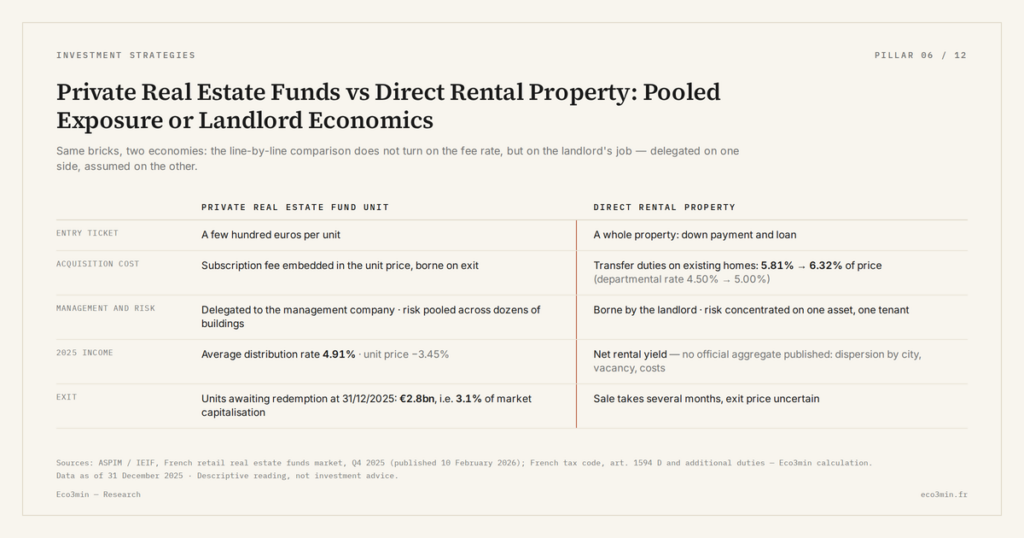
The first line separates the two clearly on amount, less so on the fee rate. A private real estate fund share can be bought for a modest sum, opening property to smaller savings; direct ownership requires a down payment, a mortgage application, and a whole building to finance. On the ticket size, the pooled vehicle wins accessibility by orders of magnitude.
On the fee rate, however, intuition misleads. Non-traded real estate funds have conventionally carried upfront loads in the high single digits to low double digits, historically near 8 to 10 percent of the amount invested, to cover acquisition and distribution. Buying a rental directly is not free either: closing costs run a few percent, and selling later typically costs a 5 to 6 percent agent commission. Stacked together, the frictions of direct ownership are of the same order as a fund’s load, not a fraction of it. The difference in nature matters as much as the difference in amount: a fund’s load is embedded in the share price and felt mostly on exit, since the redemption value equals the subscription price less the load, so it amortizes over the holding period. This is why both are long-horizon commitments, penalized heavily by an early exit. The wider context: our comparison “Choosing investments in the light of the macro cycle”.
Two nuances complete the fee picture. First, the ramp-up: a non-traded fund typically deploys new capital over time, so a fresh subscription earns a full distribution only once it is invested, while a directly owned rental produces rent from the first day of a lease. Second, the tax treatment of the costs themselves: a fund’s load is not an annually deductible expense; it is treated as part of the acquisition cost and recovered only on exit, by reducing the taxable gain. The direct owner, by contrast, can deduct a range of real expenses against rental income, from mortgage interest to repairs, that the fund holder does not control directly.
Delegated management versus the landlord’s job
The second line is the most structural, because it touches the nature of the commitment. In a fund, management is fully delegated: the manager selects the buildings, collects the rent, handles vacancy, arbitrates capital works, chases arrears. The holder receives income net of these frictions, with no time spent. In exchange, they decide nothing: not the asset, not the tenant, not the timing of a sale.
Direct ownership is the mirror image. The landlord controls every decision but absorbs every operational risk: the vacancy between tenants, the unbudgeted repair, the missed payment, regulatory compliance, the tenant relationship. These are costs and hazards that a fund share dilutes and outsources, and that the direct owner concentrates on a single asset. This is where most of the manager’s value, and its cost, sits: the management fee, levied on gross rents, pays for exactly the work the direct owner does themselves or hands to a property manager, for a comparable order of magnitude, often 8 to 10 percent of rent. In the United States that operational burden also carries a layer of local variation the fund holder never sees: landlord-tenant law, eviction timelines, rent regulation, and licensing differ sharply from state to state and city to city, so the same building can be far more demanding to operate in one jurisdiction than in another. A property manager absorbs much of this for a fee, but the ultimate legal and financial responsibility stays with the owner. The true point of differentiation is therefore not the price, but the time and operational risk that one delegates and the other carries. A complementary angle: how property reaches a portfolio.
Pooling, liquidity, yield: three trade-offs
Pooling is the third axis. A fund share gives access to dozens of buildings, often multi-sector and multi-region, leased to many tenants. The direct asset concentrates risk on one building, one tenant, one location. A vacancy in a single directly owned unit drops its yield to zero for the period; a vacancy in one building inside a fund that holds dozens is diluted across the whole. This dispersion of risk is structural, and it has no simple equivalent in direct ownership short of buying many properties.
Pooling is not the same as guaranteed diversification, however. A fund can itself be concentrated, by sector, by geography, or by a handful of large assets, so the dispersion it offers depends on how the portfolio is actually built. A single-sector office fund carries much of the same concentration risk as a directly owned office building, only spread across more tenants. The pooled structure removes the single-asset risk by construction; it does not remove the risk of a manager who has bet the portfolio on one theme. Reading the number of buildings without reading their composition overstates how much diversification a given fund truly provides.
Liquidity of exit, by contrast, favors neither. A non-traded fund offers only windowed redemptions, subject to caps: in 2022, Blackstone’s roughly 70 billion dollar BREIT triggered its redemption limits and prorated exits for about fifteen months, honoring only around 43 percent of requests in the worst month and meeting them in full for the first time only in early 2024. A directly owned building sells, but over months and at an uncertain price. Neither offers the instant liquidity of a listed vehicle, which is what sets both apart from an exchange-traded REIT, treated in the satellite on the divide between listed and unlisted property. Note that credit leverage is open to both: one can buy fund shares on margin or borrow against a rental, with the same amplification of the risk-return pair, developed in the mechanics of leverage applied to the vehicle.
Yield, finally, compares only with caution. A pooled fund distributes a smoothed, diversified income; a direct rental can post a higher net yield, but a far more dispersed one, driven by the city, the purchase price, vacancy, and the weight of local charges and taxes. Comparing the two on the advertised rate alone is a shortcut: the fund offers a mutualized, smoothed return, the direct asset a potentially higher but more volatile one, more exposed to the fate of a single building. A headline gross yield of 5 or 6 percent shrinks, once property taxes, non-recoverable charges, insurance, vacancy, and repairs are subtracted, to a net yield often a point or two lower and highly variable by market. The fund, distributing income already net of management fees and smoothed across dozens of buildings, offers a visibility the direct owner gains only after several years of operation. Taxation, which weighs heavily on both net yields, follows the rules for property income and REIT distributions, taken up in the satellite on how REIT distributions are taxed.
Private real estate funds are often dismissed on the grounds that their fees dwarf the cost of buying directly. That is inaccurate: their historical upfront loads, near the high single digits to low double digits, are of the same order as the combined closing and agent costs of a direct purchase. The real point of differentiation is not the fee rate, but the landlord’s job that one delegates and the other assumes.
At the end of the match, neither placement dominates the other on every line. The fund wins on accessibility, pooling, and delegation; the direct asset on control, the deductibility of real expenses, and the potential net yield of a well-chosen, well-run building. The choice therefore reduces to no single number, but to a trade-off between the time and risk one accepts to carry personally and those one prefers to delegate for a slice of the return. Same bricks, two jobs: it is the job, more than the bricks, that separates the two. That job carries both a price and a value: delegating frees time and dilutes risk but costs a slice of the return; carrying it can lift the net yield but exposes the holder to vacancy, repairs, and the illiquidity of a single asset.
Last updated — 26 July 2026
Disclaimer – Financial Information: The analyses, commentary, and content published on eco3min.fr are provided for informational and educational purposes only. They do not constitute investment advice or a solicitation to buy or sell financial instruments. Past performance is not indicative of future results. All investment decisions involve risk and are the sole responsibility of the reader.
Read next
Full pillar →Beneficiary Designations, the Step-Up in Basis, and the 10-Year Rule: How US Accounts Transfer at Death
At death, most US financial accounts pass outside the will, straight to a named beneficiary, under tax rules…
The Fee Stack in Variable Annuities: M&E Charges, Riders, and Subaccount Costs
A variable annuity does not carry one fee, but a stack of them. Mortality and expense charges, subaccount…
The Conventional 401(k)-Match-First Funding Order: Where It Comes From, How It Works
The question of what order to fund accounts in usually draws a fixed list, presented as a rule…