
REIT leverage and refinancing risk through the rate cycle

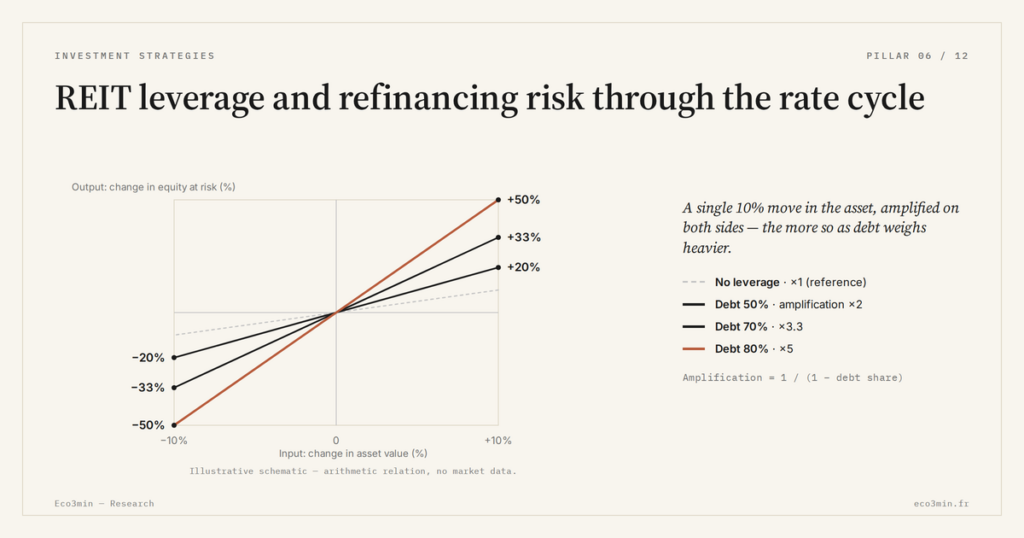
For listed REITs, the leverage that matters most sits inside the vehicle, as property debt that must be refinanced. When rates rise, two things compress returns at once: assets reprice down as cap rates climb, and maturing debt rolls over at higher coupons.
TL;DR
For a listed REIT, the leverage that drives cycle behavior is the property debt on its balance sheet, which must be refinanced at prevailing rates as each tranche matures.
- A rising-rate cycle compresses returns through two channels at once: cap rates lower asset values (the repricing channel), while maturing tranches refinance at higher coupons (the refinancing channel), eroding distributable income.
- A REIT that financed its portfolio when money cost around 2% can show comfortable interest coverage, then look stretched refinancing the same debt near 6%, with the buildings and rents unchanged.
- In the article's illustrative figures, a 10% fall in gross asset value cuts net asset value by 20% on a REIT financed half by debt, and by 33% if debt reaches 70 of a 100 portfolio.
- Reported leverage can climb in a downturn without a dollar of new borrowing: loan-to-value rises mechanically as appraised values fall, so a static gearing ratio read alone understates how leverage behaves through the cycle.
This article describes vehicle-level leverage and refinancing through the rate cycle as a mechanism to understand, with no threshold, no timing, and no recommendation to use or avoid it.
For listed REITs, the leverage that matters most sits inside the vehicle, not in the investor’s brokerage account. REITs carry property debt, and that debt has to be refinanced. When rates rise, two things compress returns at once: existing assets reprice down as cap rates climb, and maturing debt rolls over at higher coupons, lifting interest expense just as values fall. A REIT that looked conservatively geared at 2% borrowing costs can look stretched at 6%. This is the listed analog of an investor buying property on credit — the amplifier works the same way, magnifying gains in an easing cycle and drawdowns in a tightening one. The article describes vehicle-level leverage and refinancing through the rate cycle and the vehicle, as a mechanism to understand, with no threshold, no timing, and no recommendation to use or avoid it.
Where the leverage sits: inside the vehicle
An investor in a listed REIT can, of course, borrow to buy the shares, just as a French saver buys SCPI units on credit. But the leverage that defines a REIT’s behavior through the cycle is the debt the company itself carries on its balance sheet — the borrowing used to finance the buildings. A REIT funds part of its portfolio with equity and part with debt, and the ratio between the two, its gearing, determines how strongly a move in property values translates into a move in the value of the equity.
The arithmetic is the same as any leverage. Because debt is fixed in nominal terms, a rise in cap rates that lowers the gross value of the assets falls entirely on the equity slice, which sits below the debt in the capital structure. A 10% fall in gross asset value, on a REIT financed half by debt, is roughly a 20% fall in net asset value, because the debt does not absorb any of the decline. Leverage does not change the nature of the underlying property; it concentrates the cap-rate move on the equity, and therefore on the share price. The more debt in the structure, the larger the footprint of the cycle on the equity — in both directions. A related read: comparing REITs and physical real estate across regimes.
Gearing is measured in several complementary ways, none of which is a verdict on its own. The loan-to-value ratio compares debt to the appraised value of the assets, and it rises mechanically when those appraised values fall — so a REIT’s reported leverage can climb in a downturn without it borrowing a single additional dollar. Interest coverage compares distributable income to the interest bill, capturing the cash-flow side rather than the balance-sheet side. Net debt expressed in multiples of operating earnings frames the same borrowing against what the portfolio produces. Each metric lights a different facet, and each moves with the cycle: loan-to-value worsens as values fall, coverage worsens as refinancing lifts the interest bill. A single ratio, read in isolation, can therefore understate how a vehicle’s leverage behaves as rates move. In depth: the choice between pooled property funds and owning a rental.
Two compressions at once: repricing and refinancing
A rising-rate cycle hits a geared REIT through two channels that act together. The first is the repricing channel already described across the cluster: higher cap rates lower the value of the assets, and leverage magnifies that fall on the equity. The second is specific to debt: the refinancing channel. Property debt has maturities, and when a tranche comes due it must be refinanced at the rates of the day. If the cycle has lifted the cost of credit since the loan was put in place, the interest expense rises on the refinanced portion, compressing distributable income independently of any change in property values.
This second channel is what makes leverage a cash-flow risk and not only a balance-sheet risk. A REIT can see its asset values stabilize while its distributable result keeps eroding, simply because successive tranches of debt refinance at higher coupons. The maturity schedule of the debt therefore becomes a reading variable in its own right: a vehicle whose borrowings mature heavily near the peak of the rate cycle carries a risk that its gearing ratio alone does not reveal. The two channels can compound — values falling while interest expense rises — which is exactly the configuration many geared REITs faced in 2022 and 2023. Also relevant: the trade-offs across REIT vehicles.
From conservatively geared to stretched: the same vehicle at 2% and 6%
The clearest way to see the refinancing channel is to hold a vehicle’s assets constant and move only its borrowing cost. A REIT that financed its portfolio when money cost around 2% may have shown comfortable interest coverage — distributable income covering its interest bill several times over. The same portfolio, refinancing maturing debt at around 6%, sees that interest bill multiply, and the coverage shrink, even though the buildings and their rents have not changed. What looked conservative at one borrowing cost can look stretched at another, purely because of where in the rate cycle the refinancing falls.
A purely illustrative figure makes the equity amplification concrete. Take a portfolio worth 100, financed with 50 of debt and 50 of equity. If cap rates rise enough to lower the portfolio’s gross value by 10%, to 90, the debt of 50 is unchanged and the equity absorbs the entire fall, dropping from 50 to 40 — a 20% decline in net asset value for a 10% move in the assets. Raise the debt to 70, and the same 10% fall in gross value cuts the equity from 30 to 20, a 33% decline. The deeper the gearing, the larger the amplification, in both directions: the multiplier is 1 / (1 – debt share), ×2 with debt at half the portfolio, ×3.3 at 70 and ×5 at 80, where a 10% fall in gross value halves the equity. This example describes no real vehicle, names no safe or unsafe level of debt, and assumes no path for rates; it shows only that leverage scales the cycle’s effect on the equity in proportion to how much of the structure the debt represents.
This is descriptive of a mechanism, not a threshold for action. The point is not that any particular level of gearing is safe or unsafe — that depends on the assets, the lease structure, the maturity profile, and the path of rates, none of which this article assesses. The point is that a REIT’s leverage cannot be read as a fixed attribute: its weight changes with the rate cycle, growing heavier as borrowing costs rise and lighter as they fall. The same number means different things at different points of the cycle, which is why a static gearing ratio, read alone, is an incomplete signal — much as a static dividend yield is. Directly related: our frame for REITs through the cycle.
Leverage does not create the cycle risk, it multiplies it
The analytical conclusion is that leverage is an amplifier, not a standalone source of risk. The cycle risk exists for any paper-property holding, geared or not: it is the risk that the cap rate, pushed by the rate cycle, moves the value of the asset. Leverage does not change that underlying risk; it changes the exposure to it, in proportion to the debt in the structure. It magnifies gains in an easing cycle and drawdowns in a tightening one, with the same force in each direction — the asymmetry lies not in the mechanism, which is symmetric, but in the consequences, since an amplified loss can erode the equity far faster than an amplified gain builds it. This direction-dependence of the consequences, set against a symmetric mechanism, is the feature most often lost when leverage is presented through its upside alone, and it is what makes the rate cycle, not the gearing ratio, the variable that ultimately governs how heavily the debt weighs. For the broader picture: our decoding of investments by macro context.
Understanding this mechanism says nothing about what a holder should do: not whether to seek geared exposure, nor at what level, nor at what point of the cycle. Those questions turn on circumstances this article does not assess. It describes only how leverage interacts with the rate cycle, and why its asymmetric consequences deserve weighing. To compare this rate sensitivity with that of another asset, a bond exposure offers a useful reference, developed in the satellite on another asset’s rate exposure. Placing the mechanism in a reading by the prevailing rate regime belongs to the sub-pillar on choosing by the rate regime.
Leverage is often read as a way to raise returns, forgetting that it amplifies losses with the same force as gains. The mechanism is symmetric, but its consequences are not: an amplified loss can erode the equity far faster than an amplified gain builds it, and the refinancing channel can keep compressing distributable income even after asset values stabilize. Reading leverage as a one-way accelerator is the main misjudgment.
Last updated — 6 October 2026
Disclaimer – Financial and Legal Information: The analyses, commentary, and content published on eco3min.fr are provided for informational and educational purposes only. They do not constitute investment advice or a solicitation to buy or sell financial instruments. Past performance is not indicative of future results. All investment decisions involve risk and are the sole responsibility of the reader. Data, charts and calculated series are provided as is and may contain errors or lag behind their source: check any figure against the primary source cited before relying on it. Content describing laws, regulations or contracts reflects the law as of its publication date and does not constitute legal or tax advice; applying it to a specific situation requires a qualified legal or tax professional.
Read next
Full pillar →REITs and the rate cycle: how listed property reprices
One rate shock, two clocks: the listed market records it continuously (market value of US equity REIT shares,…
Target-Date Funds vs Self-Directed Portfolios: The Mechanics of a Delegated Glide Path
A target-date fund is sold as a simple, set-and-forget win. It is first something narrower: a delegated glide…
What Guaranteed Savings Products Have Paid: Fixed Annuity and Stable Value Yields Through the Rate Cycle
US guaranteed savings products credit a rate that trails the bond market rather than tracking it. Through the…