Long-Term Rates and Monetary Policy Transmission
Long-term rates aggregate expectations of future short rates, inflation expectations and a term premium. They drive most monetary transmission to the real economy — far more than policy rates alone.


Long-term rates play a central role in monetary transmission through expectations and the term premium.
TL;DR
Most monetary transmission to the real economy runs through long-term rates, which bundle expected short rates, inflation expectations and a term premium that each move independently of policy decisions.
- A ten-year sovereign yield aggregates three components that can each move independently of the policy rate: expected future short rates, long-term inflation expectations, and a term premium for holding duration.
- Bundesbank estimates (yield decomposition model, Q4 2025 update) put the 10-year Bund term premium back around +60 basis points after a decade in negative territory, signaling renewed compensation demanded for bond risk.
- In early 2026 the euro curve's 10-year/2-year slope stood near +40 basis points (Refinitiv data), positive but below its +100-to-150 historical average, reflecting subdued growth and fiscal uncertainty.
- New euro-area investment-grade issuance averaged about 3.6% in January 2026 (ECB market statistics): roughly 2.8% from the underlying swap rate and 0.8% from the credit spread, so corporate funding is priced off long swaps rather than the policy rate.
Long-term rates structure a large share of investment and financing decisions. They reflect expectations of growth, inflation and future monetary policy. Focusing exclusively on short rates obscures this essential link. The phenomenon is mapped in the analysis of how central bank decisions reach economic activity. The confusion is common in cyclical commentary. Understanding the role of long-term rates clarifies the dynamics of transmission.
The familiar objection — “the ECB has cut rates, why isn’t mortgage lending following?” — rests precisely on this confusion between short and long rates. The historical record is pieced together in why valuations matter over the long run. The policy rate sets the cost of very short-term bank refinancing. But long-term financing decisions — mortgages, industrial investment, bond issuance — depend on five-, ten- or twenty-year sovereign and swap rates, whose trajectory can diverge significantly from that of the policy rate.
What long rates say about the future economy
A ten-year sovereign yield aggregates three distinct components: expectations of future short rates (a reflection of expected monetary policy), long-term inflation expectations, and a term premium that compensates for the uncertainty of holding a security over a long horizon. These three components evolve along partially independent logics.
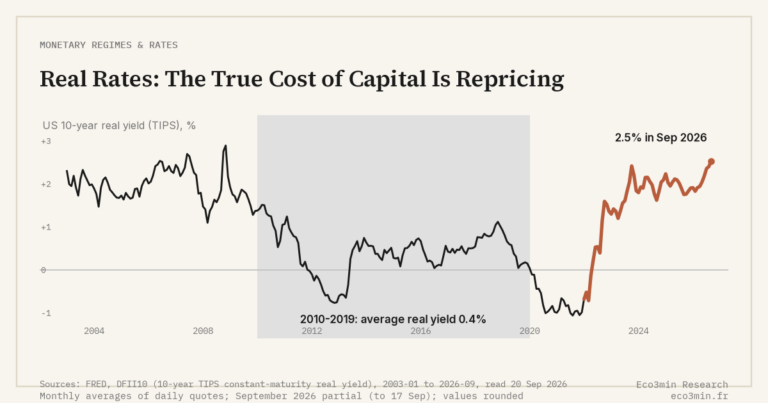
According to Bundesbank estimates (yield decomposition model, Q4 2025 update), the term premium on the 10-year Bund had returned to positive territory at around +60 basis points, after a decade in negative ground. This reversal signals a structural shift: investors once again demand compensation for the risk of holding long bonds, in an environment where inflation and fiscal trajectories are perceived as less predictable than before 2020.
The role of expectations in financial price formation explains why long rates can move before, after or independently of policy rate decisions. An ECB statement perceived as too dovish can trigger a rise in long rates if markets read it as a future inflation risk — a paradoxical effect from the standpoint of the policy rate.
The slope of the yield curve: a signal to interpret
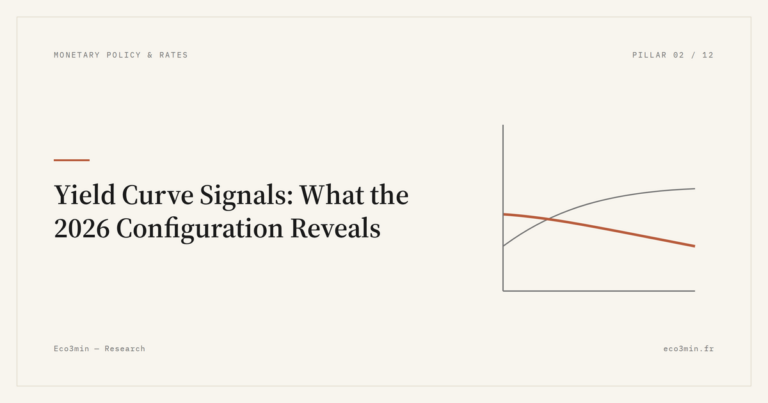
The relationship between short and long rates — the slope of the yield curve — is a leading indicator closely watched by economists. This trade-off is examined in detail in short rates versus long rates, by the data. An inverted curve (short rates above long rates) has historically preceded most US recessions since 1960. In the euro area, the spread between the 10-year Bund and the ECB deposit rate briefly re-inverted in 2023 before normalizing gradually through 2025.
In early 2026, the slope of the euro curve (10-year/2-year spread) stood around +40 basis points according to Refinitiv data, a positive level but below the historical average of +100 to +150 basis points. The persistence of a moderate slope reflects a combination of factors: subdued growth expectations, fiscal uncertainty and the gradual normalization of the ECB balance sheet.
Long rates determine the real cost of financing
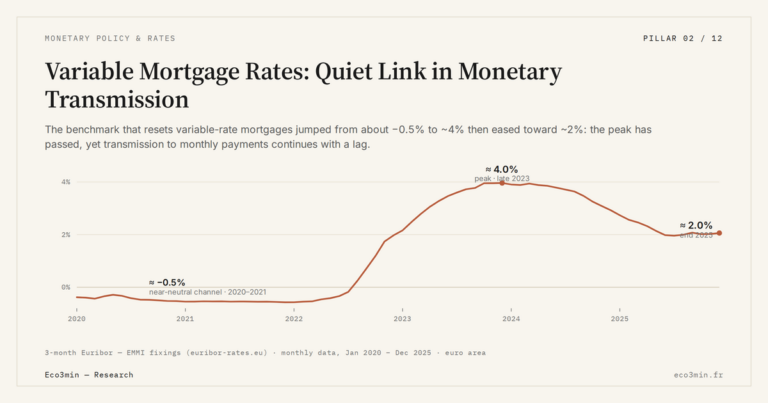
Transmission to the real estate sector illustrates this dependence on long rates concretely. Fixed-rate mortgages — which represent nearly the entire French market — are indexed to OAT yields and swap rates, not to the ECB deposit rate. When the ECB cuts its policy rate but ten-year sovereign yields remain elevated, mortgage lending eases only marginally.
The same mechanism applies to corporate financing. Five- or ten-year bond issuance is priced off swap rates of matching maturity, plus an issuer-specific credit spread. According to ECB data (market statistics, January 2026), the average yield on new investment-grade issuance in the euro area stood at ≈3.6%, of which roughly 2.8% reflected the underlying swap rate and ≈0.8% the credit spread.
- Long rates aggregate three distinct components — expectations of future short rates, inflation expectations and the term premium — each of which can move independently of the policy rate.
- The return of the term premium to positive territory since 2023 reflects a structural shift in the perception of bond risk.
- Long-term financing decisions (mortgages, investment, bond issuance) depend on long rates rather than policy rates — which explains the incomplete transmission of short-rate cuts.
The media focus on policy rate decisions obscures the fact that most monetary transmission to the real economy passes through long-term rates. The full path of a monetary impulse to the real economy necessarily runs through this intermediate link, whose behavior cannot be reduced to a simple extrapolation of the short rate. The framework deployed by monetary authorities incorporates this dimension — QE was designed precisely to act directly on long rates when the conventional channel had reached its limits. The broader context is covered in the Eco3min study of how monetary conditions shape margin trajectories.
Last updated — 10 July 2026
Disclaimer – Financial Information: The analyses, commentary, and content published on eco3min.fr are provided for informational and educational purposes only. They do not constitute investment advice or a solicitation to buy or sell financial instruments. Past performance is not indicative of future results. All investment decisions involve risk and are the sole responsibility of the reader.
Read next
Full pillar →Real Rates: The True Cost of Capital Is Repricing
Why real rates are reasserting themselves as markets' anchor and how to recalibrate investment and financing decisions facing…
Real Interest Rates: The Quiet Signal Reshaping Markets
Real interest rates: why their persistence in positive territory in 2026 is reshaping the rules for bonds, equities,…
OAT-Bund Spread: A Quiet Gauge of French Sovereign Risk
OAT-Bund spread: how this yield gap has become a key signal on French sovereign risk, fiscal policy and…