Monetary policy and real estate: how transmission works

Monetary policy influences real estate primarily through credit and long-term rates. Its impact first reaches borrowing capacity, then transaction volumes, before showing up in prices — a gradual sequence that is often misread.
TL;DR
Monetary policy reaches housing in sequence: financing first, then transaction volumes, with prices lagging twelve to eighteen months, so steady listed prices can mask an adjustment already underway in volumes.
- Transmission runs from financing to volumes to prices, with prices adjusting only on a twelve-to-eighteen-month lag because asking prices are sticky downward and transactions are infrequent.
- Per the Observatoire Crédit Logement/CSA (2025 review), the average French mortgage rate climbed from ≈1.1% in late 2021 to a ≈4.2% peak in mid-2024, easing to ≈3.4% by late 2025 as average loan duration stretched to 23.7 years.
- Loans granted fell more than 40% between the 2022 peak and the 2024 trough (Banque de France); the recovery from late 2025 stayed modest, with volumes still 25% below pre-tightening levels.
- Notarial indices (through Q3 2025) show existing-home prices down about 5 to 8% in major French metros since the 2022 peaks while transaction volumes had already fallen 22% over the same period, volumes leading and prices following.
This timeline specific to the housing market explains why monetary effects sometimes appear absent even when they are already at work. Understanding the transmission sequence — financing, activity, prices — helps avoid premature diagnoses about sector “resilience”.

Monetary policy acts on real estate through credit, long-term rates and delayed price adjustments.
The housing market responds to monetary decisions through specific channels dominated by financing. Variations in policy rates first transmit to long-term interest rates, then to bank credit conditions and the cost of mortgage loans. This first stage immediately affects households’ borrowing capacity and the profitability of real estate projects.
The adjustment in transaction volumes follows: slower sales, longer time on market, declining housing turnover. The specifics are documented in the Eco3min analysis of monetary transmission to the real economy. Prices, by contrast, respond with a lag because of structural rigidities — seller inertia, bilateral negotiations, asset heterogeneity and low transaction frequency. This sequence creates a visible gap between the monetary decision and its effect on real estate valuations.
Conflating apparent price stability with the absence of monetary impact is a common mistake. When transactions contract while listed prices hold up, the adjustment is already underway but shows up first through market liquidity rather than valuation levels. Examining credit, volumes and time-on-market simultaneously is what makes the real dynamics of the housing cycle legible.
Mortgage credit, the first link in the chain
Monetary transmission to real estate runs first through credit conditions. The structuring role of the bank channel in monetary diffusion takes on a particular dimension in real estate, where most transactions rely on borrowed financing. A monetary tightening does not immediately move listed prices, but it compresses the borrowing capacity of potential buyers.
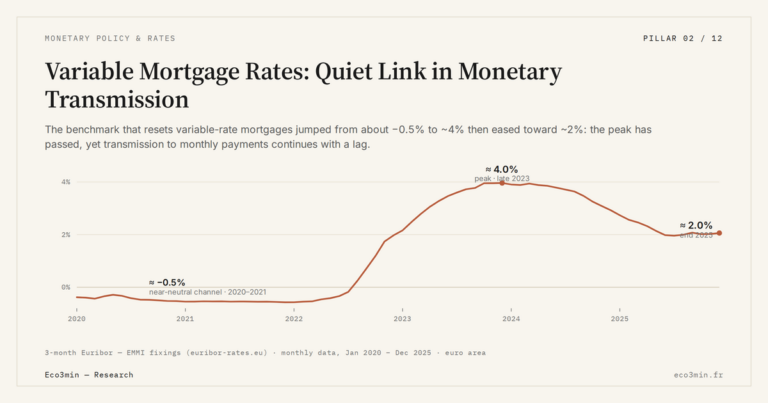
Data from the Observatoire Crédit Logement/CSA (2025 review) illustrate this sequence. The average mortgage rate in France rose from ≈1.1% in late 2021 to a peak of ≈4.2% in mid-2024, before easing back to ≈3.4% by late 2025. Average loan duration simultaneously lengthened to 23.7 years, a compensating mechanism that partly absorbs the rise in credit costs but raises the total cost borne by the borrower. Also relevant: how the real-estate access routes stack up.
The direct consequence: the number of loans granted fell by more than 40% between the 2022 peak and the 2024 trough, according to Banque de France figures. The recovery that began in late 2025 remained modest, with volumes still 25% below their pre-tightening level.
Long-term rates, not policy rates, set the pace
The weight of long-term rates in the transmission sequence is central for real estate. Mortgage credit in France is largely indexed to 10-year OATs and swap rates, not directly to the ECB’s refinancing rate. This partial decoupling explains why the rate cuts initiated since June 2024 have translated only modestly into mortgage credit conditions. The counterpart for property investors is set out in how rising rates hit leveraged REITs.
In early 2026, the 10-year OAT held around 3.1% according to Agence France Trésor data, well above the ≈0.1% level of late 2020. The persistence of elevated long-term rates remains the main brake on a rapid normalisation of mortgage financing conditions, independently of the policy rate trajectory.
Volumes first, prices later
Monetary transmission to real estate follows a characteristic sequence: transaction volumes react first, prices adjust only with a twelve-to-eighteen-month lag. This delay reflects the downward stickiness of asking prices — sellers resist a discount for a long time — and frictions inherent to the market: time on market, transaction costs, psychological attachment to the purchase price. Directly related: The mapping of how policy tightening reshapes corporate margins.
Notarial indices (data through Q3 2025) show a cumulative decline in existing-home prices of about 5 to 8% in major French metropolitan areas since the 2022 peaks, while volumes had already fallen by 22% over the same period. The state of liquidity and financing conditions determines the speed at which this adjustment process continues or reverses.
- Monetary transmission to real estate runs first through the volume of credit granted, before reaching prices with a 12-to-18-month lag.
- Long-term rates (10-year OAT, swaps) matter more than policy rates in setting mortgage credit conditions.
- The downward stickiness of asking prices mechanically lengthens the adjustment cycle, creating an intermediate zone where volumes and prices send contradictory signals.
The dominant reading in early 2026 anticipated a recovery in the housing market driven by rate cuts. This assumption probably underestimates the persistence of elevated long-term rates and the inertia of price adjustments. The long-horizon nature of monetary propagation is particularly acute in real estate, where correction cycles span several years. Decisions taken by monetary authorities influence this process without being able to accelerate its intrinsic pace.
Last updated — 12 July 2026
Disclaimer – Financial Information: The analyses, commentary, and content published on eco3min.fr are provided for informational and educational purposes only. They do not constitute investment advice or a solicitation to buy or sell financial instruments. Past performance is not indicative of future results. All investment decisions involve risk and are the sole responsibility of the reader.
Read next
Full pillar →Real Rates: The True Cost of Capital Is Repricing
Why real rates are reasserting themselves as markets' anchor and how to recalibrate investment and financing decisions facing…
Real Interest Rates: The Quiet Signal Reshaping Markets
Real interest rates: why their persistence in positive territory in 2026 is reshaping the rules for bonds, equities,…
OAT-Bund Spread: A Quiet Gauge of French Sovereign Risk
OAT-Bund spread: how this yield gap has become a key signal on French sovereign risk, fiscal policy and…