Why Monetary Policy Impact Is Hard to Measure
Monetary policy impact cannot be measured directly: lags, the absence of a counterfactual and the entanglement of multiple economic forces force analysts to rely on modelled estimates.

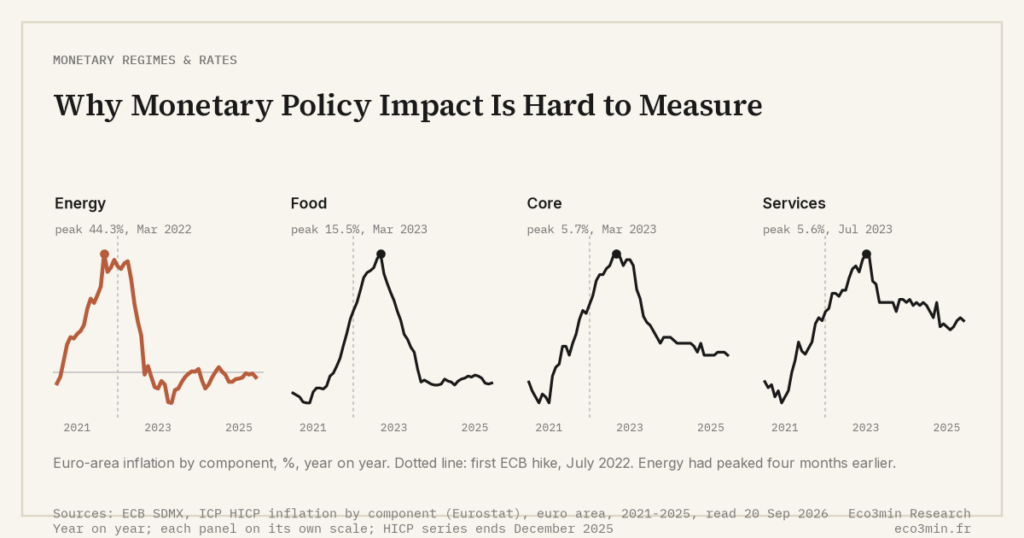
Monetary impact is hard to isolate because of lags, multiple economic interactions and the absence of a counterfactual.
TL;DR
Estimating monetary policy's effect means comparing the economy to a modelled counterfactual that never happened; competing shocks and lagged data then keep any single-point verdict incomplete.
- ECB projections (Economic Bulletin 8/2025) estimate the 2022-2024 tightening cut cumulative inflation by 2 to 3 percentage points over 2023-2025 versus a no-action path, with wide uncertainty bands.
- The 2022-2025 disinflation blended monetary tightening with energy-price normalisation, easing supply chains and slowing Chinese demand; decomposing their shares is an estimation exercise, not a measurement.
- Each gauge is partial: GDP arrives with a 45-day delay and repeated revisions, credit data run one to two months behind, and inflation embeds components (imported energy, indirect taxes) outside monetary reach.
- The ECB's October 2025 SAFE survey found 28% of euro-area SMEs citing financing costs as their main investment obstacle, yet that perception cannot be split between monetary policy and broader market conditions.
Measuring the effect of monetary policy poses a major methodological challenge. Lags, multiple interactions and the absence of a counterfactual blur the reading. Available indicators often capture only partial or delayed effects. This complexity feeds contradictory diagnoses. The mapping of how funding costs feed into margins tracks the sequence over time.
You cannot compare with what did not happen
The first obstacle to measuring monetary impact is the absence of an observable counterfactual. When the ECB raises rates and inflation slows six quarters later, it is tempting to infer a causal relationship. The complexity of this transmission, its lags and its heterogeneity are dissected in our study on the action of monetary policy in the real economy. But what would have happened without tightening? Would inflation have receded naturally as supply chains normalised? Or accelerated further?
These questions have no direct empirical answer. Economists rely on counterfactual models — simulations in which monetary policy remains unchanged — to estimate the gap attributable to central bank action. According to ECB projections (Economic Bulletin 8/2025), the 2022-2024 tightening would have reduced cumulative inflation by 2 to 3 percentage points over the 2023-2025 period relative to a no-action scenario. But these estimates depend on model assumptions and carry considerable uncertainty bands.
Isolating the monetary effect in a multi-causal world
The economy is permanently subject to multiple simultaneous forces: fiscal policy, supply shocks, geopolitical shifts, investment cycles, sectoral dynamics. Monetary policy is just one variable among others, and its effect blends with these competing influences in observed data.
The 2022-2025 episode illustrates this difficulty. Did the disinflation observed in the euro area stem mainly from monetary tightening, the normalisation of energy prices, the easing of supply chains or the slowdown in Chinese demand? Each factor played a role, but decomposing them precisely remains an estimation exercise, not a measurement. Common confusions in interpreting monetary policy have one of their roots here: the observer attributes to a single factor a result that depends on multiple causes.
Indicators that capture only partial effects
The indicators commonly used to assess monetary impact each capture only one dimension of the phenomenon. GDP measures aggregate activity but does not separate the monetary effect from other factors. Inflation embeds components over which monetary policy has no grip (imported energy prices, indirect taxes). Bank credit reflects both supply and demand, without making it easy to disentangle the two.
Sentiment surveys (PMI, consumer confidence, Bank Lending Survey) provide useful but subjective qualitative information. According to the ECB’s SAFE survey (October 2025), 28% of euro area SMEs cited financing costs as the main obstacle to investment — but it is impossible to determine which share of that perception specifically reflects monetary policy and which share reflects broader market conditions.
The lag between monetary decision and statistical observation adds another layer of complexity. GDP data are released with a 45-day delay and revised several times. Credit statistics arrive with a one-to-two-month lag. The analyst evaluating monetary policy impact always works with a distorted, delayed mirror.
- Monetary policy impact cannot be measured directly — it is estimated by comparison with modelled counterfactual scenarios.
- The entanglement of multiple simultaneous economic factors makes isolating the monetary effect methodologically difficult.
- Each commonly used indicator (GDP, inflation, credit) captures only a partial facet of the impact, with publication lags that compound the gap.
The difficulty of measurement does not imply that monetary policy is ineffective — it means that its assessment requires rigour and humility. The progressive and staged nature of monetary transmission makes any point-in-time evaluation necessarily incomplete. Central banks themselves acknowledge this uncertainty in their publications by presenting their estimates as ranges rather than point figures — an admission of complexity that public commentary should integrate more often.
Last updated — 20 September 2026
Disclaimer – Financial Information: The analyses, commentary, and content published on eco3min.fr are provided for informational and educational purposes only. They do not constitute investment advice or a solicitation to buy or sell financial instruments. Past performance is not indicative of future results. All investment decisions involve risk and are the sole responsibility of the reader.
Read next
Full pillar →Real Rates: The True Cost of Capital Is Repricing
Why real rates are reasserting themselves as markets' anchor and how to recalibrate investment and financing decisions facing…
Real Interest Rates: The Quiet Signal Reshaping Markets
Real interest rates: why their persistence in positive territory in 2026 is reshaping the rules for bonds, equities,…
OAT-Bund Spread: A Quiet Gauge of French Sovereign Risk
OAT-Bund spread: how this yield gap has become a key signal on French sovereign risk, fiscal policy and…