Monetary Policy: Why Short-Term Effects Stay Hidden
Monetary decisions produce real effects, but rarely visible in the short run. The gap between policy action, private adjustments and statistical releases creates an illusion of ineffectiveness.

Monetary policy decisions produce real economic effects, but rarely visible in the short run. The gap between central bank action, private agent responses and the release of statistical data creates an illusion of ineffectiveness.
TL;DR
Euro area GDP lands about 45 days after the quarter and is revised twice, so a rate decision can look ineffective simply because the data still describes the previous quarter.
- Quarterly GDP appears roughly 45 days after the quarter and is revised twice, the HICP lags a month and credit data six to eight weeks, so a March rate move is judged against January's reality.
- A Q3 2025 flash estimate of +0.2% was later revised to +0.3% (Eurostat); such adjustments shift the cyclical read, and full propagation registers over quarters, not weeks.
Understanding this latency is essential to read the macroeconomic cycle correctly. The economy adjusts gradually while official indicators carry a structural lag, dissociating immediate perception from underlying dynamics.

The impact of monetary decisions appears weak in the short run because of statistical lags and gradual adjustments.
In the short run, monetary decisions sometimes appear to have no tangible effect on the real economy. Households and firms gradually adjust their investment, consumption and hiring decisions, while credit and real estate markets respond at their own pace. This microeconomic inertia contrasts with the immediacy of monetary policy announcements.
An often-overlooked dimension of this gap concerns the indicators themselves. The main macroeconomic statistics — gross domestic product, employment, inflation — are released with a structural lag of several weeks to several months, then revised after the fact. This informational delay creates a dissociation between the macroeconomic dynamics in motion and the statistical snapshot available.
This discrepancy fuels the perception that monetary policy is ineffective when it actually reflects an issue in the timing of information. Effects spread through the economy before showing up in aggregate data. Reading the sequence correctly — monetary decision, behavioural adjustment, statistical materialisation — helps avoid premature diagnoses about central bank effectiveness. During that statistical silence the effect is already travelling through the channels and time lags of monetary transmission, one channel at a time.
Indicators arriving after the fact
Euro area quarterly GDP is published by Eurostat about 45 days after the end of the relevant quarter, then revised twice. The Harmonised Index of Consumer Prices comes out with a one-month lag. Credit data are only available with a six- to eight-week delay. This statistical latency means that when an observer attempts to assess the effect of a rate decision taken in March, the figures available still describe the reality of January.
According to Eurostat national accounts (Q3 2025 flash estimate), euro area growth was +0.2% in volume terms, a figure later revised to +0.3% in the detailed estimate. These revisions, seemingly mundane, substantially alter the cyclical reading and, by extension, the diagnosis on monetary effectiveness. The difficulty of isolating the real impact of monetary policy begins with this temporal opacity in the data.
Adjustments under way but still invisible
The absence of a visible signal does not mean the absence of an effect. The contractual and balance sheet rigidities that delay transmission are silent in the early months. A household gradually trimming consumption, a firm freezing a project without cancelling it, a developer pushing back a launch: these micro-adjustments accumulate but only appear in aggregate statistics with a lag.
The paradox lies in the fact that financial markets react in real time. Yield curves, credit spreads and equity valuations instantly incorporate monetary decisions. This gap between financial responsiveness and the inertia of the real economy creates an interpretive tension: markets price in what statistics do not yet show.
The shift in financial conditions following a monetary decision is therefore the first observable signal, well before adjustments in real activity. Confusing the absence of statistical movement with the absence of economic effect is the most common error in real-time evaluation of monetary policy.
Assessing the effectiveness of a monetary decision over a horizon of a few weeks. Macroeconomic indicators capture the effects with a lag of at least three to six months. A premature evaluation amounts to declaring a treatment ineffective before its effects can be measured.
Media immediacy versus economic timing
The information cycle amplifies this phenomenon. A rate decision is followed immediately by commentary, then by analyses seeking effects in the days or weeks that follow. This media tempo is incompatible with the timing of monetary transmission. The question is not whether an ECB decision produces a measurable effect within two months — that is structurally improbable across most channels. Related analysis: the Eco3min dossier on the mechanics of rates reaching profits.
The notion that central banks directly control the economy runs into precisely this reality. Their influence is real but mediated through contractual structures, anticipatory behaviours and transmission chains, none of which respond in real time. The effective duration of monetary propagation through the economy is measured in quarters, not in weeks.
The apparent short-term ineffectiveness is therefore not a dysfunction. It is the direct consequence of an economic system built on duration commitments, gradual expectations and lagged statistics. The intervention framework of monetary authorities incorporates this temporal constraint — which is why central banks emphasise the notion of trajectory rather than discrete decisions.
Last updated — 18 September 2026
Disclaimer – Financial Information: The analyses, commentary, and content published on eco3min.fr are provided for informational and educational purposes only. They do not constitute investment advice or a solicitation to buy or sell financial instruments. Past performance is not indicative of future results. All investment decisions involve risk and are the sole responsibility of the reader.
Read next
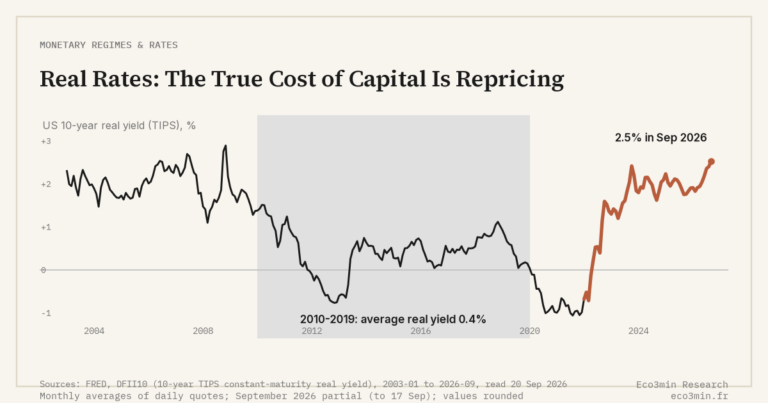
Full pillar →Real Rates: The True Cost of Capital Is Repricing
Why real rates are reasserting themselves as markets' anchor and how to recalibrate investment and financing decisions facing…
Real Interest Rates: The Quiet Signal Reshaping Markets
Real interest rates: why their persistence in positive territory in 2026 is reshaping the rules for bonds, equities,…
OAT-Bund Spread: A Quiet Gauge of French Sovereign Risk
OAT-Bund spread: how this yield gap has become a key signal on French sovereign risk, fiscal policy and…