Why Monetary Policy Always Seems to Lag
Monetary policy appears to lag because of decision delays, transmission delays and the time needed to observe the cycle. Three structural lags add up to roughly two years between an emerging imbalance and the first tangible effects of the response.


Monetary policy appears to lag because of decision delays, transmission delays, and the time needed to observe the cycle.
TL;DR
The apparent lateness of monetary policy stacks three separate delays in recognition, decision and transmission, with the peak effect of a rate decision on inflation landing in the second year, eighteen to twenty-four months out, and the full loop running beyond two years.
- Recognition, decision and transmission delays compound: the ECB’s own assessment of the tightening begun in December 2021 (Economic Bulletin 3/2023) puts the peak impact on growth in 2023 and on inflation in 2024, eighteen to twenty-four months after the first decisions.
- The 2021-2022 episode shows the limits of real-time steering: the ECB held negative rates as inflation accelerated, its December 2021 projections still expecting a return below 2% by 2023 on a transitory-shock assumption that broke in spring 2022.
Monetary policy is frequently accused of acting too late. This impression comes from the gap between diagnosis, decision and transmission. Economic adjustments unfold over a long time horizon, rarely aligned with the latest cyclical data. Understanding this lag helps distinguish perceived delay from structural constraint.
Three Delays That Stack Up
The apparent lag of monetary policy results from the accumulation of three types of delay. Eco3min documents these channels in the Eco3min framework on monetary transmission. The first is the recognition lag: the time needed to identify a cyclical turning point from data published with delay. The second is the decision lag: the time between diagnosis and effective action, constrained by the schedule of monetary policy meetings and the search for consensus within the governing council. The third is the transmission lag: the time between the decision and its measurable effects on the real economy.
Cumulatively, these three delays close a feedback loop that runs beyond two years between the moment an imbalance starts forming and the moment the monetary response reaches its peak effect. The ECB’s model-based assessment of the tightening begun in December 2021 (Economic Bulletin 3/2023) puts the peak impact on GDP growth in 2023 and on inflation in 2024, with an average disinflationary effect of around 2 percentage points over 2023-2025: a peak in the second year, eighteen to twenty-four months after the decision.
The Myth of Real-Time Steering
The accusation of lag implicitly rests on the idea that perfect timing is achievable. This assumption ignores a fundamental constraint: central banks decide on the basis of past data and uncertain projections. They have no real-time indicator of the exact state of the economy.
The 2021-2022 episode illustrates this difficulty. The ECB held negative rates while inflation accelerated, a choice retrospectively criticized as too late. But at the time of the decisions, the ECB’s internal projections (published in December 2021) anticipated a return of inflation below 2% as early as 2023 (1.8% in both 2023 and 2024), a forecast based on the assumption of a transitory supply shock. The persistent nature of the shock only became evident in spring 2022, when the war in Ukraine reshaped the diagnosis.
The rigidities that delay the economy’s response to rate moves add a further layer: even if the ECB had acted earlier, the effect on inflation would not have been immediate. The lag complaint conflates two distinct timescales — that of the decision and that of transmission.
The Hindsight Bias
Judgment on the timing of monetary policy suffers from a systematic hindsight bias. With the benefit of hindsight, the right decision always appears obvious. But at the moment it has to be made, signals are ambiguous, data are contradictory and forecast models diverge.
The asymmetry of monetary effects across the cycle further complicates calibration. Acting too early by raising rates against inflation that turns out to be transitory risks an unnecessary slowdown. Acting too late against persistent inflation costs credibility and requires sharper subsequent tightening. Central banks navigate continuously between these two risks, with instruments whose effects are time-displaced.
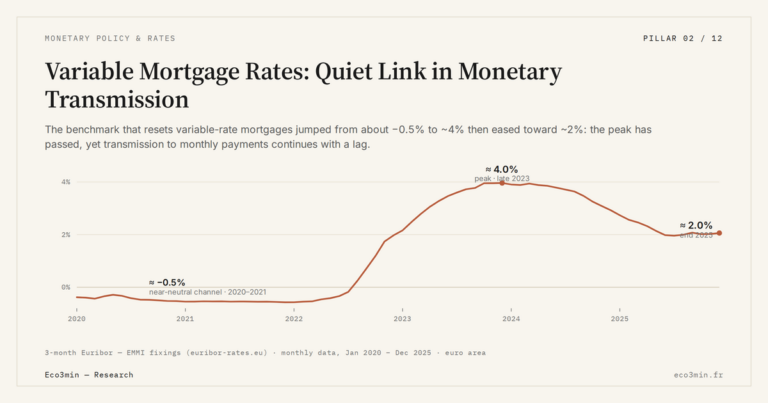
The 2024-2026 monetary cycle offers a real-time case study. The ECB rate cuts initiated in June 2024 (deposit facility rate from 4.00% to 2.00% in eight steps, through June 2025) were contested by some as too slow. The analysis of structural transmission delays places their full impact on activity in 2026, two years after the first decisions.
As of 22 September 2026, the case study has changed direction: the energy shock tied to the Middle East conflict lifted euro area inflation to 3.2% in August 2026 (Eurostat) and the ECB raised its deposit facility rate to 2.25% on 17 June and 2.50% on 16 September. The same mechanics apply to the hikes: they place the peak effect on prices in 2027-2028, while the 2024-2025 cuts are still delivering theirs. A fuller account appears in the Eco3min view of the pass-through of tighter money to profits.
The perceived lag of monetary policy is not a correctable anomaly. It reflects the very nature of an instrument that operates through indirect channels, with incompressible delays and on the basis of incomplete information. The operational setup of monetary authorities is designed to manage this temporal uncertainty, prioritizing trajectory consistency over instant responsiveness.
Last updated — 22 September 2026
Disclaimer – Financial Information: The analyses, commentary, and content published on eco3min.fr are provided for informational and educational purposes only. They do not constitute investment advice or a solicitation to buy or sell financial instruments. Past performance is not indicative of future results. All investment decisions involve risk and are the sole responsibility of the reader.
Read next
Full pillar →Real Rates: The True Cost of Capital Is Repricing
Why real rates are reasserting themselves as markets' anchor and how to recalibrate investment and financing decisions facing…
Real Interest Rates: The Quiet Signal Reshaping Markets
Real interest rates: why their persistence in positive territory in 2026 is reshaping the rules for bonds, equities,…
OAT-Bund Spread: A Quiet Gauge of French Sovereign Risk
OAT-Bund spread: how this yield gap has become a key signal on French sovereign risk, fiscal policy and…