DGS10: 10-Year Treasury Yield as a Macro Signal and Financing Benchmark

DGS10, the Fed’s daily Constant Maturity series, is the nominal 10-year Treasury yield that anchors all long-term pricing in the U.S. economy: mortgages, corporate bonds, equity discount rates, fiscal sustainability.
TL;DR
DGS10, the Fed's daily 10-year Constant Maturity yield, anchors US mortgages, corporate spreads and equity discount rates; its post-2022 climb to 4-5% repriced the term premium, fiscal risk and transmission.
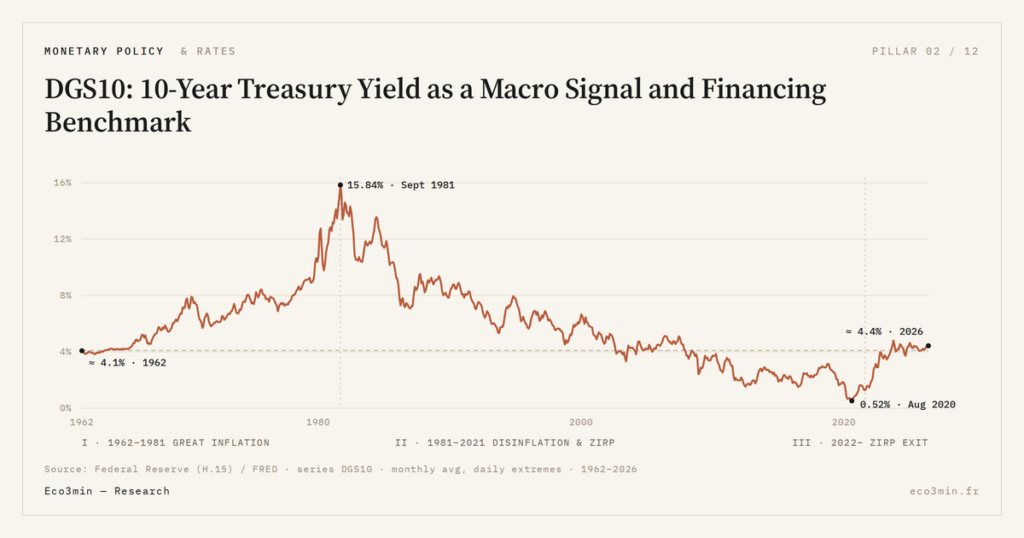
- Built from an interpolated Treasury curve since January 1962, the 64-year series ran from 4.06% on 2 January 1962 to a 15.84% Volcker peak on 30 September 1981, a 0.52% trough on 4 August 2020 and 5.0% in October 2023, averaging 4.48% in May 2026 before closing at 5.01% on 16 September 2026, its highest since July 2007, across three distinct regimes.
- As the standard discount-rate proxy, a 270 bps rise (1.55% to 4.25%) from November 2021 to October 2022 accounts, via a 12-15 year-duration DCF, for nearly all the Nasdaq 100's 30%-plus derating while basket earnings fell only 5-8%.
- The 30-year mortgage tracks DGS10 plus 150-200 bps and hit 7.79% (Freddie Mac PMMS) at the October 2023 peak of 5.0%; existing-home sales fell to a 3.84 million annualized rate in September 2024 and to 4.06 million for the full year 2024, the lowest annual total since 1995 (NAR).
- A higher projected equilibrium underpins the move: the FOMC’s longer-run federal funds median rose from 2.5% (December 2019) to 3.1% (June 2026) while the Holston-Laubach-Williams r-star stayed near 1%, and the ACM term premium turned positive, at +48 bps by end-2024 and +75 bps by end-2025.
After a decade of ZIRP, the post-2022 exit returned DGS10 to a 4-5% range that simultaneously repriced the natural rate of interest, the U.S. fiscal risk premium, and the mechanics of monetary transmission.
1. DGS10: what the FRED series actually measures
When FRED displays DGS10 = 4.32% on a Tuesday morning, this number is not the yield of a specific Treasury bond with an identifiable CUSIP. It is the yield of a hypothetical bond with exactly 10 years of residual maturity, reconstructed each business day by the Federal Reserve from an interpolated curve of outstanding Treasuries. The method, known as Constant Maturity Treasury (CMT), has been published in the H.15 Selected Interest Rates release since 1962, giving 64 years of continuous daily history. This construction matters for macroeconomic analysis because no actual bond has a constant residual maturity over time: its remaining life shrinks each day, which would make raw yield series non-comparable from one year to the next. On the same question: what the 10-year Treasury yield drives.
The Treasury Department’s algorithm long relied on a quasi-cubic Hermite spline calibrated on on-the-run Treasury quotes at the pillar maturities (1M, 3M, 6M, 1Y, 2Y, 3Y, 5Y, 7Y, 10Y, 20Y, 30Y); since 6 December 2021 it uses a monotone convex method that interpolates instantaneous forward rates between those same points (Treasury, Yield Curve Methodology). The 10-year CMT yield is the point of that par curve read at exactly ten years, computed by the Treasury and republished by the Fed in the H.15. Source: the FRED DGS10 series for the 10-year Treasury yield. For the full methodological detail, see the Constant Maturity calculation method.
This technical plumbing has direct consequences for macro analysts: DGS10 smooths certain market tensions. The Treasury illiquidity episodes of March 2020 and October 2023, when the on-the-run 10Y diverged materially from the off-the-run, only partially appeared in DGS10. In March 2020, the on-the-run versus off-the-run 10Y spread widened sharply before the Fed intervention of 15 March 2020, while the published DGS10, built on on-the-run quotes only, captured little of that stress. Capturing these tensions requires cross-referencing DGS10 with other indicators: Bloomberg US Government Securities Liquidity Index, MOVE Index, auction tail spreads, and dealer take-up as a share of primary allocations.
The series begins on 2 January 1962 at 4.06%. Sixty-four years later, in May 2026, it averages 4.48%, before crossing back above 5% on 15 September 2026. This near-perfect return to the starting point conceals three radically different macroeconomic regimes that three yield regimes since 1962 detail: the Great Inflation of 1962-1981 (a structural rise to 15.84% in September 1981, the absolute peak of the series during the Volcker tightening), disinflation and ZIRP from 1981 to 2021 (a long bond bull market down to the 0.52% trough of August 2020), and the post-2022 ZIRP exit (the brutal repricing to 5.0% in October 2023).
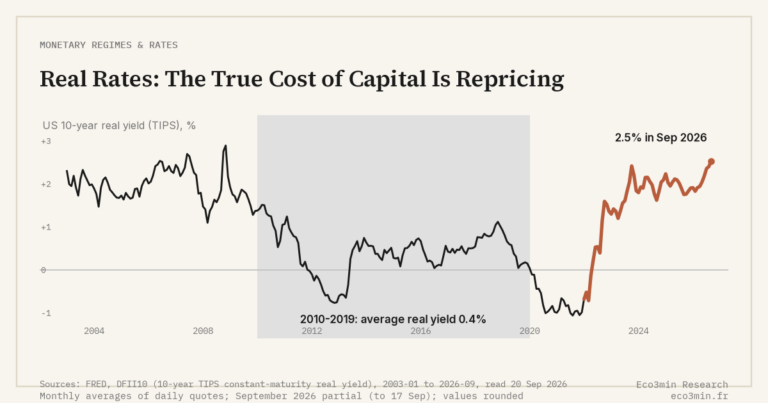
Several adjacent Treasury series deserve clear distinction from DGS10. DGS10 denotes the nominal 10-year. DFII10 (Daily Treasury Inflation-Indexed 10-Year) is the ex-ante real yield on the 10-year TIPS, available since January 2003. T10YIE (Treasury 10-Year Inflation Expectations) is the breakeven inflation computed as DGS10 minus DFII10, measuring average expected annualized inflation over the coming decade. DGS3M is the 3-month CMT yield, the standard short-rate reference; DGS2 and DGS30 denote the 2-year and 30-year respectively. All these yields follow the same CMT methodology and are published simultaneously in the H.15 release. The full DGS10 daily series is available in the FRED DGS10 daily dataset with download and methodology notes. For context: the relationship between copper-gold and the term premium.
The DGS10 series interacts with the broader Treasury issuance calendar in ways the daily series does not fully capture. Refunding announcements published quarterly by the Treasury, which detail upcoming coupon and bill issuance volumes, regularly move DGS10 by several basis points on the publication day alone. The August 2023 refunding announcement, which increased long-end issuance more than expected, is widely read as one driver of the climb toward 5% that autumn. Reading DGS10 in isolation from the Treasury issuance calendar therefore misses an important driver, particularly in periods of large supply uncertainty. Worth reading alongside: Gold and the fiscal dimension of the U.S. monetary regime.
2. The four functions of DGS10 in the real economy
DGS10 is not tracked for its own sake: its centrality comes from its transmission into real variables. Four channels dominate and structure U.S. macroeconomic analysis.
2.1 Reference discount rate for long-term valuations
Every valuation built from discounted future cash flows — corporate DCF models, real estate pricing, infrastructure project appraisal, pension sustainability analysis, long-dated derivative pricing — uses a discount rate. DGS10 serves as the standard proxy for the 10-year risk-free rate in nearly every U.S. financial model. When DGS10 moved from 0.65% (August 2020 average) to 5.0% in October 2023, the Gordon-Shapiro multiplier of a growth company, 1/(r minus g) with r = DGS10 plus a risk premium, contracted sharply: with a 5% premium and 4% perpetual growth it fell from 1/(0.0565 minus 0.04), about 61, to 1/(0.09 minus 0.04) = 20, a division by three, mechanically compressing the present value of far-dated cash flows. A related read: Eco3min’s mapping of the policy-to-profits channel.
That move accounts mechanically for a substantial share of the growth sector derating observed in 2022-2023, independent of operating fundamentals. The Nasdaq 100 corrected by more than 30% between November 2021 and October 2022, while aggregate earnings of the basket contracted only 5 to 8%. Over the same window, DGS10 rose from 1.55% to 4.25%, a 270 bps move. A straightforward DCF application, using a 12 to 15-year average cash-flow duration for the tech basket, accounts for essentially all of the observed derating.
The valuation-DGS10 elasticity is not uniform: long-duration sectors (unprofitable tech, early-stage biotech, growth REITs) are far more sensitive than short cash-flow sectors (consumer staples, banks, cyclical energy). The CAPE ratio relative to DGS10, sometimes called the yield gap or excess CAPE yield, historically follows a negative correlation: as DGS10 rises, the sustainable CAPE compresses. Our Q&A on duration and rate sensitivity sets out how this works. This mechanism is documented in Robert Shiller’s work since the 1980s (Yale ICF working papers, annual CAPE and yields dataset). The 1962-2024 correlation between DGS10 and the inverse CAPE (earnings yield) is roughly 0.9 on rolling decade averages and 0.8 on monthly data (Shiller dataset).
The discount rate channel extends beyond listed equities. It also structures private equity, venture capital, and commercial real estate pricing. U.S. PE funds typically value portfolio companies on cash-flow or EBITDA multiples whose equilibrium level tracks the inverse of DGS10. The 2022-2024 repricing pushed buyout debt multiples down to 5.9 times EBITDA in 2023, 17% lower than a year earlier and the lowest since 2012, according to Bain & Company’s Global Private Equity Report 2024.
2.2 Anchor for mortgage rates and corporate bond yields
In the United States, the 30-year fixed mortgage rate is indexed on DGS10 through Fannie Mae and Freddie Mac MBS. The empirical rule observed by Freddie Mac since 1990 is straightforward: 30Y mortgage rate ~ DGS10 + 150 to 200 bps of spread, with the spread varying according to servicer financing conditions and MBS liquidity. In October 2023, when DGS10 peaked at 5.0%, the 30Y mortgage rate reached 7.79% (Freddie Mac PMMS, week of 26 October 2023), a 279 bps spread — historically elevated, reflecting MBS market stress following the regional bank failures and the Fed’s exit as a structural MBS buyer.
The mortgage-DGS10 elasticity has direct consequences for the U.S. housing market. In the year following the October 2023 DGS10 peak, existing home sales (NAR) dropped to an annualized 3.84 million in September 2024, and full-year 2024 sales came in at 4.06 million, the lowest annual total since 1995. Loans locked in at rates below 4% still made up 54% of the outstanding stock at end-2024 and 50% in Q1 2026, creating a structural blockage in housing turnover (Federal Housing Finance Agency, National Mortgage Database). Monetary transmission to corporate earnings deconstructs the upstream channel.
In the corporate bond market, DGS10 functions as a benchmark on top of which credit spreads are added, calibrated to issuer ratings. An A-rated investment grade 10-year typically trades at DGS10 + 80 to 150 bps. A BB single-B high yield trades at DGS10 + 300 to 700 bps. The DGS10 rise between 2022 and 2023 mechanically lifted corporate yields by more than 250 bps on IG and 350 bps on HY, with no underlying deterioration of issuer fundamentals.
This repricing had a direct impact on average corporate issuance maturities. Over 2022-2024, U.S. corporates shortened the average maturity of their issuance, preferring to wait for long-end normalization rather than locking high coupons on long maturities. This strategy reduces stock duration but exposes corporates to a refinancing wall concentrated in 2026-2029, particularly acute in the BBB and BB tiers.
The corporate refinancing wall is concentrated in specific industry segments. Real estate investment trusts (REITs), particularly office and retail subsectors, carry mortgage debt structures highly sensitive to DGS10 levels. Leveraged buyout debt from the 2019-2021 vintage, typically priced at floating rates with caps, is rolling into a higher rate environment with limited natural hedging capacity. Telecom and media issuers, which used 10+ year tenors heavily during the ZIRP era, face refinancing decisions at substantially higher coupons. The aggregate maturity wall for U.S. corporates over 2026-2029 amounts to about $5.1 trillion (S&P Global Ratings, 2025-2029 maturity study), with speculative-grade debt representing roughly 27% of the global total.
2.3 Primary input of financial conditions indices
The three most-followed financial conditions indices (FCIs) incorporate DGS10 as a key variable: the Goldman Sachs FCI weights each component by its effect on GDP four quarters after a shock, which gives the 10-year yield a weight nearly seven times that of the exchange rate (Goldman Sachs, G10 Financial Conditions Indices, 2017), the Chicago Fed NFCI weights it through the risk sub-component, and the Bloomberg US FCI includes it in the rates bloc. A DGS10 rise, holding other variables constant, therefore tightens these indices, and it is through this calibration, not the yield level itself, that the 10-year weighs on growth over the following quarters.
DGS10 enters FCIs both as a price (yield level) and as a volatility (via the MOVE Index, which measures implied volatility on Treasury options). A DGS10 rise paired with a MOVE spike — the configuration observed in October 2023 and April 2025 — tightens financial conditions doubly. MOVE touched nearly 199 in mid-March 2023 (post-SVB), its highest since the 264 peak of October 2008, signaling major pricing stress along the Treasury curve.
The incorporation of DGS10 in FCIs has direct implications for Fed reaction. When long yields tighten autonomously, the FOMC can slow the pace of Fed Funds hikes because the market is already doing part of the work. The long-end tightening of September-October 2023 was explicitly cited by Jerome Powell as contributing to the Fed Funds pause decided at the 1 November 2023 FOMC. This substitution logic between Fed Funds and long yields is a transmission mechanism in its own right, distinct from the direct policy-rate-to-short-rate channel.
2.4 Signal of long-term expectations
DGS10 embeds forward-looking information on a 10-year horizon in two additive components: the expected path of the Fed Funds Rate over the coming decade, and a term premium that compensates holders for uncertainty around that path. The Fed publishes the Adrian-Crump-Moench (ACM) term premium decomposition daily, accessible from the Federal Reserve Bank of New York website. See our term-premium data series for the underlying data. Over 2010-2021, the 10-year ACM term premium fell from +274 bps (February 2010) to -165 bps (9 March 2020), reflecting the negative premium imposed by Treasury demand during QE programs. Since 2022, the term premium component has returned to positive territory: +48 bps at end-2024 and +75 bps at end-2025, after a peak of +89 bps on 21 May 2025.
DGS10 also contains a decomposition between real yield (captured by DFII10, the 10-year TIPS yield) and inflation expectations (captured by the T10YIE breakeven, defined as DGS10 minus DFII10). This identity makes it possible to empirically settle between two opposing readings of the same DGS10 move. The method is detailed in how to decompose nominal into real and expectations.
The forward-looking information embedded in DGS10 exceeds the information contained in current Fed Funds. For that reason, the market closely monitors long-yield surprises: a +20 bps move on DGS10 following an FOMC suggests a repricing of the entire Fed path well beyond the immediate decision. Conversely, a stable DGS10 in response to an unexpected Fed Funds decision indicates that markets view the surprise as transient, reducing the expected macroeconomic impact.
3. Reading the current phase: why 2022-2026 is not a classical cycle
Over 64 years of history, DGS10 has gone through many rising phases. The post-2022 repricing (0.52% in August 2020, 4.98% in October 2023, 4.48% in May 2026, 5.01% in September 2026) at first glance resembles a classical hiking cycle. Three quantitative elements nonetheless make it qualitatively different from the 1994, 1999-2000, 2003-2007 and 2015-2018 cycles.
3.1 The repricing of the natural rate of interest (r-star)
The natural rate of interest, or r-star (r*), is the real equilibrium rate that maintains the economy at full employment with stable inflation. Holston-Laubach-Williams estimates, maintained by the Federal Reserve Bank of New York (post-Covid version, Staff Report no. 1063, June 2023), show no upward shift: r-star stands at 1.27% in Q4 2019, 0.87% in Q4 2024 and 1.01% in Q2 2026 (one-sided estimates). The upward revision shows up elsewhere, in the FOMC’s own longer-run policy rate: the median moved from 2.5% (December 2019) to 3.1% (June 2026), about 60 bps higher, which at a 2% inflation target amounts to an r-star near 1.1%.
This revision affects DGS10 directly. If r-star = 1% and inflation target = 2%, the theoretical DGS10 equilibrium is around 3% + term premium. With a term premium near 50 bps, the theoretical equilibrium is 3.5%. A DGS10 at 4.5% in May 2026 and 5% in September 2026 implies either a higher term premium, a still-underestimated r-star, or inflation expectations above 2% — three readings the TIPS/breakeven decomposition allows to discriminate.
Several factors argue for a higher r-star than in the 2010s. U.S. demographics show a slowdown in aging expected after 2030, reducing downward pressure on net savings. Investments in artificial intelligence, semiconductors and decarbonized energy create structurally stronger demand for savings than in the 2010s. Post-COVID reshoring and U.S. industrial policies (CHIPS Act, IRA) raise the marginal cost of capital. The combination of these factors justifies a higher r-star than the 2010s decade, which transmits mechanically to the DGS10 equilibrium.
The empirical identification of r-star carries substantial uncertainty bands. The 95% confidence interval around the Holston-Laubach-Williams point estimate is typically +/- 100 bps, meaning a published estimate of 1.0% could be consistent with true values ranging from 0% to 2%. This statistical uncertainty propagates to any DGS10 equilibrium calculation built on r-star. The practical implication is that no single point estimate of equilibrium DGS10 should be treated as a precise benchmark — a fan of plausible equilibrium values is more honest, and the question becomes whether observed DGS10 sits inside or outside this fan.
3.2 The renewed weight of fiscal risk
The U.S. federal deficit stands at 6.2% of GDP for fiscal year 2024 and 5.8% for fiscal year 2025 (Treasury, FRED series), against a 4.8% average over 2010-2019, post-crisis years included. Total federal debt reaches 122.6% of GDP in Q1 2026, up from 106% at end-2019; debt held by the public, 98.7% against 78%. This configuration forces the Treasury Department to refinance a meaningful share of the stock each year, on top of the primary deficit.
The marginal buyers of Treasuries have changed. Foreign holders, central banks included, who carried 34% of total U.S. federal debt at end-2014, carry only 24% as of end-2025 (Treasury, TIC). The Fed, which expanded its balance sheet to $9 trillion in 2022, has begun a quantitative tightening that structurally removes demand. Regional banks pulled back from the Treasury market after the SVB crisis of March 2023. The market had to find new marginal buyers — money market funds, basis-trading hedge funds, retail investors — who demand a higher term premium. The supply pressure of Treasury issuance on yields documents this mechanism.
This reintroduction of fiscal risk into DGS10 pricing has a historical precedent: the 1976-1981 period and, to a lesser extent, 1992-1994 saw a visible fiscal premium develop in the long U.S. curve. The 2022-2026 phase, situated within the broader context of monetary regimes and interest rates, shares three characteristics with these precedents: a structural deficit above 5% of GDP, political difficulty in passing bipartisan fiscal compressions, and increased media attention to long-term CBO trajectories. It differs by the magnitude of debt-to-GDP (a historical peacetime level) and by the absence of an inflationary relay to erode the real value of the stock — 2026 inflation ranging between 2.4% and 4.2% (CPI, January to August) versus 7.6% to 13.5% in 1978-1980.
3.3 The rare configuration of DGS10 < Fed Funds
The Fed Funds target range was cut to 3.50-3.75% in December 2025, then raised to 3.75-4.00% on 17 September 2026, while DGS10 climbed from 4.2% (January 2026 average) to 4.9% in September. The DGS10 minus effective Fed Funds spread, negative without interruption from December 2022 to April 2025 on monthly averages (twenty-seven months, trough at -148 bps), has turned positive again: +86 bps in May 2026, more than +100 bps in September. The configuration where the 10-year sits below the policy rate is rare: across 64 years of series, eleven episodes of at least five months (1966-67, 1968-70, 1973-74, 1978-80, 1980-81, 1989-90, 1998, 2000-01, 2006-08, 2019, 2022-25). Eight were followed by an NBER recession within 9 to 21 months.
The 2022-2025 episode stands out by its duration and by its exit: the T10Y3M spread flipped back into positive territory on 13 December 2024 after twenty-six months of inversion (first negative close on 18 October 2022), re-inverted intermittently until October 2025, and stands near +0.8 points in September 2026, with no recession dated by the NBER. This mixed configuration is also legible against why the 4% threshold reset the regime. It, with both short and long slopes back in positive territory without a recession, challenges recession-signal models and is analyzed in the 10y / 3m spread as recession signal.
The strictest reading of the DGS10 < Fed Funds episodes that were followed by a recession gives a median delay of about 15 months between the first month of crossing and the official NBER recession start. But this statistic rests on eight observations only, with two false positives (1966-67, 1998) and a 2022-2025 episode with no recession to date, and remains statistically fragile. More importantly, contexts differ sharply: 1979 was dominated by Volcker’s fight against inflation, 2000 by the dot-com bubble unwind, 2006-2007 by the pre-subprime crisis. The 2024-2026 configuration does not replicate any of these contexts identically, calling for caution in mechanically extrapolating the signal.
Where the series stands, as of 22 September 2026. DGS10 closed at 5.01% on 16 September 2026, its highest since 19 July 2007, after averaging 4.89% in September against 4.21% in January. The decomposition settles the reading: from January to September 2026, DFII10 moved from 1.91% to 2.54% and the T10YIE breakeven from 2.31% to 2.35%, a move more than 90% driven by real yields even as CPI inflation rose from 2.4% in January to 4.2% in May and 3.4% in August. The Fed raised its target range to 3.75-4.00% on 17 September, the first hike since July 2023; the ACM term premium stands at +64 bps and the Freddie Mac 30-year mortgage rate at 6.95%, its high for the year. Source: FRED (DGS10, DFII10, T10YIE, CPIAUCSL, DFEDTARU, MORTGAGE30US), NY Fed ACM.
3.4 Comparison with previous DGS10 hiking cycles
Comparing the 2022-2026 repricing with three documented hiking cycles helps isolate what makes it distinct. The 1994 cycle, when DGS10 moved from 5.8% to 8.0% within 12 months after the surprise tightening under Greenspan, was dominated by the repricing of Fed Funds expectations. The ACM term premium, already elevated, stayed around 250 bps (245 bps in January 1994, 266 bps in November), and the real component (measured ex post via TIPS, which did not yet exist) explained only a modest fraction of the move. Consequence: normalization was rapid, DGS10 falling back below 6% by 1996.
The 2003-2007 cycle, which saw DGS10 move from 3.1% to 5.3%, accompanied a Fed Funds cycle (1.0% to 5.25%) with an ACM term premium that compressed instead, from 168 bps in June 2003 to 74 bps in June 2007. This is what Greenspan called the conundrum in his February 2005 Congressional testimony: the long end was not rising in proportion to the Fed tightening. The ex-post explanation — structural demand from Asian central banks recycling trade surpluses into Treasuries — was only fully understood after 2008.
The more recent 2015-2018 cycle saw DGS10 move from 1.7% to 3.2%. Term premium remained in negative territory through most of the cycle. The move was almost entirely driven by the Fed Funds expectations leg (DFII10 contributed 70%, T10YIE 30%). Normalization was abruptly interrupted at end-2018 by the risk-asset selloff, forcing the Fed to pivot.
The 2022-2026 cycle stands apart from these three precedents on three markers: the contribution of term premium to the total move (one third of the rise from January 2022 to December 2024 per the NY Fed’s ACM decomposition, 41% from the August 2020 trough), the persistence of elevated yields despite a Fed Funds pause, and the transient positive correlation between equities and bonds in stress episodes. These three markers converge on a diagnosis of monetary regime change rather than a simple hiking cycle.
4. Three misreadings to correct
DGS10 fuels contradictory interpretations across financial media. Three frequent readings deserve correction because they generate repeated analytical errors.
4.1 DGS10 as discounted sum of expected Fed Funds
The theoretical term structure formulation says the 10-year yield is the integral of expected Fed Funds over 10 years plus a term premium. This formulation is mathematically correct but operationally misleading if the second term is neglected. Between 2010 and 2021, the ACM 10-year term premium spent most of the time in negative territory (down to -165 bps on 9 March 2020), meaning Treasury holders were paying a premium to hold them rather than the reverse — a phenomenon tied to QE programs, post-2008 safe-asset demand, and prudential regulation (Basel III required banks to hold HQLA stock, mostly Treasuries).
Since 2022, term premium has returned to positive territory, contributing directly to DGS10 levels independent of Fed Funds expectations. Conflating the two readings leads to underestimating the persistence of elevated yields even if the Fed eases. October 2023 illustrates the point: while Fed Funds futures were already pricing aggressive cuts for 2024, DGS10 rose to 5.0% because the term premium was rebuilding. The transmission mechanism through policy rates details this decomposition.
4.2 DGS10 as expected inflation
This formulation conflates the nominal yield with breakeven inflation. DGS10 is nominal, T10YIE is the inflation expectation, and the difference between them (DGS10 minus T10YIE = DFII10, the 10-year TIPS yield) is the real yield. The same middle term is broken down in the breakeven inflation component. In October 2023, the DGS10 move from 3.8% to 5.0% was driven roughly 80% by the real leg (DFII10 from 1.5% to 2.5%), and only about 20% by the inflation leg (T10YIE from 2.2% to 2.5%). Reading this move as a reawakening of inflation expectations is empirically wrong: it was first and foremost a rise in real yields.
The error has operational consequences: a move driven by real yields has different implications for asset classes than a move driven by inflation. Real assets (gold, TIPS, infrastructure) benefit from rising inflation expectations but suffer from rising real yields. Nominal assets (long Treasuries, fixed-coupon corporate bonds) suffer doubly. The DGS10 move from 3.8% to 5.0% in October 2023 translated into a positive observed correlation between equities and bonds over the 6-week window, breaking the decade-long negative correlation pattern that had supported 60/40 strategies.
4.3 Rising DGS10 as imminent recession
This reading inverts the documented causality. Historically, it is yield curve inversion (DGS10 below short rates like DGS3M or DGS2) that precedes recessions, not DGS10 rising in absolute level. A standalone rise in DGS10 is not a recession signal: it can on the contrary accompany robust growth if driven by rising real yields and a normalized term premium. The U.S. growth phases of 1962-1969, 1983-1989 and 2003-2007 were all associated with historically elevated DGS10 levels, without signaling imminent recession.
What predicts recession is the slope — not the level. The most documented signal is T10Y3M, the difference between DGS10 and DGS3M: when it flips into negative territory, a recession typically follows within 6 to 18 months as seen in the 1973, 1980, 1981, 1990, 2001, 2008 and 2020 episodes. This distinction is essential and connects directly to the broader yield-curve literature.
The level-versus-slope distinction has more than analytical importance: it is the foundation of nearly every operational recession model used by U.S. macro practitioners. The Cleveland Fed model, the NY Fed model, the Conference Board Leading Economic Index — all use yield curve slope inputs, not yield levels. Practitioners who track standalone DGS10 as a recession signal therefore work outside the documented framework, with a track record that does not stand empirical scrutiny across multiple cycles.
DGS10 is rising because markets expect more inflation. This reading only holds episode by episode, and it fails on the most recent ones. The empirical DGS10 = DFII10 + T10YIE decomposition makes it possible to settle each episode case by case, without projecting a narrative onto the nominal yield. The October 2023 and April 2025 episodes were both dominated by the real component (78% and 96% of the move, FRED DFII10), not by the inflation component.
5. International transmission of DGS10
DGS10 is not only the U.S. cost-of-capital reference: it is the world’s most followed sovereign yield and indirectly structures global fixed income pricing. Three channels dominate this international transmission.
5.1 Correlations with AAA sovereign yields
The 2000-2024 correlations between DGS10 and European 10-year sovereign yields (German Bund 10Y, French OAT 10Y) are systematically positive but vary across periods: 0.84 on monthly changes over the 2010-2019 decade, 0.78 over 2020-2024, divergent Fed/ECB monetary cycles having reduced the link only at the margin (Fed H.15, OECD). The Bund-Treasury spread, which was negative (Treasuries above Bund) over most of 2009-2015, fluctuated around 150-200 bps over 2022-2024 before stabilizing around 170 bps in 2025.
This transmission has one main mechanism: global bond arbitrageurs, primarily European and Japanese pension funds, smooth divergences through their cross-border allocations. When DGS10 rises faster than Bund 10Y, these investors rotate part of their allocations toward Treasuries, contributing to spread compression and pulling the Bund higher with a lag. The channel is partially neutralized by FX hedging costs, which can erode or even invert the apparent yield pickup.
5.2 Impact on emerging market yields
Investment-grade emerging market sovereign yields (Mexico, Indonesia, Poland, South Africa) follow DGS10 with a beta around 0.8-1.2. A 100 bps DGS10 rise empirically translates into an 80 to 120 bps rise in EM IG sovereign yields, depending on the episode and risk class. This transmission rests on both the demand channel (global investors require a minimum spread over Treasuries) and the FX channel (a higher DGS10 typically strengthens the dollar against EM currencies, weighing on issuer solvency for local-currency debt).
The 2022-2024 episode illustrated this mechanism: the 335 bps DGS10 rise between January 2022 and the October 2023 peak passed through to dollar-denominated emerging market sovereign yields, more so on the high yield segment than on investment grade. Several sub-investment-grade issuers were forced into restructuring (Ghana, Sri Lanka, Zambia) for which DGS10 is not the main cause but the accelerator.
5.3 Influence on savings rates and the carry trade
The DGS10 versus JGB 10Y differential (the Japanese sovereign yield long maintained under yield-curve control by the BoJ) structured the global carry trade for two decades: borrow in low-cost yen to buy higher-yielding Treasuries. The progressive normalization of Japanese YCC policy since 2022 and the JGB 10Y rise toward 1.5% in 2025, then 2.9% in August 2026 (OECD), compressed this differential and triggered carry trade unwinds, most visibly in August 2024 (a brutal USD/JPY drop accompanied by global equity volatility).
The DGS10 versus Bund 10Y differential plays a similar role for euro-U.S. capital flows. When the spread widens (DGS10 higher), net flows historically rotate toward dollar assets. This mechanism accompanied the EUR/USD move from 1.18 in 2021 to 1.05 in 2022, and partially explains the dollar’s resilience despite apparent cyclical divergence.
6. Reading DGS10 over the coming quarters
DGS10 remains a central state variable of the monetary regime. Three reading angles allow characterization of each move without projecting a narrative, staying in the register of empirical observation.
6.1 Decompose every move into real and breakeven
The minimal discipline is to publish, alongside every DGS10 commentary, the DFII10 (TIPS) and T10YIE (breakeven) decomposition for the same date. A +30 bps DGS10 move over 5 days can be (i) +30 bps real / 0 breakeven (real tightening), (ii) +5 bps real / +25 bps breakeven (inflation reawakening), (iii) +15 bps real / +15 bps breakeven (mixed move). The three have very different economic implications and call for potentially opposite monetary policy responses. In depth: the delayed pass-through from rates to earnings.
The Fed publishes the three series daily (DGS10, DFII10, T10YIE) on the H.15. This decomposition is the most powerful tool for decoding a yield move without falling into the narrative trap. It has one limit worth flagging: T10YIE is not a pure measure of inflation expectations. It includes an inflation risk premium and is biased by a TIPS liquidity premium that can turn negative in stress periods (TIPS are less liquid than nominal Treasuries). The Fed also publishes the adjusted breakeven (TIPS-implied expected inflation) which removes this premium, but with a multi-week delay.
6.2 Monitor the DGS10 / Fed Funds Rate spread
The DGS10 minus Fed Funds relationship (the fix-short spread) captures the long curve slope and indirectly the term premium. A persistently negative spread signals either an anticipation of marked Fed Funds cuts ahead, or a very low term premium. The 2026 configuration (DGS10 at 4.48% in May and 4.89% in September, against an effective rate of 3.63% then 3.88%) marks the exit from that zone. Across the eleven episodes of at least five months where DGS10 fell below DFF since 1962, eight were followed by a recession within 9 to 21 months.
Tracking the DGS10/DFF spread should be combined with tracking the T10Y3M spread. When both are negative simultaneously, the recession signal is most robust (1979, 1989, 2000, 2007, 2022-2024 episodes). When only DGS10/DFF is negative but T10Y3M is positive, the signal is ambiguous: that was the configuration of winter 2024-2025. In September 2026 both spreads are positive, which switches the signal off in the strict sense, a reading to be confirmed by other indicators (Sahm rule on unemployment, ISM manufacturing, credit conditions via the Senior Loan Officer Survey).
The ACM term premium published by the NY Fed is the best available proxy for the premium demanded by marginal holders. The +75 bps threshold was crossed intermittently in 2025 (peak of +89 bps on 21 May 2025) without settling there; a sustained rise beyond it would signal a structural loss of Treasury attractiveness as a safe asset, and a repricing of U.S. fiscal risk. Conversely, a term premium compression into negative territory would signal either a return of foreign demand or a new QE cycle.
Qualitative tracking goes through the quarterly Treasury Borrowing Advisory Committee reports, which publish bid-to-cover ratios on Treasury auctions, allocations to dealers, primary investors and indirect bidders. A persistent drop in bid-to-cover on 10-year auctions, paired with a rise in dealer take-up, is a leading signal of long-end demand stress that transmits to DGS10 within a few weeks.
6.4 Articulate with the full curve
DGS10 in isolation is not enough. A coherent reading integrates DGS3M, DGS2, DGS5, DGS30 to capture the full curve shape. A DGS10 stable around 4% can mask a 2s10s steepening or a 10s30s flattening that radically change the macroeconomic interpretation. Cycle-signal models (CFR Recession Probability Model, NY Fed Term Spread Model) typically use T10Y3M rather than standalone DGS10 for that reason. Data reference: The yield-curve inversion series.
Reading by curve segments also allows identification of specific messages. A 2s10s steepening at the start of a Fed Funds cutting cycle typically signals an expected recession with a substantial fiscal and monetary response. A 10s30s flattening, conversely, signals deterioration of long-term expectations on growth or fiscal stability. These messages are distinct and complementary, each calling for a different macro reading grid. Our guide to steepeners and flatteners walks through each case.
Full-curve monitoring also integrates stress indicators: MOVE Index (Treasury option implied volatility), bid-ask spreads on on-the-run Treasuries, primary dealer take-up as a percentage of auction allocations. When these indicators deteriorate simultaneously, the published DGS10 becomes an increasingly noisy proxy of the true macroeconomic pricing. The March 2020, March 2023 (post-SVB) and October 2023 stress episodes all combined simultaneous deterioration of these indicators with a marked DGS10 move, justifying never reading the 10-year yield in isolation from the market conditions producing it.
The relationship between DGS10 and the 5-year U.S. sovereign CDS, long anecdotal, has become more significant since the May 2023 debt ceiling episode. The 5-year U.S. CDS, which traded below 30 bps over 2014-2021, rose to a record 69 bps on 12 May 2023, while the 1-year CDS exceeded 175 bps, before falling back after the political agreement. This CDS volatility introduces a new sovereign risk premium component into DGS10 that did not exist in earlier regimes.
One under-appreciated property of DGS10 is its function as a coordination device across heterogeneous market participants. Hedge funds running basis trades, pension funds matching long liabilities, bank treasuries managing HQLA stocks, foreign reserve managers, retail BondLadder investors — all consult DGS10 as their common reference point, even when their actual transactions occur in different segments of the curve. This convergence makes DGS10 the most resilient public macro signal available, in the sense that no single category of participants can durably distort its level without provoking opposing flows from another category.
DGS10 is not a passive thermometer of U.S. macro: it is the active channel through which all monetary policy and all fiscal trajectories translate into the cost of capital.
7. DGS10 as a state variable of the monetary regime
The 1962-2026 DGS10 sequence tells the story of three successive monetary regimes, readable in the real/breakeven decomposition and in the relationship to Fed Funds. The 1962-1981 regime was dominated by drifting inflation expectations until the Volcker shock. The 1981-2021 regime was that of disinflation, then post-2008 monetary repression that pushed the term premium into negative territory. The regime opened in 2022 combines natural rate repricing, fiscal risk reintroduction, and positive term premium.
Each regime corresponds to a different DGS10 elasticity to underlying variables. In the 1962-1981 regime, DGS10 reacted strongly to CPI surprises: one point of inflation surprise translated into 30-50 bps of DGS10 rise within weeks. In the 1981-2021 regime, it reacted more to Fed Funds decisions and QE announcements, with a Fed Funds to DGS10 elasticity (monthly averages) of 0.6 in 1994, close to 0.1 in 1999-2000 and 2004-2006, and 0.3 in 2015-2018. In the post-2022 regime, it incorporates a fiscal component absent from the two previous ones, and the Fed Funds to DGS10 elasticity comes out at 0.4 on the upleg of the 2022-2023 cycle (March 2022 to August 2023) but becomes nearly zero or even negative in the anticipated easing phases.
Reading DGS10 is therefore not about comparing its level to a long-term historical average: it is about identifying the regime one is in and applying the appropriate reading grid. This regime identification, more than any level forecast, is the central challenge of fixed income analysis in 2026. The tools remain the same — real/breakeven decomposition, term premium monitoring, full-curve articulation — but their interpretation shifts with the identified regime.
The likely persistence of a post-2022 monetary regime distinct from previous decades implies that mental anchors built on 2010-2021 (DGS10 capped around 3%, negative term premium, mortgage rates below 4%) must be revised. The ongoing repricing is not a cyclical anomaly to correct: it is a normalization toward an equilibrium level consistent with the new r-star, fiscal and demographic configuration. The implications extend well beyond the Treasury market alone and touch the entire U.S. macroeconomic pricing complex.
For 2026 macro analysis and beyond, three open questions will structure the reading of DGS10. First, how far can the upward revision of r-star continue, and what macroeconomic conditions (productivity, demographics, deficits) would stabilize it? Second, how does the term premium evolve as a function of the U.S. fiscal trajectory and the composition of Treasury demand by investor cohort? Third, under what conditions would the equity/bond correlation flip durably from positive (inflationary regime) to negative (disinflationary regime), with implications for diversified portfolios?
Each of these questions extends beyond DGS10 alone but is directly observable in its decomposition and dynamics. The 10-year yield is therefore not the solution to a macro problem but the most consolidated dashboard for tracking the progressive resolution of these structural uncertainties. It is this synthetic function, more than any standalone figure, that justifies the singular status of DGS10 in U.S. and global macro-finance.
This regime-identification approach has practical implications for portfolio construction and macro communication. For portfolio construction, it means that duration risk in 2026 cannot be assessed by reference to 2010-2019 volatility regimes — current DGS10 volatility, conditional on the fiscal and term premium configuration, is structurally higher. For macro communication, it means that headline DGS10 movements should always be reported with their TIPS/breakeven decomposition; reporting DGS10 alone, as is still common in financial media, leaves the reader without the information needed to assess whether the move is real-rate driven or inflation-driven, with very different policy implications.
The post-2022 regime also reopens questions that were considered settled during the QE era. The relationship between DGS10 and the U.S. dollar’s reserve currency status, treated as exogenous over 2010-2021, has become a live empirical question as fiscal trajectories deteriorate and as alternative reserve assets gain marginal share. The transmission channels from DGS10 to mortgage rates, corporate bond yields and emerging market sovereign yields, treated as stable empirical relationships, have shown structural breaks since 2022 that warrant ongoing monitoring rather than assumed constants. Also relevant: Monetary Transmission to Corporate Earnings: Time Lags, Margins, and Rate-Cycle Effects.
- DGS10 is a daily Constant Maturity construction published by the Fed in the H.15 release, not the yield of an identifiable Treasury bond, which implies a smoothing of on-the-run versus off-the-run tensions.
- Four economic functions: discount rate for long-term valuations, anchor for mortgages and corporate bonds, primary input of financial conditions indices, signal of long-term expectations through the TIPS + breakeven decomposition.
- The 2022-2026 repricing combines a higher projected neutral rate (FOMC longer-run median 2.5% to 3.1%, HLW r-star near 1%), fiscal risk reintroduction (deficit 6.2% of GDP in 2024, debt/GDP 122.6%), and a positive term premium (+75 bps at end-2025): three factors absent from earlier cycles.
- Three misreadings to avoid: DGS10 as pure sum of expected Fed Funds (ignores term premium), DGS10 as proxy for expected inflation (conflates nominal and real), rising DGS10 as recession signal (it is the slope that predicts, not the level).
- The operational reading grid decomposes every move into TIPS + breakeven, monitors the DGS10 minus Fed Funds spread and the ACM term premium, and articulates DGS10 with the rest of the curve (DGS3M, DGS2, DGS30).
Last updated — 22 September 2026
Disclaimer – Financial Information: The analyses, commentary, and content published on eco3min.fr are provided for informational and educational purposes only. They do not constitute investment advice or a solicitation to buy or sell financial instruments. Past performance is not indicative of future results. All investment decisions involve risk and are the sole responsibility of the reader.
Read next
Full pillar →Real Interest Rates: The Quiet Signal Reshaping Markets
Real interest rates: why their persistence in positive territory in 2026 is reshaping the rules for bonds, equities,…
OAT-Bund Spread: A Quiet Gauge of French Sovereign Risk
OAT-Bund spread: how this yield gap has become a key signal on French sovereign risk, fiscal policy and…
Inverted Yield Curve: Reading a Regime Signal Without Immediate Effect
The inverted yield curve operates as a regime signal, not a timing tool. Its lagged effects are constitutive…