Why Rate Hikes Don’t Slow the Economy Right Away
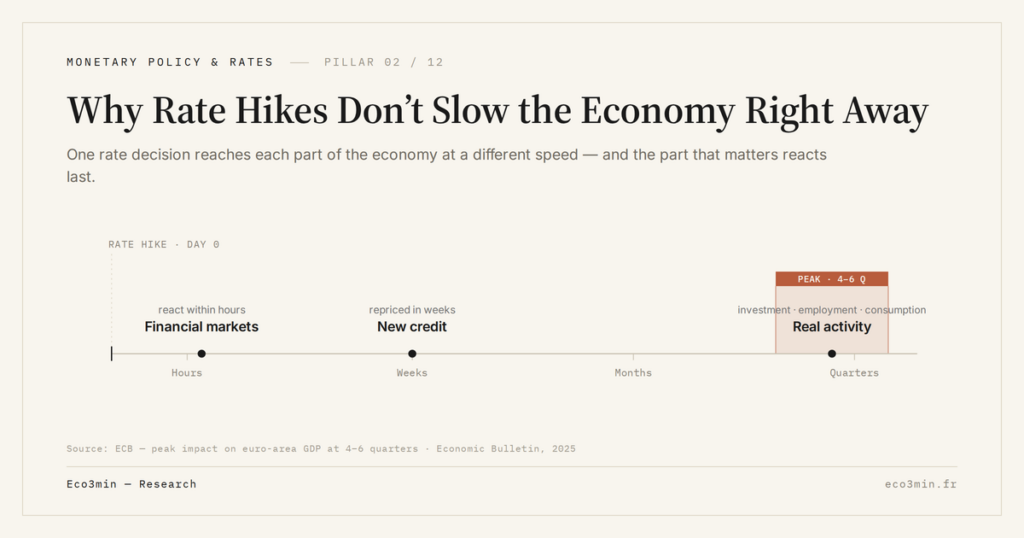
Rate hikes act on the economy with a lag because of decision delays and existing contracts. Financial markets reprice within hours, but real activity only adjusts over four to six quarters.

Rate hikes act on the economy with a lag because of decision delays and existing contracts.
TL;DR
A tightening cycle's peak impact on euro-area GDP lands four to six quarters after the decision (ECB); French debt renewing at only ~6% a year explains the delay.
- Financial markets reprice within hours and new consumer-loan rates within weeks, but productive investment, employment and consumption — the bulk of activity — shift only over several quarters.
- The same lags act as shock absorbers: an economy reacting instantly would show far higher swings in output and employment, so a tightening dismissed at three months can bite hard twelve months on.
After a rate hike, the economy often keeps moving as if nothing had happened. This apparent inertia feeds the perception that monetary policy is ineffective. In reality, private decisions adjust on staggered schedules, through existing contracts and gradual reallocation. Understanding this lag helps avoid an overly instant reading of the cycle.
An Ocean Liner Doesn’t Brake Like a Car
The ocean liner image best captures the gap between a rate decision and its visible effects. When the ECB raises its policy rate, it changes the cost of bank refinancing at very short maturities. But the economy runs on contracts signed months or years earlier: fixed-rate mortgages, indexed commercial leases, multi-year wage agreements, committed industrial orders.
These commitments continue to produce their effects regardless of the new rate level. A household that borrowed at 1.5% in 2021 for twenty years keeps repaying at the same pace. A company that signed a supply contract in March does not renegotiate it in July because the ECB moved in June. The real economy continues along its pre-existing tracks while the monetary signal propagates slowly. For the complete mapping, see the framework on the corporate-earnings side of monetary transmission.
According to Banque de France data (Stat Info Crédits, December 2025), the average residual maturity of outstanding mortgage loans was 16.2 years. This means the stock of French household debt only renews at roughly 6% per year: only new borrowers feel the new conditions immediately. The rest of the stock continues at historically low rates.
What Reacts Quickly and What Resists
Not everything stays still after a rate hike. Some segments of the economy adjust quickly. This is traced in detail in this question on wars financial markets history. Financial markets reprice within hours: bond prices fall, rate-sensitive sectors (listed real estate, utilities) correct, credit spreads widen. Rates on new consumer loans and overdrafts rise within weeks. This is unpacked carefully in the Eco3min framework on the curve-equity decoupling.
But the segments that weigh most heavily in economic activity — productive investment, employment, current consumption — only move much later. The contractual and balance-sheet mechanisms behind these transmission lags operate silently for months before showing up in the statistics. According to ECB research (Economic Bulletin 6/2025), the peak impact of monetary tightening on euro area GDP falls between four and six quarters after the decision — a one to one-and-a-half year lag.
- After a rate hike, existing contracts (loans, leases, wage agreements) continue to produce their effects for months or even years.
- Financial markets react within hours, but real activity (investment, employment, consumption) only adjusts over quarters.
- The peak GDP impact of a tightening cycle falls between four and six quarters after the decision, according to ECB estimates.
A Slowness That Protects as Much as It Frustrates
This lag, often perceived as a flaw in the system, also plays a stabilizing role. If the economy reacted instantly to every rate move, the volatility of activity and employment would be considerably higher. Long-duration contracts, wage rigidities and investment lags act as shock absorbers that smooth transmission and prevent abrupt adjustments.
Impatience with monetary policy results often leads to premature judgments. A tightening dismissed as ineffective after three months can produce a marked slowdown twelve months later, when contracts expire and new financings fully reflect the revised cost of capital.
The full sequence by which a monetary decision reaches the economy extends well beyond the media attention horizon. The decisions taken by monetary authorities are calibrated taking these delays into account — which is why they anticipate turning points rather than tracking them in real time.
Last updated — 7 July 2026
Disclaimer – Financial Information: The analyses, commentary, and content published on eco3min.fr are provided for informational and educational purposes only. They do not constitute investment advice or a solicitation to buy or sell financial instruments. Past performance is not indicative of future results. All investment decisions involve risk and are the sole responsibility of the reader.
Read next
Full pillar →Real Rates: The True Cost of Capital Is Repricing
Why real rates are reasserting themselves as markets' anchor and how to recalibrate investment and financing decisions facing…
Real Interest Rates: The Quiet Signal Reshaping Markets
Real interest rates: why their persistence in positive territory in 2026 is reshaping the rules for bonds, equities,…
OAT-Bund Spread: A Quiet Gauge of French Sovereign Risk
OAT-Bund spread: how this yield gap has become a key signal on French sovereign risk, fiscal policy and…