REIT discount to NAV: when listed liquidity means volatility

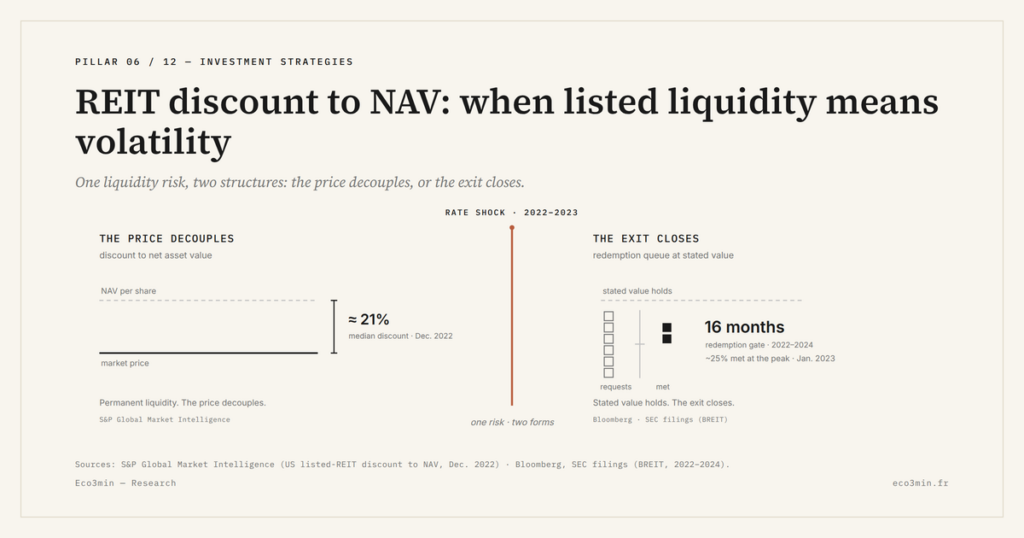
A listed REIT lets you sell any second the market is open, but the price you get is not the net asset value. REITs routinely trade at a discount or premium to NAV, and that gap widens when the rate cycle turns: instant liquidity is paid for in mark-to-market volatility.
TL;DR
Listed REITs trade at a discount or premium to net asset value, and that gap widens when the rate cycle turns: instant liquidity is paid for in mark-to-market volatility.
- In a tightening phase the quote falls ahead of the appraisal-based NAV and the discount widens; through 2022 and 2023 many listed REITs traded at wide discounts, the market signaling it expected appraisals to fall further as they caught up with the rate shock.
- Forced selling sharpens the move: institutions unable to sell their illiquid holdings sell the liquid REITs to rebalance, pushing quotes below any reasonable estimate of property value precisely when the rate shock is at its peak.
- On the unlisted side the same shock formed redemption queues: at the peak the largest American non-traded fund honored only about 43% of one month's withdrawal requests, prorating exits for roughly fifteen months and queuing more than fifteen billion dollars before meeting them in full in early 2024.
- The discount is the listed mirror of that queue: one vehicle prices the stress into its quote, the other into the availability of an exit. Neither removes the cap-rate risk; the listed structure makes it loud and immediate, the unlisted one quiet and deferred.
This article describes how the discount to NAV behaves through the cycle and why it is the listed mirror of an unlisted fund’s redemption-queue risk — a structural feature to understand, not a timing signal.
A listed REIT solves the liquidity problem that haunts unlisted property funds — you can sell on the exchange any second the market is open — but it solves it by introducing another feature: the price you get is not the NAV. Listed REITs routinely trade at a discount or premium to net asset value, and that gap widens precisely when the rate cycle turns. In 2022, several large REITs traded well below their last reported NAV, not because the buildings had vanished, but because the market repriced the cap-rate assumption faster than appraisers. Instant liquidity, in other words, is paid for in mark-to-market volatility. This article describes how the discount behaves through the cycle and why it is the listed mirror of an unlisted fund’s redemption-queue risk, as a structural feature of the vehicle through the cycle — not a timing signal, and without treating the listed-versus-unlisted divide or leverage, which belong to other satellites.
Instant liquidity, but not at NAV
The defining feature of a listed REIT is that its shares trade continuously on a public exchange. There is no redemption request, no queue, no waiting for an inflow to match an outflow: a holder who wants to exit sells into the market, instantly, at the prevailing quote. This is the liquidity that unlisted vehicles cannot offer, and it is real. But it comes with a condition that the unlisted structure does not impose: the exit price is whatever the market will pay at that moment, which is rarely the net asset value.
NAV is an accounting anchor, struck off periodic appraisals. The market price is a live figure, set by buyers and sellers who discount expected rents at a rate that moves with the bond market every day. The two coincide only by accident. In practice the share trades at a discount to NAV — below the appraised value of the portfolio per share — or at a premium above it. The discount is not a malfunction; it is the market expressing, in real time, a view that the appraisal-based NAV does not yet reflect. The holder gains the ability to sell instantly and gives up, in exchange, any guarantee of selling at the stated value of the underlying property.
How the discount behaves through the cycle
The width and sign of that gap are governed by the rate cycle. In an easing phase, when liquidity is abundant and the market expects appraisals to rise, REITs can trade at a premium to a NAV that still reflects yesterday’s lower values. In a tightening phase the relationship inverts: as rates rise and the market anticipates that appraisers will mark cap rates higher, the quote falls ahead of the NAV, and the discount widens. Through 2022 and into 2023, many listed REITs traded at wide discounts to their last reported NAV, the public market signaling that it expected those appraisals to fall further as they caught up with the rate shock.
This makes the discount a cyclical variable in its own right. It is widest when the rate shock is fresh and the appraisals are most stale, and it narrows as appraisers catch up and the two measures reconverge. The mistake is to read a wide discount as a static verdict — a permanent judgment that the vehicle is worth less than its assets. It is better read as a measure of how far ahead of the appraisal the market has moved at a given point in the cycle, a distance that opens and closes as rates move and appraisals follow. Related analysis: the macro-cycle lens applied to investment vehicles.
Historically, listed REITs have swung between premiums and discounts across cycles rather than sitting at a fixed relationship to NAV, and the 2022-2023 episode was a sharp move toward the discount end of that range. The dispersion by sector mirrored the drawdown itself: office REITs, where the doubt over future rents was deepest, traded at the widest discounts, while segments whose rents the market judged durable held closer to NAV. The discount therefore carried two layers of information at once — the general repricing of the cap-rate assumption, common to all property, and a segment-specific judgment on the credibility of each portfolio’s rents. Reading the headline market discount without separating those two layers conflates a cyclical, marketwide gap with a verdict on a particular vehicle’s assets.
Instant liquidity paid in mark-to-market volatility
The discount is the visible face of a trade-off. A listed REIT converts the illiquidity of property into the daily volatility of a quote. The holder can always sell, but the price at which they sell carries the full, immediate weight of the rate cycle — including the forced-selling pressure that hits listed vehicles when institutions, unable to sell their illiquid holdings, sell the liquid ones to rebalance. That pressure can push a REIT’s quote below any reasonable estimate of its property value, purely for liquidity reasons, and it does so fastest precisely when the rate shock is at its peak.
So the two structures present the same underlying risk in opposite forms. The unlisted vehicle offers a stable displayed value and, in exchange, a conditional liquidity that can turn into a queue. The listed vehicle offers permanent liquidity and, in exchange, a price that can swing far from the value of the buildings. Neither removes the cap-rate risk; they distribute its visibility differently. The unlisted holder is exposed to a liquidity that may not be there when needed; the listed holder is exposed to a price that may be far below NAV at the moment of exit. Choosing between them is choosing which face of the same risk to carry, not choosing a lower level of risk. The listed structure makes the cost loud and immediate, written into a falling quote; the unlisted structure makes it quiet and deferred, hidden in a queue that may form only months after the shock. Loudness is not the same as severity, and the quiet structure is not the safer one — it is the one that postpones the reckoning. On the same theme: Our analysis of REIT asset location across account types.
The redemption-queue mirror on the unlisted side
The clearest way to see the trade-off is to put the listed discount beside the unlisted queue. At the end of 2022, the largest American non-traded property funds — Blackstone’s vehicle and a Starwood-managed peer — triggered the redemption caps written into their rules, honoring only a fraction of withdrawal requests and prorating exits for some fifteen months. Their displayed values had barely moved, because appraisals lag; but the door to exit narrowed sharply. The same rate shock that pushed listed REITs to wide discounts pushed unlisted funds into redemption queues. One vehicle priced the stress into its quote; the other priced it into the availability of an exit.
The proration detail makes the cost concrete. At the height of the stress, the largest of these funds honored only about 43% of the withdrawal requests it received in a single month, spreading the rest across later windows; the restrictions ran for roughly fifteen months before the fund met redemptions in full for the first time in early 2024, by which point more than fifteen billion dollars of exit requests had been queued and released over time. None of this implied the buildings had failed; the portfolios were still there, still earning rent. What had failed, temporarily, was the promise of immediate liquidity against an illiquid asset base — the same promise a listed REIT keeps, but only by letting the exit price absorb the shock instead. In the same vein: how rates reshape a REIT position.
The symmetry is exact. A listed discount lets you sell, but below NAV; a redemption gate keeps the displayed value intact, but does not let you sell. In both, the rate cycle is the trigger, and in both the cost lands on the holder who wants liquidity at the wrong moment of the cycle. This structural risk hardens further when leverage is added to the vehicle, which the satellite on when leverage compounds the risk examines. Placing the structure in a regime-based reading belongs to the sub-pillar on situating the asset by regime.
A wide discount to NAV is often read as proof that a listed REIT is permanently overvalued or that its assets are impaired. More often it is a cyclical, forward-looking gap: the market has repriced the cap-rate assumption faster than appraisers, and the discount measures that distance. It is widest when the rate shock is fresh and narrows as appraisals catch up — a feature of the liquidity-volatility trade-off, not a standing verdict on value.
Last updated — 12 July 2026
Disclaimer – Financial Information: The analyses, commentary, and content published on eco3min.fr are provided for informational and educational purposes only. They do not constitute investment advice or a solicitation to buy or sell financial instruments. Past performance is not indicative of future results. All investment decisions involve risk and are the sole responsibility of the reader.
Read next
Full pillar →Beneficiary Designations, the Step-Up in Basis, and the 10-Year Rule: How US Accounts Transfer at Death
At death, most US financial accounts pass outside the will, straight to a named beneficiary, under tax rules…
The Fee Stack in Variable Annuities: M&E Charges, Riders, and Subaccount Costs
A variable annuity does not carry one fee, but a stack of them. Mortality and expense charges, subaccount…
The Conventional 401(k)-Match-First Funding Order: Where It Comes From, How It Works
The question of what order to fund accounts in usually draws a fixed list, presented as a rule…