Vacancy and Turnover: The Cost That Erodes a Landlord’s Real Return

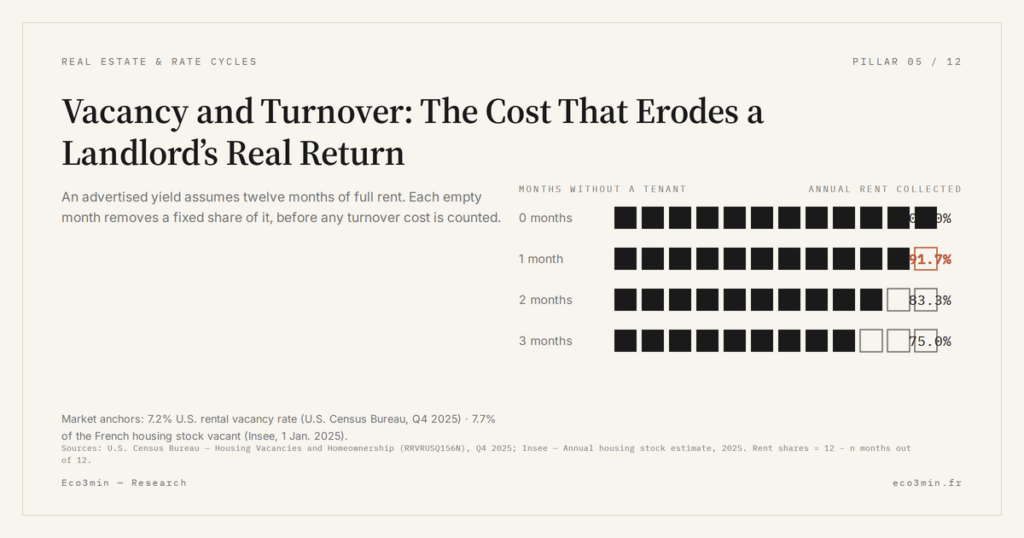
A listing shows full rent, twelve months a year. The owner knows the gaps between tenants, the make-ready costs between leases, and the days a unit sits empty before it re-leases.
Vacancy is not an occasional accident; it is a recurring cost baked into the hold. Ignoring it confuses the rent a property could earn with the rent it actually collects.
Vacancy and tenant turnover remove a recurring slice of return that no advertised yield shows; one empty month cuts the annual yield more than a year of rent negotiation.
- The US rental vacancy rate was 7.3% in Q1 2026 per the Census Housing Vacancy Survey, within the healthy 5% to 8% range.
- One vacant month in twelve removes roughly 8% of annual rent, before any make-ready cost.
- Turnover, make-ready plus leasing, adds a cost the advertised cap rate rarely prices in.
Physical versus economic vacancy
Vacancy comes in two forms, and only one is obvious. Physical vacancy is the unit standing empty between tenants, the gap a landlord can see. Economic vacancy is subtler: rent lost to below-market pricing, to concessions offered to fill a unit, or to amounts billed but never collected. A property can be physically full and still bleed economic vacancy if its rents lag the market or its tenants pay late. One vacant month erases more return than a year of rent haggling.
This reframes a common assumption, that rent runs twelve months a year and vacancy is the exception. Over a hold, the reverse holds: frictional vacancy between tenants is certain, not hypothetical, and it returns with every turnover. The advertised yield, computed on twelve months of full rent, ignores that recurring cost, which is exactly what what the owner actually banks corrects for.
Economic vacancy is the harder half to see because the unit is occupied. Concessions, a month free to sign a lease, quietly cut the effective rent below the face rent a listing advertises. Loss to lease, the gap between what a long tenant pays and what the unit would fetch today, does the same in reverse when rents rise faster than in-place leases. Bad debt from tenants who stop paying rounds out the category. None of these shows as an empty unit, yet each lowers the rent that actually reaches the owner, which is why economic vacancy often matters as much as the physical kind. A full building can still run a meaningful gap between its rent roll and its collected income, and only the second feeds the yield.
Turnover cost
Every change of tenant triggers spending the rent does not cover. Make-ready comes first: cleaning, repainting, minor repairs, sometimes replacing worn fixtures. Leasing follows: advertising the unit, showing it, paying a leasing commission where one applies, and screening for a solid applicant. Between the old tenant’s move-out and the new one’s move-in sit days, sometimes weeks, with no rent at all.
The detail of these costs often escapes the first calculation. A unit returned in ordinary condition needs only a light make-ready, but damage, a worn appliance or a code upgrade turns a modest cost into a large one. Leasing commissions, where a broker or manager places the tenant, commonly run a portion of a month’s rent or more. And the pressure to fill a unit quickly can push an owner to accept a slightly lower rent or a weaker applicant, two indirect ways of paying for vacancy that never appear as a line item but show up later in slower payment or earlier turnover.
The right way to carry this cost is to annualize it. A turnover that costs two months of rent every three years is not a one-off shock but an ongoing charge of roughly two-thirds of a month’s rent per year, spread evenly for planning. Treating it as an annual line, rather than an occasional surprise, is what separates an underwriting model that holds from one that looks good until the first tenant leaves.
Added up, a single turnover often costs more than a month’s rent even when the vacancy itself is short. A high-turnover property, where tenants cycle every two or three years, therefore carries a hidden cost well above one leased steadily to the same tenant. This line sits on top of the operating costs set out in how NOI is built line by line, and it is the most volatile of them.
Effect on effective yield
The effect models simply. Effective gross income starts from the full rent, subtracts the vacancy rate, then removes turnover costs. A property advertised at a 6% gross yield, running an 8% vacancy rate, collects only 92% of its rent, which trims the yield to about 5.5% before any turnover cost. Add the cost of a make-ready and re-lease, and the effective figure falls further.
The magnitude is stark in its simplicity: one month of rent lost in twelve is one-twelfth of annual income, close to 8% of yield gone on that line alone. No upward rent negotiation offsets such a hole as quickly, which is why controlling vacancy matters more over a hold than optimizing the headline rent. The yield that survives vacancy is the one that supports value, priced against the risk-free benchmark in the premium over Treasuries.
A full example fixes the order of magnitude. A unit renting for $1,500 a month brings $18,000 a year at perfect occupancy. On a turnover every three years, with one month of vacancy and $2,000 of make-ready at each change, the annualized cost of vacancy and turnover approaches $1,150 a year, more than 6% of gross rent erased on that line alone, year after year. The figure assumes no market downturn; it follows from the mechanics of turnover itself, and it stacks on top of the operating costs and financing already counted. An owner who omits it is not optimistic but mismeasured.
The comparison with rent optimization is instructive. Raising a $1,500 rent by 3% adds $540 a year, real but slow. Cutting one turnover over the same period, by keeping a good tenant, can save more than a month’s rent plus make-ready in a single stroke. Over a long hold, tenant retention and short re-lease times move the effective yield more than the headline rent does, which is why professional operators track days-to-lease and turnover frequency as closely as the rent roll. The lesson is not that rent growth is worthless but that it competes for attention with a cheaper, faster lever most owners overlook.
What the market decides
Vacancy is not uniform across the country. The national rate of 7.3% in early 2026 spans a wide range, from 2.5% in tight Maine to 12% in oversupplied South Carolina, so a national average tells a local owner little. Professionally managed apartment stock often runs tighter, near 5%, while newly delivered units and large complexes lease up more slowly and post higher vacancy until they stabilize.
New supply is the swing factor most owners underweight. A metro absorbing a wave of deliveries can see vacancy climb and concessions widen for a year or two even as population grows, because units arrive faster than tenants. A buyer underwriting a stabilized 5% vacancy into such a market inherits the lease-up risk without pricing it. Conversely, a supply-starved metro can hold vacancy well below the national rate for years. The current number matters less than its direction, and direction is set by the construction pipeline more than by the last quarter’s print.
Supply is the swing factor. A market absorbing a wave of new construction sees vacancy climb and concessions widen, pressing effective rents down even where the headline rent holds. A supply-starved market does the reverse. Reading vacancy therefore means reading the local supply pipeline as much as the current rate, a dynamic tied to the broader the true real-estate cycle and framed within the net-yield sub-pillar.
The national average is therefore the wrong number for a single property. A 7.3% rate blends a metro where a unit re-leases in a week with a declining town where it waits a year. For an owner, the only vacancy that matters is the one in their submarket, judged on real demand, the pace of comparable re-leases and the condition of the unit. Underwriting a specific building on the national figure applies a statistic that does not describe it, the mirror error of ignoring vacancy altogether. Both misprice the same line, one too high and one too low.
- Vacancy is physical (empty units) and economic (below-market rent, concessions, uncollected rent); both cut effective income.
- One vacant month in twelve removes about 8% of annual rent; a single turnover often costs more than a month’s rent.
- The national 7.3% rate hides a 2.5% to 12% state range; local supply, not the average, sets a property’s real vacancy.
The hole worth pricing
Vacancy is the line listings pass over and owners pay without seeing. Pricing it, from a realistic vacancy rate and a turnover cost, turns a theoretical yield into a plausible income. It is an exercise in prudence more than pessimism: a modest effective yield that holds beats a flattering advertised one never reached. A disciplined owner budgets vacancy as a certain expense, alongside property tax and insurance, not as a distant risk they hope to dodge, and prices the property on the income that survives it. Each subtraction is developed across the wider the real-estate and rate cycles pillar.
Last updated — 3 August 2026
Disclaimer – Financial Information: The analyses, commentary, and content published on eco3min.fr are provided for informational and educational purposes only. They do not constitute investment advice or a solicitation to buy or sell financial instruments. Past performance is not indicative of future results. All investment decisions involve risk and are the sole responsibility of the reader.
Read next
Full pillar →Cap Rate Spread: What Rental Yield Pays Over the 10-Year Treasury
A 5% cap rate sounds attractive. But 5% against what? A risk-free 10-year Treasury yields near 4.5% in…
US Rental NOI, Line by Line: What Net Operating Income Really Subtracts
A US rental yield is advertised gross: annual rent over price. Between that number and the income an…
Loan Term Mechanics: How 15-Year vs 30-Year Reshapes the Monthly Payment
Stretching a mortgage’s term lowers the monthly payment, so a given income can carry a larger loan. The…