When the Inflation Regime Shifts, Yesterday’s Hedge Becomes Tomorrow’s Risk

A protection set for the regime that has just ended becomes a risk when inflation shifts: yesterday’s hedge loses its engine, and the cost of mistiming the regime often exceeds the cost of picking the wrong asset.
TL;DR
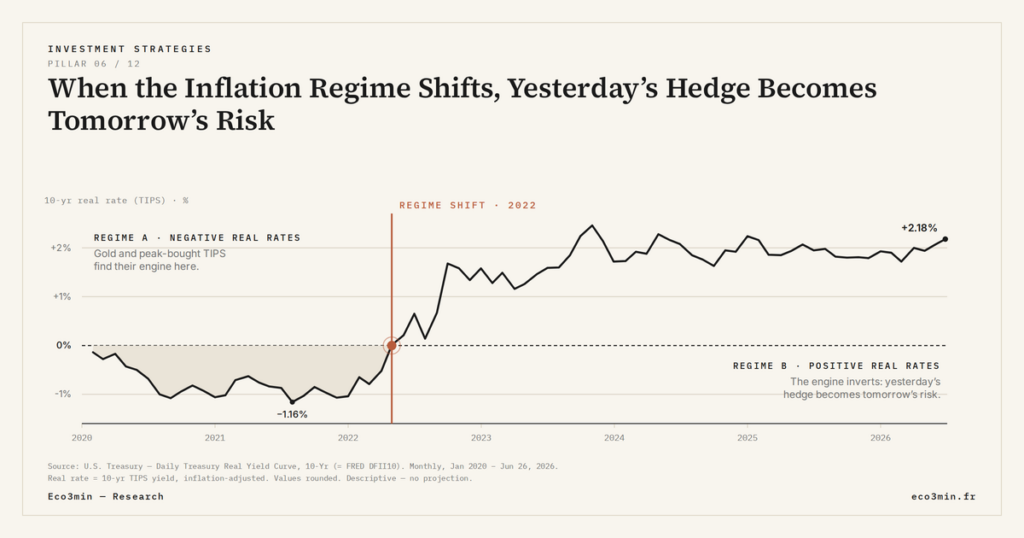
Inflation-linked bonds bought at the 2022 peak took a market loss when real rates climbed, showing that a hedge held past the regime that justified it starts to cost.
- Mistiming the regime has historically inflicted heavier real losses than picking a mediocre asset: an asset suited to the regime cushions a poor selection, while one unsuited to it concentrates the loss, so position in the regime cycle matters more than the choice within a list.
- Correlations shift with the regime too: the negative equity/long-bond correlation that anchored the balanced portfolio for two decades reversed in 2022, when both fell together under rising real rates.
This page handles the dynamic dimension static analyses miss. It closes the umbrella on its limit: a map of protections is only worth as much as your read of which regime you are in, and when it changes.
A protection is always dated
Choosing a protection against inflation is implicitly a bet on a regime. Gold is justified by negative real rates, inflation-linked bonds by inflation running above expectations, interest-bearing cash by short rates above inflation. Each of these protections holds as long as the regime that grounds it persists. The day the regime changes, the implicit bet underneath it stops being valid, even though the asset itself has not changed. A complementary angle: the commodity hedge for stocks.
This is the limit that a regime-by-regime protection map carries within it. A map says what held in each regime. It does not say when you move from one regime to the next. Yet it is precisely the transition that decides the saver’s fate, because a protection held beyond the regime that justified it does not merely stop protecting: it starts to cost. The danger, therefore, is not picking the wrong protection, it is keeping it too long.
When yesterday’s hedge becomes tomorrow’s risk
The reversal is not a thought experiment. It materialised recently, on the protections judged most obvious. Inflation-linked bonds bought at the 2022 inflation peak, with the idea of locking in a hedge, recorded a market loss when inflation receded and real rates climbed: the entry point, set for the outgoing regime, proved unfavourable for the incoming one. Gold accumulated in anticipation of durably negative real rates lost its main support as soon as those turned positive.
In both cases, the protection was not bad in itself: it was poorly synchronised with the regime that followed. The asset bought for a negative-real-rate regime met a positive-real-rate regime, and the engine of the protection reversed. It is the exact continuation of the reversal from the 1970s to 2022: what is presented there as a comparison of two regimes becomes here a transition risk, lived by whoever held the first regime’s protection into the second.
Regime transitions have a property that worsens the risk: they are rare but abrupt. A regime can last years, which anchors conviction and gives the protection time to look infallible, then flip in a few months. It is exactly when a protection has most proved itself that it is most exposed to the reversal, because the regime that rewarded it is drawing to a close.
This makes the shift costly less through analysis than through behaviour. A protection that worked through an entire regime accumulates conviction, and conviction is sticky. Someone who was right to hold gold through years of negative real rates has every psychological reason to keep holding it as those rates rise, because the recent record rewards the position. Selling a protection that has just worked feels like abandoning a winner, when the regime has in fact removed its engine. The asymmetry is uncomfortable: the discipline a regime shift demands runs against the experience the previous regime has just delivered. It is this gap, between what recent data suggest and what the coming regime requires, that makes the frontier genuinely hard.
Mistiming the regime costs more than picking the asset
From this follows the thesis specific to this page: for an inflation protection, mistiming the regime generally costs more than choosing the wrong asset. Holding the “right” asset in the wrong regime has historically inflicted heavier real losses than holding a mediocre asset in the right regime. The reason is mechanical: an asset suited to the regime cushions even an imperfect selection, while an asset unsuited to the regime concentrates the loss whatever its intrinsic merit.
This hierarchy shifts attention. The usual debate is about the asset, gold versus linkers versus property, as if the ranking were stable. But the ranking depends on the regime, and the real question is the position in the regime cycle, not the selection within a list. Savings perfectly diversified across protections, but all set for the outgoing regime, remain exposed to the shift: diversification across assets does not protect against a common error of regime.
This hierarchy has a counter-intuitive consequence for rebalancing reflexes. Mechanical rebalancing, which means adding to what has fallen and trimming what has risen, works as long as the regime does not change. At the shift, it can work backwards: it pushes the saver to add to the outgoing regime’s protection, now cheaper because it has begun to break down, at the very moment its engine disappears. What looks like an opportunity, buying back at a low price an asset that has just fallen, may be nothing more than the acceleration of a bet on a regime that is over. The frontier is therefore not only a passive risk of prolonged holding. It is also an active trap for anyone applying rebalancing rules calibrated on the stability of the regime.
Correlations shift too
The shift has a corollary that savers discover the hard way: the relationships between asset classes are not stable from one regime to another. The protection reputed to be diversifying par excellence, holding both equities and long bonds, rested for two decades on a negative correlation between the two. That correlation reversed in 2022, when equities and bonds fell together under the rise in real rates, depriving the balanced portfolio of the cushion it counted on.
A hedge can therefore stop protecting not because the asset changed, but because its relationship to the other assets changed with the regime. The detail of this correlation inversion, and its consequences for the balanced portfolio, belong to the correlation that flips. The point kept here is that a protection built on a stable relationship inherits the risk of that relationship coming undone at the shift.
Taking a protection’s past performance for a future guarantee assumes the regime does not change. A hedge that has just succeeded is precisely the one whose favourable regime is most likely drawing to a close. Reading it correctly means judging a protection by its consistency with the coming regime, not by its success in the outgoing one.
Recognising the shift
The whole challenge then moves to a question of identification, which is the hard part: how do you know a regime is shifting? The honest answer is that you rarely know in real time. A regime does not announce itself. It is often recognised after the fact, once the new real-rate path has set in. The general definition of a macroeconomic regime change, its markers and its precedents, belongs to macro regime shifts explained. This page focuses on its consequence for protections.
Short of certainty, what remains accessible is a watch on leading signals, inflation expectations, the dynamics of real rates, the orientation of monetary policy, which deliver only a probability of transition, never a date. This uncertainty does not disqualify the protection grid by regime. It refines its use. The grid says what protects in each regime. The reading of the transition says when to stop relying on it. The two combine in adjusting exposure to the cycle, which extends this page onto the operational terrain of the position in the cycle.
The posture this implies is uncomfortable but coherent: holding any protection with the awareness that it is conditional and revisable, rather than as a permanent feature of the portfolio. It means reading a hedge’s recent success as evidence about the outgoing regime, not as a forecast about the next one, and treating the strongest convictions, the ones a long favourable regime has built, as the ones most worth re-examining. None of this delivers a clean exit signal, because none exists. What it offers is a frame that keeps the question open at the moment it matters most, when a protection has worked long enough to feel like a certainty.
The limit that closes the umbrella
This page closes the umbrella on its own limit. A map of protections by regime is a powerful and incomplete tool: powerful because it ties each regime to what has historically held, incomplete because it does not say when you change regime. Its value depends entirely on the clarity with which you read the transition. A protection is never acquired. It is consistent with a regime, and the regime can shift. It is the umbrella’s last lesson, and the most unsettling: the most dangerous protection is not the one that never worked, it is the one that worked perfectly until the day the backdrop changed. The map does not erase that risk. It names it, locates it at the transition, and reminds the reader that reading the current regime matters more than perfecting the choice of asset. It is on that limit, not on a recipe, that the analysis closes.
Last updated — 12 July 2026
Disclaimer – Financial Information: The analyses, commentary, and content published on eco3min.fr are provided for informational and educational purposes only. They do not constitute investment advice or a solicitation to buy or sell financial instruments. Past performance is not indicative of future results. All investment decisions involve risk and are the sole responsibility of the reader.
Read next
Full pillar →Beneficiary Designations, the Step-Up in Basis, and the 10-Year Rule: How US Accounts Transfer at Death
At death, most US financial accounts pass outside the will, straight to a named beneficiary, under tax rules…
The Fee Stack in Variable Annuities: M&E Charges, Riders, and Subaccount Costs
A variable annuity does not carry one fee, but a stack of them. Mortality and expense charges, subaccount…
The Conventional 401(k)-Match-First Funding Order: Where It Comes From, How It Works
The question of what order to fund accounts in usually draws a fixed list, presented as a rule…