When an Economy Becomes Strategically Stable but Economically Inefficient
Macro-financial analysis of strategically stable economies that gradually become inefficient. Capital allocation deteriorates, productivity slows, and innovation retreats without any visible crisis to trigger adjustment.

Infographic — The paradox of strategic stability: when institutional solidity masks a silent erosion of economic efficiency.
TL;DR
An economy can hold its institutions and alliances steady while capital allocation, productivity and innovation quietly decay, a regime Eco3min calls inefficient strategic stability that markets fail to sanction.
- OECD productivity research ties the regime to a rising share of low-productivity "zombie firms" sustained since the 2010s, which capture resources from more dynamic competitors.
- Durably higher real rates push capital toward predictable, conservative uses, while stable risk premia and uncorrecting valuations strip market signals of their power to flag weak allocation.
This analysis decodes an expanding macro-financial phenomenon: economies that maintain their geopolitical anchoring and institutions while watching their economic dynamism quietly erode. Beyond spectacular crises, this pattern challenges analysts and investors: how can a system remain robust on the surface while gradually losing its drivers of performance?
The most vulnerable systems are not those that visibly falter, but those whose apparent functioning makes any critical examination feel unnecessary.
This reading aligns with work from the OECD, IMF, and BIS on capital allocation and productivity, which documents how economies can maintain institutional stability while accumulating inefficiencies — a phenomenon sometimes labeled “zombification” or linked to analyses of secular stagnation.
This analysis draws on OECD and IMF research on capital allocation, productivity, and economic “zombification” mechanisms, in order to identify configurations in which institutional stability coexists with progressive degradation of efficiency.
Introduction — The Empirical Observation
Many advanced and emerging economies have been moving through a phase of paradoxical continuity for several years. Institutional architecture remains intact, political balances do not tip over, international strategic alliances endure, and no systemic shock comes to shake the structure.
Beneath this façade of solidity, indicators of economic vitality are nonetheless declining. Productivity gains are thinning, innovation struggles to spread across the productive fabric, and capital deploys along increasingly conservative lines. Markets themselves move within an in-between zone, with neither euphoria nor a clearly identifiable growth engine.
This prolonged inertia does not stem solely from internal economic choices. It is anchored in a broader configuration where the stability of alliances, institutional frameworks, and power relations reduces the pressure for adjustment. This logic fits squarely within structural geopolitics: an environment where strategic anchoring secures the framework, but tends to freeze economic trade-offs, at the cost of a progressive erosion of efficiency.
This gap raises a major question: through what mechanism can an economy combine strategic solidity with progressive degradation of its efficiency? And why does this erosion remain so faintly visible in conventional market analyses?
Macro-Financial Environment and Dominant Reading
The setting in which this dynamic unfolds is not extreme. It combines sluggish growth, interest rates stabilized at constraining levels, and contained volatility. Central banks have closed the chapter of monetary expansion without tipping into aggressive tightening, while fiscal policies prioritize the management of immediate balances at the expense of transformative investment.
Against this backdrop, the dominant narrative is built around the notion of resilience. Recession avoidance, the orderly decline of inflation, and the absorption of geopolitical tensions are presented as proof of structural robustness. Markets translate this reading into stable risk premia and relative indifference to long-term fragility signals.
This interpretation rests on macroeconomic aggregates that, taken in isolation, signal no imminent rupture. It relies heavily on reassuring synthetic indicators whose apparent stability can mask deeper structural vulnerabilities, as detailed in the analysis of misleading economic indicators. As shown in the study on reassuring macroeconomic indicators, this data tends to mask diffuse imbalances visible only through microeconomic and sectoral dynamics.
Anatomy of the Observed Phenomenon
The case under analysis corresponds to a prolonged sequence in which economic authorities manage to preserve a stable institutional framework while accumulating defensive trade-offs. Economic policy orientations primarily aim to contain uncertainty, prevent shocks, and perpetuate existing equilibria.
For corporations, this configuration translates into a priority placed on margin protection, risk mitigation, and financial optimization. Long-term productive investment retreats proportionally, while projects with strong innovative content struggle to mobilize financing on acceptable terms.
OECD productivity studies show that in some advanced economies, the share of low-productivity firms artificially kept in operation — sometimes called “zombie firms” — has significantly increased since the 2010s, capturing resources at the expense of more dynamic firms and weighing on aggregate productivity gains.
In financial markets, this trajectory generates increased dispersion of performance, hard-to-read sectoral rotations, and overvaluation of assets perceived as defensive. Reactions to earnings releases become erratic, with some companies posting solid financial results without sustained market traction.
What stands out is not the absence of acceleration, but the system’s capacity to operate in this intermediate state without triggering any identifiable corrective mechanism.
Decoding the Narrative and Underlying Mechanisms
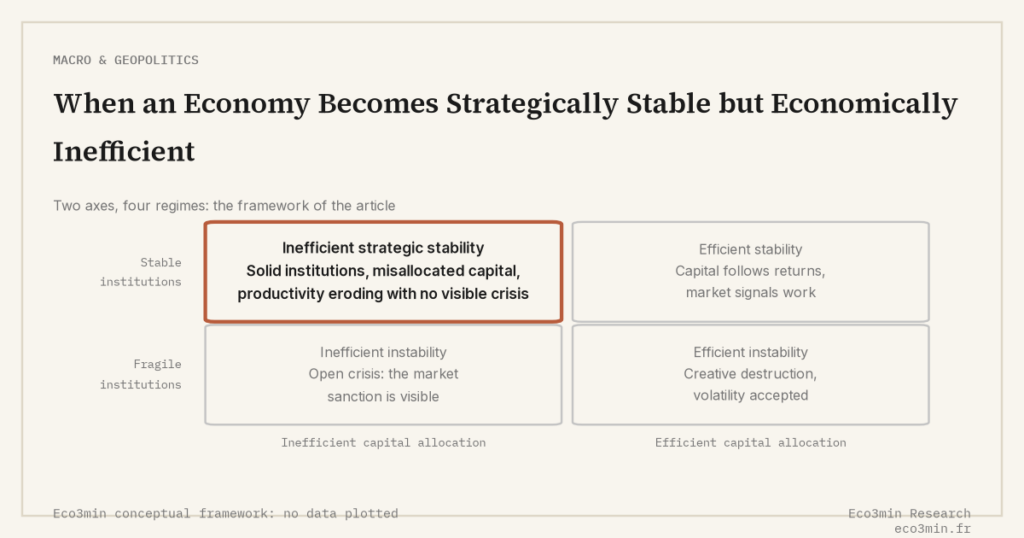
The dominant narrative establishes an implicit equivalence between institutional stability and economic effectiveness. This conflation leads to interpreting the absence of crisis as proof of optimal resource allocation. Yet this reasoning confuses the durability of the framework with the relevance of the decisions made within it.
At the macroeconomic level, the first lever at work is the cost of capital. In a regime of durably higher real rates, as analyzed in the article on real policy rates, long-horizon projects mechanically lose attractiveness. Investment retreats toward conservative uses, at the expense of innovation and future productivity.
A micro-financial mechanism adds to this: a growing preference for predictability. Economic actors favor strategies with anticipatable cash flows, even when their contribution to growth potential remains limited. This logic reduces exposure to immediate losses but increases the risk of prolonged stagnation.
Expectations also play a determining role. In an environment where shocks are actively averted, agents internalize the conviction that the system will be preserved at all costs. This belief reduces pressure to adapt and reinforces decisional inertia, consolidating inefficiency without threatening surface stability.
This configuration tends to be self-reinforcing. Markets exert no pull-back force as long as institutional stability holds and rupture scenarios remain outside the range of possibilities. Authorities, for their part, have little incentive to alter a trajectory that minimizes apparent risks, even as it gradually erodes the system’s efficiency.
The political and financial cost of change then appears greater than the cost of inertia. The absence of immediate sanction reinforces defensive trade-offs that are rational in the short term but suboptimal over the long term, locking the system into a low-performance equilibrium without an obvious adjustment trigger.
- Conflating absence of crisis with economic efficiency.
- Reading stable risk premia as a signal of optimality.
- Equating predictability of cash flows with quality of capital allocation.
- Assuming that markets automatically sanction inefficiency.
Insights into How Markets Function
This case highlights a fundamental property of financial markets and contemporary economies: stability does not guarantee optimality. Markets can operate durably in a regime where prices reflect the absence of catastrophe rather than the quality of growth prospects.
This configuration appears both in some advanced economies and in heavily regulated sectors or those benefiting from implicit support.
In such a regime, market signals lose informational power. Risk premia do not widen, valuations do not correct meaningfully, but capital selection mechanisms weaken. This dynamic fits within the analytical framework developed in the pillar page on macroeconomics and geopolitics, where political and economic equilibria can diverge over long horizons.
The signal emitted is not cyclical but structural: markets do not systematically sanction inefficiency as long as it does not directly compromise the system’s stability.
Scope, Limits, and Major Lessons
- in heavily regulated sectors,
- in companies shielded from competition,
- in asset classes benefiting from implicit support,
- in financial architectures designed to prevent shocks rather than encourage adaptation.
This trajectory is not an isolated case. It can be observed in economies with varied institutional profiles, whenever the priority given to stability durably outweighs the imperative to adapt. The same mechanisms can appear in certain sectors, companies, or asset classes subject to protective regulation or implicit expectations of support.
This case nonetheless does not allow for any conclusion of inevitable outcome. It provides neither a rupture timeline nor a crisis prediction. It illuminates a dynamic, not a precise tipping point.
Institutional stability prolongs defensive capital allocation, weakens productivity and innovation, and defers adjustment as long as geopolitical anchoring remains unchallenged.
The structuring lessons can be summarized as follows:
- Institutional stability does not guarantee optimal capital allocation.
- Markets can operate durably in a suboptimal regime.
- Economic inefficiency can remain invisible as long as it does not threaten stability.
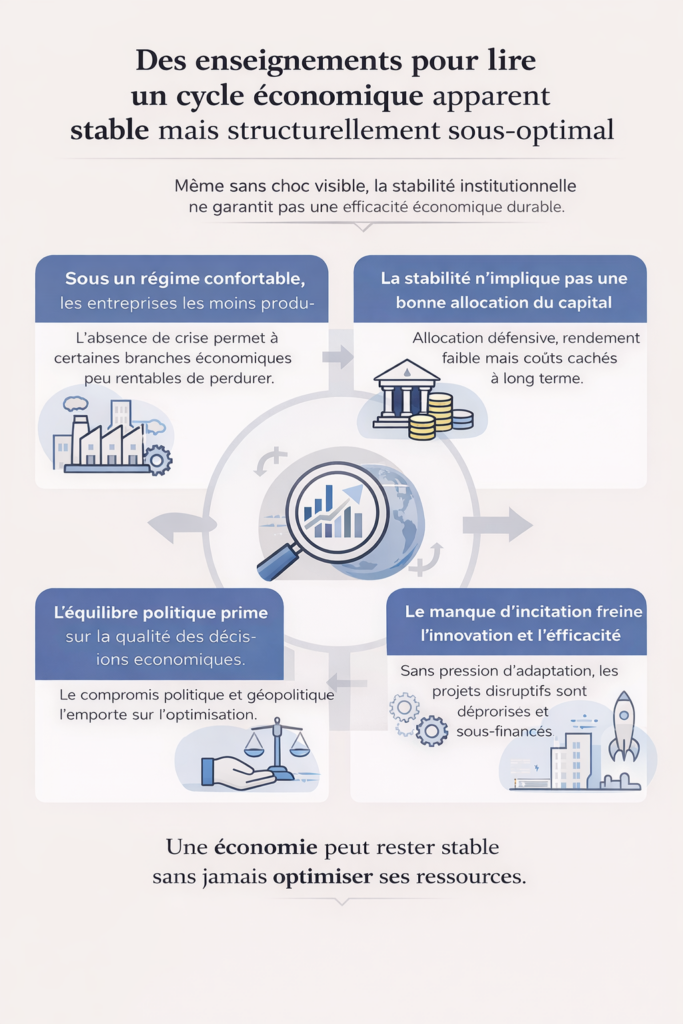
- Institutional stability can coexist with growing economic inefficiency.
- The absence of visible crisis does not mean optimal capital allocation.
- Markets can durably internalize a suboptimal regime without emitting an alert signal.
- Cycle analysis requires distinguishing the stability of the framework from the relevance of economic decisions.
The hardest configurations to decode are not those marked by instability, but those in which the system continues to operate on the surface while gradually undermining its internal drivers. In such regimes, risk is not event-based: it is dynamic, cumulative, and remains largely invisible until a shock reveals its scale. Shocks of that kind increasingly arrive from outside, which is where economic geopolitics and global fragmentation enter the frame.
This case study thus offers an analytical framework transposable to other macro-financial contexts, recalling that the most complex regimes to grasp are often those that appear to function without a hitch.
Last updated — 20 September 2026
Disclaimer – Financial Information: The analyses, commentary, and content published on eco3min.fr are provided for informational and educational purposes only. They do not constitute investment advice or a solicitation to buy or sell financial instruments. Past performance is not indicative of future results. All investment decisions involve risk and are the sole responsibility of the reader.
Read next
Full pillar →Monetary Tightening: How Central Banks Are Reshaping Financial Markets
After more than a decade of ultra-accommodative policy, monetary tightening has reintroduced the real cost of capital as…
Hidden Unemployment: Reading the Real Labor Market in 2026
Headline unemployment is stabilizing while broad underemployment still runs above pre-2020 levels. Reading the gap between official rates…
2026 Economic Outlook: Key Trade-Offs After the End of Cheap Money
2026 ushers in a more constrained macro regime where real rates stay positive, fiscal space narrows and geoeconomic…