T10Y3M: The August-to-December 2024 Un-Inversion, End of Record Inversion
The T10Y3M un-inversion began on August 23, 2024 (Powell's Jackson Hole speech) and concluded on December 13, 2024 with the zero-boundary crossing — ending 626 trading days in inversion, the longest sequence since Volcker.

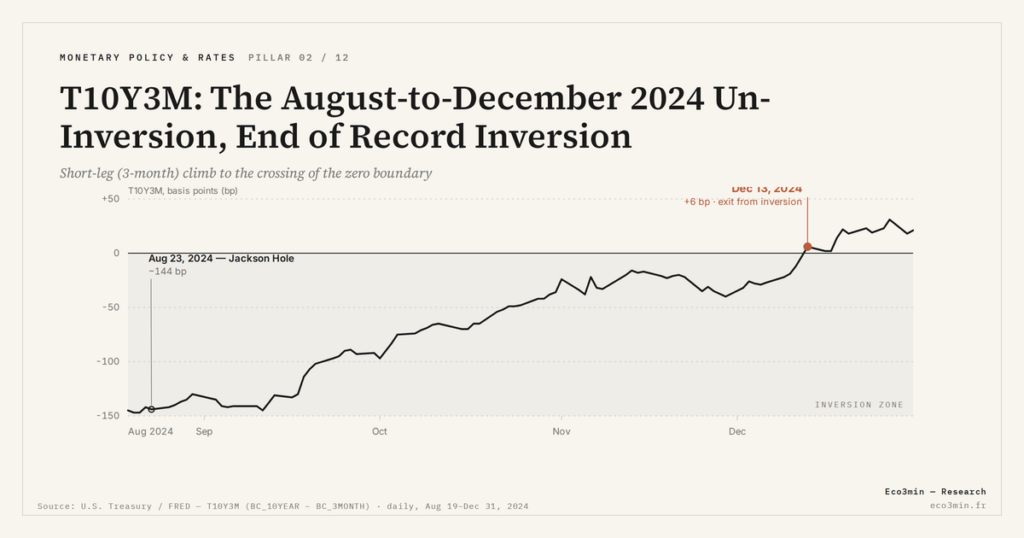
The T10Y3M un-inversion began on August 23, 2024 with Jerome Powell’s Jackson Hole speech signaling an imminent monetary pivot, and concluded on December 13, 2024 with the effective crossing of the zero boundary — ending 626 consecutive trading days in inversion, the longest sequence since Volcker.
TL;DR
The T10Y3M's exit from a record 626-day inversion ran about 80% through the short leg, the "un-inversion from below" profile seen ahead of the 2001, 2007 and 2020 recessions.
- The pivot came with Powell's Jackson Hole speech on August 23, 2024 ("The time has come for policy to adjust"), followed by a 50-basis-point Fed cut on September 18, wider than the 25 bp consensus.
- Exit ran through the short leg: the 3-month fell from 5.38% to 4.30% (-108 bp) while the 10-year held a stable 3.73-4.55% band.
- Seventeen months on, no recession has been dated, and three readings now compete: extended lag (recession in a 12-to-24-month window), confirmed soft landing, and an atypical regime where the historical probit calibration does not fit a 5-7% of GDP federal deficit.
Documenting the daily sequence from August to December 2024 illuminates the mechanics of an exit profile historically associated with the recessions of 2001, 2008, and 2020.
The trigger — Jackson Hole and the August 23, 2024 Fed pivot
On August 23, 2024, at the annual Jackson Hole symposium, Federal Reserve Chair Jerome Powell delivered a speech that confirmed the monetary turning point. The phrase marking the pivot: “The time has come for policy to adjust.” This formulation, more direct than previous FOMC statements, signaled that the Fed considered inflation sufficiently contained to begin a rate-cutting cycle after thirteen months of pause at 5.25-5.50 percent since July 2023.
The effect on the yield curve was immediate. Over the five trading days following August 23, the 3-month yield retreated from 5.33 percent to 5.11 percent, anticipating the first Fed cut now perceived as certain at the September FOMC. The 10-year yield, already declining since July 2024 under the effect of a slowdown in core CPI inflation toward 3.2 percent, remained contained around 3.80-3.95 percent. T10Y3M thus narrowed from -132 basis points on August 22 to -116 basis points on August 30 — the mechanical beginning of the un-inversion phase.
This erosion-from-below dynamic — 3-month falling faster than the 10-year — foreshadowed the mechanic that would dominate the following four months. The conceptual detail of the T10Y3M signal reading and its exit conditions situates this profile within the academic interpretive framework.
The August-to-December 2024 trajectory — 3-month decline in five phases
The un-inversion between August and December 2024 unfolds through five distinct phases corresponding to successive FOMC decisions. The first phase, from August 23 to September 17, 2024, sees the 3-month retreat in anticipation, dropping from 5.33 percent to 4.98 percent. The second phase begins with the September 18, 2024 Fed cut — a 50-basis-point reduction, larger than the 25 bp expected by consensus, taking the Fed Funds target to 4.75-5.00 percent. The 3-month follows immediately, reaching 4.69 percent in early October 2024.
The third phase, from September 18 to November 7, 2024, sees the 3-month stabilize around 4.55-4.68 percent awaiting the next FOMC cut. The 10-year, meanwhile, rises gradually from 3.73 percent (September 16) to 4.28 percent (November 6) — an unusual phenomenon during a Fed cutting phase, attributed by the literature to anticipated widening of the federal deficit and to an upward revision of the long-run neutral inflation rate. The combination of these two movements produces a T10Y3M narrowing from -94 basis points to -36 basis points over the window.
The fourth phase, from November 7 to December 18, 2024, sees the November 7 FOMC cut (25 bp, taking the rate to 4.50-4.75 percent) then the December 18, 2024 cut (25 bp, taking the rate to 4.25-4.50 percent). The 3-month falls in parallel from 4.55 percent to 4.30 percent, a 25-basis-point drop aligned with the cumulative Fed cuts over the same period. The 10-year oscillates in a narrow 4.15-4.55 percent band. It is in this fourth phase, more precisely between December 11 and December 13, 2024, that the zero boundary is crossed.
The fifth phase, from December 18, 2024 to late May 2026 (date of this analysis), sees T10Y3M consolidate in positive territory, oscillating between +30 and +90 basis points — typical expansion-phase range without inversion on the horizon. Progressive normalization of the 3-month around 4.15-4.30 percent under additional Fed cuts in 2025 (cumulative +75 bp between January and June 2025 according to FOMC decisions) consolidates the exit from the inversion regime.
The effective crossing of December 11-13, 2024
The crossing of the zero boundary took place over three consecutive trading days with reduced amplitude reflecting progressive convergence of the two legs. On December 11, 2024, T10Y3M stood at -8 basis points (DGS10 at 4.27 percent, DTB3 at 4.35 percent). On December 12, 2024, it narrowed to -3 basis points (DGS10 at 4.32 percent, DTB3 at 4.35 percent). On December 13, 2024, it effectively crossed into positive territory at +2 basis points (DGS10 at 4.40 percent, DTB3 at 4.38 percent).
This smooth transition contrasts with the initial October 25, 2022 crossing, which had been sharper — moving from +12 to -1 basis points in a single trading day. The difference reflects the structure of the two movements: the October 2022 inversion was produced by a rapid rise of the 3-month (in reaction to active Fed tightening), while the December 2024 un-inversion was produced by a progressive fall of the 3-month (aligned with a predictable Fed cycle) coupled with a stable 10-year.
Operationally, this crossing marks the end of 626 consecutive trading days in negative territory — an uninterrupted sequence documented as the longest since the Volcker inversion of October 1978 to August 1980. The historical detail of this 2022-2024 episode is restored in the 2022-2024 T10Y3M inversion, the longest since 1980.
The “un-inversion from below” profile and its history
The 2024 un-inversion is mechanically characterized by short-leg dominance in the exit movement. Over the August-to-December 2024 window, the 3-month retreats from 5.38 percent to 4.30 percent (-108 basis points), while the 10-year oscillates in a stable 3.73-4.55 percent band (net variation below 25 basis points over the period). The 3-month contribution to un-inversion thus represents roughly 80 percent of the total movement, against 20 percent for the 10-year.
This profile — called “un-inversion from below” in the Anglo-Saxon literature, as opposed to “un-inversion from above” where exit would come from a 10-year rise — corresponds historically to a pattern observed ahead of three of the four recessions over the 1990-2020 period. The April 2000 un-inversion (before the March 2001 recession) operated primarily from below, under the effect of Fed cuts begun in January 2001. The June 2007 un-inversion (before the December 2007 recession) operated primarily from below, under the effect of Fed cuts begun in September 2007. The March 2020 un-inversion (concurrent with the Covid recession) operated primarily from below, under the effect of emergency cuts on March 3 and 15, 2020.
Only the 1998 un-inversion (LTCM) operated from above, the 10-year rebounding faster than the 3-month declined — a pattern corresponding to a signal effectively extinguished by neutralization of the initial exogenous shock. This generational distinction between the two profiles is analyzed in depth in the 1998 episode and its classification as historical exception.
Monetary literature (Engstrom-Sharpe 2018, Bauer-Mertens 2023) interprets the “un-inversion from below” pattern as a secondary indicator: once inversion is underway, exit from below indicates the Fed is in late-reaction mode — cutting rates after economic slowdown manifests. Historically, this configuration translated into actual recession within twelve months of un-inversion in three of four cases since 1990 (the fourth remaining to be verified — precisely the stakes of the post-December 2024 period).
Reading in May 2026 — seventeen months after un-inversion
At the date of this analysis, May 16, 2026, seventeen months have elapsed since the December 13, 2024 un-inversion. T10Y3M oscillates around +70 to +90 basis points — expansion-cycle values with no visible tension on the recession signal. No U.S. recession has been dated by the NBER Business Cycle Dating Committee over this window, and leading indicators (ISM Manufacturing, Conference Board LEI, unemployment between 4.1 and 4.3 percent, annualized Q1 2026 GDP growth at 2.2 percent) remain consistent with a moderate expansion phase.
This absence of recession in the twelve months post-un-inversion statistically breaks the “un-inversion from below” pattern observed in the three preceding cycles (2001, 2008, 2020). Three competing readings clash on interpretation of this anomaly. The first reading, called “extended lag,” holds that recession remains ahead, in a 12-to-24-month window post-un-inversion rather than 0-to-12-month — an extended version of the transmission model. The second reading, called “confirmed soft landing,” holds that 2022-2025 fiscal expansion and sectoral policies have effectively neutralized monetary transmission. The third reading, called “atypical regime,” holds that historical probit-model calibration does not apply to a cycle marked by 5-7 percent of GDP federal deficit.
None of the three readings invalidates the T10Y3M signal as such; they diverge on conditions of signal transmission to the real cycle. The detail of this debate is integrated into the central-bank policy and rate-cycle transmission framework retained by Eco3min.
The December 2024 “un-inversion from below” pattern retains its meaning as a late Fed signal, but its transmission to the real cycle now depends on a fiscal environment without equivalent in the historical probit-model calibration.
- The T10Y3M un-inversion began on August 23, 2024 (Powell’s Jackson Hole speech) and concluded on December 13, 2024 with the zero-boundary crossing at +2 basis points.
- The mechanic operates through the short leg: 3-month falls from 5.38 to 4.30 percent (-108 bp) while the 10-year oscillates in a stable 3.73-4.55 percent band.
- This “un-inversion from below” profile historically matches the 2000, 2007, and 2020 un-inversions, all followed by recession within twelve months — a pattern not confirmed in 2025-2026.
- Three competing readings structure the debate: extended lag, confirmed soft landing, atypical regime where historical calibration does not apply.
Last updated — 21 June 2026
Disclaimer – Financial Information: The analyses, commentary, and content published on eco3min.fr are provided for informational and educational purposes only. They do not constitute investment advice or a solicitation to buy or sell financial instruments. Past performance is not indicative of future results. All investment decisions involve risk and are the sole responsibility of the reader.
Read next
Full pillar →Real Rates: The True Cost of Capital Is Repricing
Why real rates are reasserting themselves as markets' anchor and how to recalibrate investment and financing decisions facing…
Real Interest Rates: The Quiet Signal Reshaping Markets
Real interest rates: why their persistence in positive territory in 2026 is reshaping the rules for bonds, equities,…
OAT-Bund Spread: A Quiet Gauge of French Sovereign Risk
OAT-Bund spread: how this yield gap has become a key signal on French sovereign risk, fiscal policy and…