Why Real Estate Does Not Always Protect Against Inflation
Mismatches between inflation, incomes and financing explain why real estate does not always protect against rising prices, especially in higher-rate regimes.


Mismatches between inflation, incomes and financing explain why real estate does not always protect against rising prices.
TL;DR
Real estate hedges inflation only when rents, incomes, and financing move in step; in the euro area, inflation near 3% at end-2025 outpaced rents that leases and solvency held back.
- Consumer prices can accelerate while rents lag by several quarters, held back by multi-year leases, partial indexation, and the household solvency constraint that caps what tenants absorb when wages trail prices.
- Between 2022 and 2024, European long rates rose from near 0% to around 2.5–3% before stabilizing in 2025, so a higher discount rate compresses real-estate values even when the asset itself is real.
- Since end-2025, a hybrid regime has widened the mismatch: inflation slows without hitting prior targets while rates stay durably above pre-2022 levels, too weak to lift rents yet enough to weigh on financing.
Real estate is often presented as a natural shield against inflation. This idea rests on a direct equivalence between rising prices and the value of real assets. In practice, incomes, expenses and financing do not necessarily move at the same pace as inflation. The structural role of financing in real estate price dynamics is examined in our analysis of real estate and the credit cycle. The confusion stems from too broad a reading of the relationship between prices and purchasing power. Understanding these mismatches helps qualify the protective role often attributed to real estate. The same reasoning extends into the limits of inflation as a shield for property value on that front.
The Core Gap: Price Inflation vs Flow Inflation
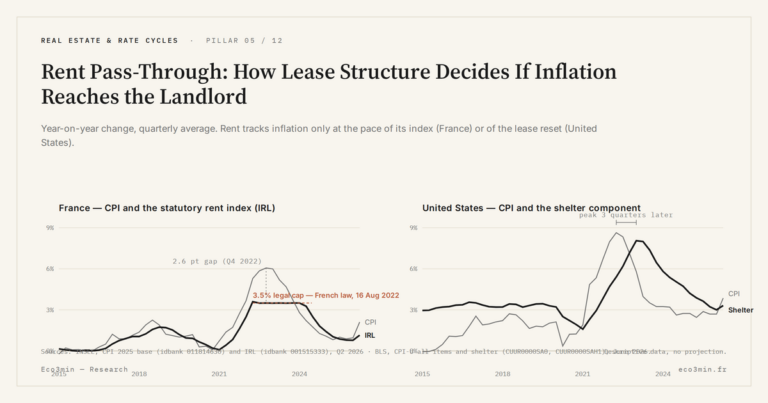
The heart of the misunderstanding lies in the difference between inflation as measured by price indices and the evolution of real economic flows tied to real estate. Consumer prices can accelerate while rents react more slowly, sometimes with several quarters of lag. In the euro area, inflation remained close to ≈3% at the end of 2025, while the rise in observed rents across several major metropolitan areas stayed materially lower over the same period. Further detail: our study on real estate, inflation and the protection paradox.
This inertia stems from multi-year leases, partial indexation mechanisms and, above all, the solvency constraint on households. High inflation does not mechanically raise real incomes. When wages lag, the capacity to absorb higher rents deteriorates, which limits the transmission of inflation to rental flows.
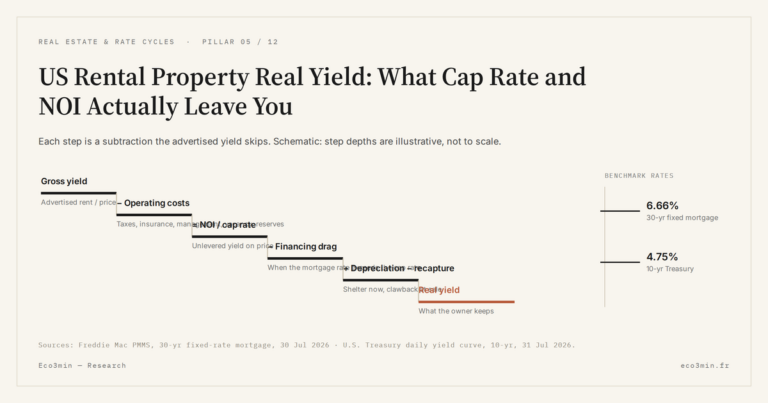
This constraint is all the more poorly perceived as standard indicators tend to overstate real flows, particularly when rental yield is interpreted without integrating expenses, taxation and the cost of capital, as detailed in the analysis on the limits of rental yield.
When Financing Neutralizes the “Real Asset” Effect
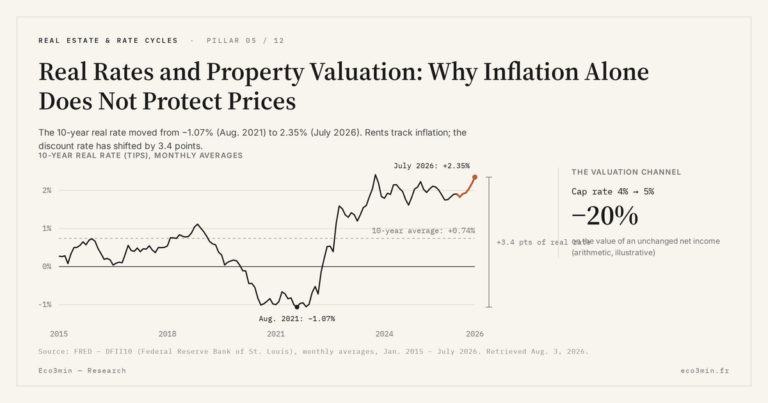
Another often-underestimated channel is the cost of capital. Real estate structurally depends on credit. Yet recent inflation phases came alongside marked monetary tightening. Between 2022 and 2024, European long rates moved from near 0% to levels around 2.5–3%, before stabilizing in 2025.
This rise in financing costs acts as a compression force on prices, even in the presence of inflation. The asset is real, but its value remains discounted at a higher rate. This is precisely the mechanism examined in the broader framework set out in the analysis of counter-intuitive reactions in the real estate market, where the rate effect can dominate the price effect across several cycles. Related work: The cap-rate driver behind REIT pricing.
This mechanism connects to the analysis showing why a rise in rates does not always trigger an immediate decline in real estate prices, with the shock first transmitting through credit and volumes before affecting valuations, as explained in the study on rate transmission to the real estate market.
Dominant Consensus and Point of Divergence
Part of the consensus still considers that real estate protects “in the long run” against inflation, assuming a gradual convergence between rents, incomes and the general price level. This reading rests on extended historical averages.
The divergence here concerns timing and frictions. The analysis suggests that, over intermediate horizons, inflation can coexist with an erosion of real estate purchasing power: rents capped by solvency, expenses rising faster than incomes, and higher discount rates. The issue is not the real nature of the asset, but the imperfect synchronization of its economic components.
Why the Question Is Particularly Relevant Now
Since the end of 2025, the debate has shifted subtly. Inflation is slowing without returning to prior targets, while rates remain durably higher than before 2022. This hybrid regime widens the mismatches: inflation is no longer strong enough to mechanically lift rents, but persistent enough to weigh on expenses and financing costs.
What Many Are Really Trying to Understand
The real question is not so much whether inflation “raises” or “lowers” real estate, but whether it improves or worsens the overall economic balance of a property. In other words: does a general rise in prices translate into a strengthening or a weakening of real flows once financing and expenses are integrated?
Variables That Could Reverse This Reading
This analysis could be invalidated if several conditions occurred simultaneously: a durable acceleration in nominal incomes, a marked easing of credit conditions, or a supply shock structurally reducing the available stock. Conversely, sustained positive real rates or a regulatory tightening on rents would reinforce the disconnect between inflation and real estate protection.
Observable Economic Implications
For households, this translates into greater tension between recurring expenses and incomes, even in an inflationary environment. For sector companies, the rise in operating costs can exceed that of collected rents. In markets, real estate valuation becomes more sensitive to financial conditions than to the inflation level alone, which connects to the broader macro framework set out on the pillar page real estate, cycles and interest rates.
- Price inflation does not transmit automatically to rents or to net real estate flows.
- Financing costs can neutralize, or even reverse, the protective effect expected from a real asset.
- Protection against inflation depends above all on the synchronization of incomes, expenses and rates.
Last updated — 18 July 2026
Disclaimer – Financial Information: The analyses, commentary, and content published on eco3min.fr are provided for informational and educational purposes only. They do not constitute investment advice or a solicitation to buy or sell financial instruments. Past performance is not indicative of future results. All investment decisions involve risk and are the sole responsibility of the reader.
Read next
Full pillar →US Rental Property Real Yield: What Cap Rate and NOI Actually Leave You
A rental listing leads with a yield. Divide the annual rent by the price and the number looks…
Cap Rate Spread: What Rental Yield Pays Over the 10-Year Treasury
A 5% cap rate sounds attractive. But 5% against what? A risk-free 10-year Treasury yields near 4.5% in…
Vacancy and Turnover: The Cost That Erodes a Landlord’s Real Return
A listing shows full rent, twelve months a year. The owner knows the gaps between tenants, the make-ready…