2007-2008: The First Modern Global Food Crisis

In 2007-2008, the world faced its first food crisis of truly global scope. The surge in grain prices, against a backdrop of low stocks, and the spread of export restrictions triggered unrest in more than thirty countries.
TL;DR
World grain production stayed close to normal in 2007-2008; depleted stocks and a wave of export bans turned a moderate imbalance into unrest across more than thirty countries.
- The surge came not from the size of any deficit but from low stocks: with the usual buffer depleted, a moderate imbalance produced a sharp spike across the whole staple-grain basket.
- Importers and operators rushing to secure supply raised immediate demand, so the fear of shortage fed the scarcity it anticipated, a self-reinforcing effect on a narrow-supply market.
- What gave bread its political charge was immediacy and universality: a rise felt directly and daily by everyone, converting an abstract macro imbalance into a shared, urgent grievance.
This article reconstructs the 2007-2008 sequence, its overlapping causes and its chain reactions, and shows why it remains the textbook case for the transmission from wheat prices to instability.
The 2007-2008 crisis holds a particular place: it was the first episode in which a grain surge translated, almost simultaneously, into social tension across several continents. As such it is the empirical demonstration of the mechanism analysed in wheat as an early-warning signal. Its interest lies less in the scale of prices than in a counter-intuitive chain: in each seeking to protect itself, states collectively deepened the shortage.
The 2007-2008 chain of events
The crisis did not arise from a sudden collapse in production. It was the culmination of a gradual erosion of world stocks, which had declined over several successive seasons, depriving the market of its usual absorbing cushion. When reserves are low, the market loses its ability to absorb a deficit, and the slightest hazard turns into price strain. It was onto this weakened terrain that several converging factors grafted themselves.
On the supply side, unfavourable weather reduced harvests in some major exporting regions, withdrawing expected volumes from the market. On the demand side, world grain consumption was rising steadily, driven by population growth and shifting diets in emerging economies. The combination of reduced supply and sustained demand, on already depleted stocks, set off a rapid rise in grain prices, with wheat among the most affected.
This rise did not stay confined to a single product. The prices of several staple grains climbed in concert, which closed off the option of shifting from one to another and amplified the pressure on importing countries. The simultaneity of the rise across the whole grain basket is one of the traits that distinguish 2008 from a shock on an isolated market: it was the entire base of the staple diet that grew dearer at once. This price trajectory, visible in the historical wheat price record, sits within the broader agricultural commodity cycles that 2008 marks as a turning point.
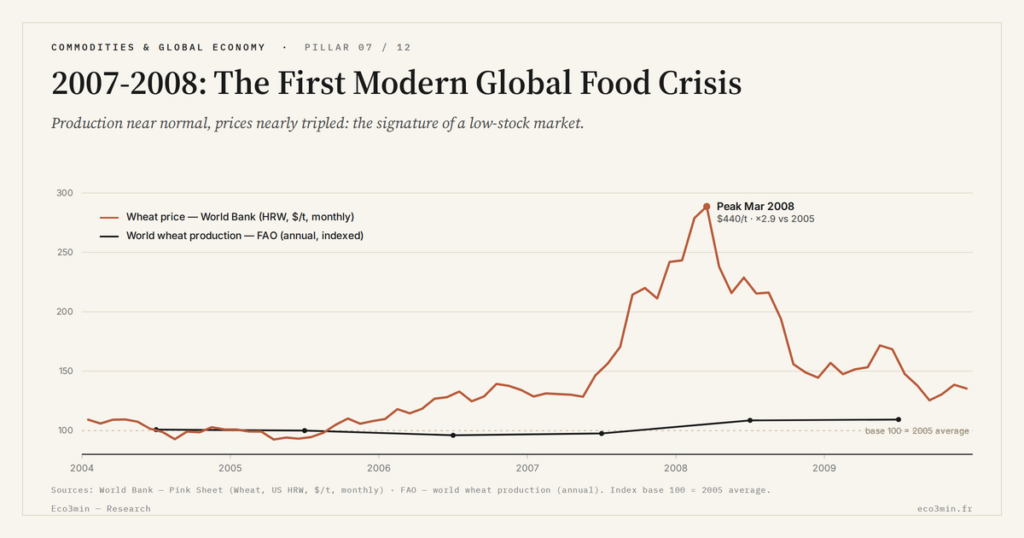
The scale of the move was striking in its speed. Within a few quarters, benchmark wheat prices rose sharply: US HRW wheat went from an average of $152 a tonne in 2005 to $440 in March 2008, close to three times as much (World Bank Pink Sheet), a pace unrelated to the actual change in world production. This gap between a violent price rise and a relatively stable physical supply is the signature of a low-stock market: it is not the size of the deficit that sets the scale of the spike, but the thinness of the cushion the deficit lands on. With abundant reserves, the same shock would have been absorbed without major strain; with depleted reserves, it produced a surge. The 2008 crisis thus illustrates, at the scale of a single episode, the amplifying role of low stocks, turning a moderate imbalance into a sharp spike.
As prices climbed, an anticipation mechanism kicked in. Importers and operators, fearing a shortage, sought to secure their supplies, which raised immediate demand and fed the rise. The fear of running short thus nourished the scarcity it anticipated, a self-reinforcing effect characteristic of tight markets with narrow supply. But it was a political reaction, more than a financial one, that would turn a rise into a crisis.
The export-restriction trap
Faced with the surge, some thirty exporting countries restricted or banned their foreign sales to preserve domestic supply and contain the rise in the price of bread at home (FAO, 2008). Taken individually, each of these decisions is understandable: a government confronting public anger over the cost of food first seeks to protect its domestic market. The individual logic is defensive and rational.
But the sum of these decisions produced the opposite of the intended effect at the global level. Each restriction withdrew supply from the international market, deepening the shortage for importing countries that had no production of their own to protect. Scarcity fed new restrictions, in a spiral where the caution of each worsened the insecurity of all. It is the classic configuration of a collective-action trap: behaviour that is rational at the individual level leads to a collectively destructive outcome.
The spread of these restrictions followed a logic of contagion. As soon as one large exporter limited its sales, others, fearing in turn for their own domestic markets, were prompted to follow, out of caution or anticipation. A defensive measure taken in one place called forth another elsewhere, and the movement was self-sustaining. Faced with this gradual closing of the breadbaskets, importing countries were largely defenceless: with no production to protect and no surplus to mobilise, they bore both the price rise and the shrinking of available supply, with no lever to shield themselves in the short run. The crisis thus revealed a fundamental asymmetry of the market: exporting countries had tools to protect themselves, even at others’ expense, while dependent importers had no choice but to absorb the shock in full.
This mechanism is the heart of the lesson of 2008. It shows that, in a concentrated, narrow-supply food market, the political responses to a shock can amplify its scale as much as the initial shock itself. The 2008 shortage was not only a physical imbalance between supply and demand; it was deepened by a succession of sovereign decisions that, added together, drained the international market. It is also this episode that has since fuelled the debate over the respective parts of fundamentals and speculation in price spikes, laid out in the contested role of speculation.
2008 is often presented as the result of a collapse in agricultural production. This is inaccurate: production stayed close to its usual levels. The crisis arose from low stocks, sustained demand and, above all, export restrictions and panic, far more than from a physical shortage of grain.
From prices to the street: the unrest of 2008
The transmission from the surge to social tension was rapid and geographically wide. Food-related unrest broke out in more than thirty countries, from Haiti to Bangladesh, by way of Egypt and Cameroon (World Bank, 2008). The immediate trigger was the same everywhere: a rise in the price of staples, bread foremost, that became unbearable for households already spending a high share of their budget on food. The mechanism is set out in the tie between fast surges and instability.
These movements were not a mere mechanical reaction to price. They expressed a rupture in the implicit social contract by which a state guarantees its population access to affordable staple food. When that contract cracks, protest often extends beyond the food issue to encompass governance, inequality and the legitimacy of power. In some countries, the unrest had direct political consequences, up to the fall of government officials. The price of bread acted as a revealer and a catalyst of pre-existing tensions.
The intensity of the unrest was not uniform, and this unevenness illuminates the transmission mechanism. The hardest-hit countries combined heavy import dependence, a high share of food in household budgets and a limited budgetary capacity to cushion the rise through subsidies. Conversely, economies where food weighed less, or that had room to absorb the shock, came through the episode without major social rupture. The map of the 2008 unrest thus overlaps with the map of structural vulnerability: it was not the level of the world price that decided the outcome, but the way that price translated locally, filtered by dependence and the weight of food. The same surge produced a crisis in one place and a mere increase in another.
What gives food unrest its particular political charge is the immediacy and universality of the grievance. Unlike many economic shocks, a rise in the price of bread is felt directly, daily and by everyone, with no delay and no possibility of postponement. It concentrates a diffuse economic strain into a single, visible and symbolically loaded object — the loaf, the staple, the most basic guarantee a society owes its members. This is one reason food prices have historically been among the more reliable precursors of political turbulence: they convert an abstract macroeconomic imbalance into a concrete, shared and urgent experience. In 2008, this conversion happened on a global scale and within a compressed window, which gave the episode its character of a synchronised crisis rather than a series of unrelated national difficulties.
It is precisely this articulation that makes 2008 a textbook case. The episode does not show that the price of wheat alone causes social crises, but that a food surge, in already fragile societies, lowers the threshold at which unrest is set off and can serve as a spark. The crisis thus made visible a channel of transmission — from the world market to the street — that the following decades would see recur, with different triggers but a comparable mechanism.
The legacy of 2007-2008 is twofold. It durably placed food security among strategic concerns, and it provided the first clear demonstration that the political response to a grain crisis — export restrictions foremost — can determine its scale as much as the initial supply shock. It also prompted attempts at international response — better information on stocks, coordination of export policies, early-warning systems — meant to keep the next surge from degenerating through the same chain of events. Whether or not these responses kept their promises, they reflect a lasting awareness: the stability of food prices is not only a matter of harvests, but of market governance, reliable information and collective discipline among exporters. It is in this that 2008 goes beyond the status of a past episode: it set a reading grid still used to anticipate and interpret grain crises.
Last updated — 22 September 2026
Disclaimer – Financial Information: The analyses, commentary, and content published on eco3min.fr are provided for informational and educational purposes only. They do not constitute investment advice or a solicitation to buy or sell financial instruments. Past performance is not indicative of future results. All investment decisions involve risk and are the sole responsibility of the reader.
Read next
Full pillar →Reading the refinery utilisation rate: the threshold, the season, the turnarounds
A refinery runs full near ninety percent, not a hundred: the last slice of nameplate capacity is a…
IMO 2020: the regulatory shock that rewrote product spreads
An environmental rule on marine sulfur can move a refining spread more than a swing in crude. IMO…
The 2022–2023 refining golden age: anatomy of an episode
In 2022, refined fuel prices climbed faster than crude. That gap, measured by the 3-2-1 crack spread, reached…