Wheat as a Forward Indicator of Social Unrest and Geopolitical Risk

When wheat prices surge, the first thing to crack is rarely financial markets but the social balance of importing nations. The growing concentration of exports in a handful of producing basins makes the transmission from price to instability sharper than it once was.
TL;DR
Wheat's forward quality comes from timing: the world price records a supply shock weeks or months before it surfaces as costlier bread and social strain in importing nations.
- Two channels run at different speeds: the price reprices near-instantly on the exchange, while it moves through import contracts, public budgets and subsidy schemes before surfacing as social strain.
- Low world stocks are the silent multiplier: the stocks-to-use ratio measures the cushion, and the major grain crises all struck on already-depleted reserves, when no deficit could be absorbed without a surge.
- In February 2022, the invasion of Ukraine pushed wheat to record highs and revived fears of a global shortage (FAO Food Price Index, March 2022).
This article asks whether the price of wheat works as a forward indicator of social and geopolitical strain, and why the geography of supply now amplifies its reach. The frame is analytical, not predictive.
Three recent episodes trace the same pattern. The 2007-2008 grain spike coincided with food-related unrest in more than thirty countries, from Haiti to Bangladesh (World Bank, 2008). The 2010-2011 run-up, driven in part by Russia’s export ban imposed in the summer of 2010, preceded the Arab Spring by a matter of months. In February 2022, the invasion of Ukraine pushed wheat to record highs and revived fears of a global shortage (FAO Food Price Index, March 2022). Each time, the same question returns: does the price of wheat foreshadow social ruptures, or merely accompany them? The answer turns less on fate than on mechanism, and that mechanism has hardened as exportable supply has grown more concentrated.
A signal that hits the street before portfolios
Most commodities are read through a financial lens: a rising price squeezes margins, redirects flows, repositions expectations. Wheat follows a different order of effects. Its first shockwave is not financial but alimentary, and it lands where bread accounts for a decisive share of both calorie intake and household budgets. That feature is what justifies treating wheat not as one asset among others, but as a gauge of social strain.
The mechanism rests on wheat’s place in the staple diet of a large part of humanity. Where rice dominates in Asia and maize serves mainly animal feed and industry, wheat is the grain of bread, and bread remains, across much of North Africa, the Middle East and sub-Saharan Africa, both the most consumed and the most politically sensitive food. When its world price surges, the increase does not dilute across a diversified consumption basket: it concentrates on the most visible and most immediate line of spending for the most constrained households.
The empirical record supports this reading without turning it into an automatism. The 2007-2008 sequence saw world grain prices climb sharply against a backdrop of low stocks, and cost-of-living protests broke out almost simultaneously across three continents (World Bank, 2008). Three years later, the 2010-2011 run-up coincided with a wave of unrest across the Arab world whose immediate trigger was often the price of bread, before grievances broadened to governance and employment. The price of wheat did not cause those uprisings on its own; it acted as an additional source of strain in already fragile societies, lowering the threshold at which movements with multiple deep causes are set off.
This relationship between bread prices and social tension is nothing new. The long history of agrarian and urban societies is dotted with episodes where a sharp rise in the cost of grain preceded unrest: dear grain has accompanied moments of political rupture long before futures markets existed. What has changed is not the nature of the link but its scale and speed. The price now forms on an integrated world market, and a disruption in a distant basin reaches the cost of bread thousands of kilometres away within days. The channel is old; its geographic reach is new.
This distinction is precisely what separates analysis from caricature. Presenting the price of wheat as the sole cause of social crises is a shortcut. Describing it as a forward signal amounts to observing that an observable, measurable, continuously quoted variable begins to diverge before social tension becomes visible. The informational value of such a signal does not depend on its ability to explain everything, but on its ability to anticipate. To understand where this signal forms, one has to go back to the structure of the market: who produces, who exports, who depends on wheat to feed its population, which is the subject of how the global wheat market is structured.
One point remains underappreciated in the standard reading. The share of wheat actually available for export is thin relative to total production: most of the world harvest is consumed inside producing countries. The international market therefore covers only the upper, residual layer of supply. This thinness of the exportable margin explains why a localised shock, even a modest one at the scale of global production, can trigger a disproportionate price move: it is not the total stock that contracts, but the tradable fraction, already narrow, that tightens further. The recurrence of these spikes is visible in the historical wheat price series, which records each episode of scarcity.
There is a further reason to read wheat differently from a financial asset. When a commodity reprices on a futures exchange, the adjustment is near-instantaneous and absorbed by professional participants who hedge, arbitrage and reallocate. The social repricing of wheat works on a slower and blunter clock. It moves through import contracts, public budgets, subsidy schemes and household spending before it surfaces as strain, which means the financial signal can run weeks or months ahead of its social consequence. This separation between a fast financial channel and a slow social channel is what gives the price its forward quality: by the time the cost of bread has visibly risen in an importing country, the world price has often already recorded the shock. Reading the financial signal early is therefore not a matter of forecasting the social outcome, but of observing, before anyone else needs to, that the upstream pressure has begun to build. The barometer’s usefulness lies in this lead time, not in any claim to predict where or whether the pressure will break.
Why wheat, and not another grain
If the price of wheat works as a barometer, it is because it combines three properties that no other staple brings together to the same degree: high intensity of international trade, dietary centrality in regions that are both populous and budget-exposed, and a political charge attached to bread. Examining these three traits shows why maize and rice, no less essential, do not play the same role as a signal.
Wheat is the most traded grain in the world. A substantial share of its consumption passes through international trade, whereas rice is mostly produced and consumed inside the large Asian countries, and maize serves first animal feed and industrial uses. This trade intensity makes wheat a good whose price is set on a genuinely integrated world market, sensitive to the decisions of a handful of exporters and importers. Rice, more compartmentalised, transmits its shocks in a more uneven and local way; maize, more tied to animal and industrial demand, responds to price signals that do not translate directly into the cost of the human plate.
The second property is geographic and social. The countries where wheat weighs most heavily in daily diets sit largely across North Africa, the Near and Middle East and the Horn of Africa, regions where per-capita wheat consumption ranks among the highest in the world and where a large share of supply is imported. In these economies, bread is not one product among many: it is an anchor food, often subsidised, whose price households track to the cent. A rise in the world price feeds through almost mechanically to the perceived cost of living, a dynamic developed in import dependence across North Africa.
Wheat’s centrality in these diets can be measured by its share of calorie intake. In several countries on the southern shore of the Mediterranean, bread and wheat-based products supply a fraction of daily calories well above the world average. This nutritional dependence has a direct consequence: demand for wheat is rigid, little sensitive to price in the short run, because there is no immediate, culturally equivalent substitute. A good with rigid demand and concentrated supply meets the conditions for high price volatility when a shock hits, since neither consumption nor supply adjusts quickly.
The third property is political. Bread occupies, in the collective imagination of many societies, a place that exceeds its nutritional value. It stands for an implicit social contract: a state that guarantees access to bread at a stable price asserts a form of protection over its population. When that price slips its moorings, it is not only a budget that tightens but a promise that wavers. This symbolic weight explains why historic social movements, in several countries, were triggered or aggravated by a rise in the price of bread, and why the governments concerned devote considerable budgetary resources to cushioning swings in the world price.
These three traits place wheat at the intersection of the market and the political. They locate it within a broader family of commodities whose price cycles obey both physical supply dynamics and geopolitical factors, a common frame found in the agricultural commodities landscape and, more broadly, in commodities in the global economy. But wheat holds a singular position within it: few staples combine to this degree exposure to international trade and direct social sensitivity. That singularity is what makes it a gauge, where other commodities are merely cost variables.
Export concentration as a structural amplifier
The core of the thesis is not that the price of wheat influences stability — that link is old — but that this influence has intensified as exportable supply has concentrated in a small number of basins. This concentration is the mechanism that turns a local shock into a global one, and it is what makes the signal more sensitive today than two decades ago.
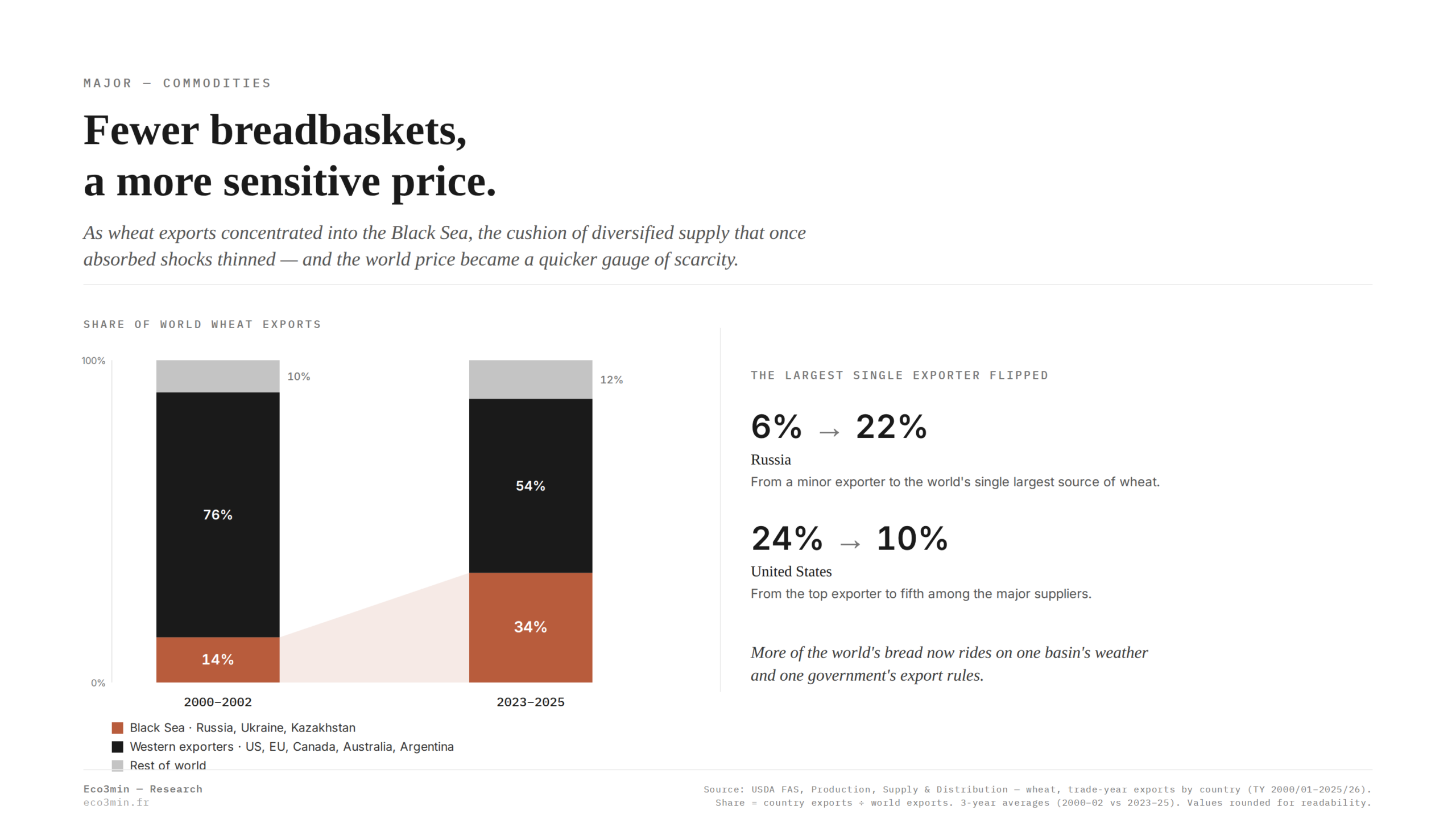
Over the past twenty years, the map of wheat exports has tightened. The Black Sea region, Russia foremost, has risen to become a decisive supplier to the world market, to the point that a few countries together now account for a large share of internationally traded volumes (USDA, 2021). This ascent was long perceived as a source of abundance: additional, competitive supply that helped contain prices for importing nations. But the same concentration that lowered prices also concentrated risk. When a growing share of exportable supply flows through a single basin, the resilience of the system erodes in proportion.
USDA figures (Production, Supply and Distribution database, exports by country on a trade-year basis, three-year averages) measure that shift. Between 2000-2002 and 2023-2025, the Black Sea share (Russia, Ukraine, Kazakhstan) of world wheat exports rose from 14% to 34%, while the historical Western exporters (United States, European Union, Canada, Australia, Argentina) fell from 76% to 54%. Russia alone climbed from 6% to 22% and now ranks first worldwide; the United States slipped from 25% to 10%, from first to fifth among the major suppliers.
The reasoning is structural before it is cyclical. A market whose exportable supply is spread across many origins absorbs a localised shock through redeployment: if a harvest fails somewhere, other breadbaskets can, at least partly, compensate. A market whose supply concentrates in a few basins loses that capacity for substitution. The same incident — a drought, a conflict, a political decision to restrict sales — then produces a far larger price effect, because there is no longer a cushion of alternative origins to draw on at short notice. Concentration does not create shocks; it multiplies their reach. The precise anatomy of this phenomenon, applied to the decisive basin, is treated in the Black Sea concentration of supply.
To this geographic concentration is added an aggravating factor: the concentration of decisions. A few exporting states hold, in effect, a capacity to influence the world market that exceeds their demographic or economic weight. A decision to restrict exports, taken to protect the domestic market of a single one of these countries, can be enough to destabilise the supply of dozens of others. Fragility thus stems not only from nature — droughts, frost, crop disease — but also from politics: a small number of actors concentrate a market power whose internal trade-offs transmit on a global scale.
This concentration is also the product of a historical shift. For much of the twentieth century, the world wheat market was dominated by a small group of Western exporters — North America, and later the European Union and Oceania — whose production was relatively diversified across geography and climate. The emergence of the Black Sea region as a major supplier redrew that map within two decades, adding competitive supply but also shifting the market’s centre of gravity toward a basin more exposed to political and climatic hazard. The result is not only greater concentration but concentration on origins whose institutional predictability is lower. A market can be concentrated yet relatively stable if its large exporters maintain predictable trade policies and a low risk of rupture; it becomes fragile when concentration falls on origins liable to change their export rules abruptly. The transformation of the wheat map combines both effects: fewer origins, and origins whose decisions are harder to anticipate.
This logic of concentration is not unique to wheat. It appears, in another form, in the sensitivity of energy markets to the geography of supply and to disruptions, a structural parallel illuminated by geopolitical tensions over energy. The comparison stops at the structure, however: the grain chain and the energy chain mobilise distinct mechanisms, distinct actors and distinct channels of transmission to the real economy. Wheat offers the version most directly tied to social stability, because its price translates into the cost of bread.
The consequence for the signal function is central. The more concentrated exportable supply is, the more sharply the price reacts to a given event, and the more that price becomes a sensitive indicator of strain to come. Concentration raises volatility, and volatility raises the informational value of the signal: a market that overreacts to supply shocks transmits the information about emerging scarcity earlier and more loudly. The barometer has become more reactive not because the world produces less wheat, but because it exports it from fewer places.
Low stocks, the silent multiplier
Geographic concentration explains why a shock propagates, but it does not exhaust the question of its intensity. A second, less-discussed variable governs the scale of price spikes: the level of world stocks. They determine whether a supply disruption translates into an orderly adjustment or a price surge. Stocks are the system’s cushion, and their depletion is the silent multiplier of wheat crises.
The mechanism is that of a shock absorber. At any given moment, the world holds a volume of wheat in reserve, built up during good harvests, that can be drawn down to fill a production deficit. As long as that stock is comfortable, a poor crop has only a limited effect on prices: consumption draws on the reserve while a new harvest restores balance. The stocks-to-use ratio — the share of annual demand that available reserves could cover — measures the depth of this cushion. When it is high, the market is resilient; when it is low, it becomes fragile, because the slightest deficit can no longer be absorbed without price strain.
This hidden variable explains why shocks of seemingly comparable size produce very different price effects. A poor harvest arriving after several years of abundance and rebuilt stocks goes almost unnoticed. The same poor harvest arriving after a run of deficits, on already depleted reserves, can trigger a spike. The price reacts not only to the day’s event but to the state of the cushion the event lands on. The major grain crises have in common that they occurred against a backdrop of low world stocks, a condition that deprived the market of any room to absorb the shock.
Yet stocks are not distributed neutrally. A large share of world reserves is held by a few major countries, some of which manage them primarily for domestic security and do not offer them to the international market in a crisis. The distinction between gross world stock and stock genuinely available for export is therefore essential: the apparent cushion can be thicker than the effective one. A market can show reassuring global reserves while remaining exposed, because the fraction of those reserves liable to be exported to deficit countries is far thinner.
A further difficulty lies in the quality of information about these stocks. The true level of world reserves is among the most uncertain figures in the grain market, because a major share of stocks is held by countries with limited statistical transparency. When a large portion of world reserves sits in a few economies that disclose little about their actual volumes, the estimate of the available cushion rests partly on approximation. This opacity has a direct effect on market behaviour: lacking clear visibility on mobilisable reserves, operators react more to the perception of scarcity than to its precise measure, which can sharpen price moves during a shock. The barometer is therefore affected by informational noise: it integrates not only real physical scarcity but also uncertainty about the scale of that scarcity. A market that knew the state of its reserves precisely would react more moderately than one forced to work with partial estimates; part of the price of wheat’s sensitivity stems from this blind spot on stocks, which amplifies the anticipatory component of spikes.
The combination of these two variables — concentration of exportable supply and the level of the mobilisable stock cushion — defines the barometer’s sensitivity at any given moment. When supply is concentrated and stocks are low, the system is doubly fragile: a localised shock can be neither offset by other origins nor absorbed by reserves, and the price surges. Reading the price of wheat as an indicator therefore means not looking at it alone, but relating it to the state of stocks and the dispersion of supply, which condition the scale of its reaction to any event.
Stocks also behave asymmetrically over time, which sharpens the multiplier. Reserves are rebuilt slowly, over successive good harvests, because building stock means diverting grain away from current consumption and bearing the cost of storage. They are drawn down quickly, in a single bad season, when a deficit must be covered at once. This ratchet — slow to fill, fast to empty — means the cushion is often thinner on the way into a crisis than the long-run average would suggest, because a run of tight years erodes reserves faster than the following good years replace them. The market can therefore enter a shock with a depleted buffer even when production over the cycle looks adequate. It is this timing mismatch, between the slow accumulation and the rapid depletion of stocks, that explains why scarcity can build quietly for several seasons and then express itself abruptly in price. The state of the cushion at the moment a shock lands matters more than the average level of stocks across the cycle.
From world price to the street: the transmission chain
To say that the price of wheat precedes instability says nothing about the path by which a price quoted on an international market becomes tension in a city. That path is a transmission chain, and it is partial, lagged and uneven across countries. Describing its links shows why the barometer works, but also why reading it calls for caution.
The first link connects the world price to the cost of importing. For a country that covers a substantial share of its needs through outside purchases, a rise in the world price translates directly into a heavier import bill, to which freight costs and, where relevant, the exchange-rate effect are added if the national currency weakens against the invoicing currency. The same world-price shock therefore hits an importer with a weakening currency harder, which can turn a moderate move in the international price into a surge in the local cost. The currency channel is, in this respect, an often-overlooked amplifier: a simultaneous depreciation and a rise in the wheat price compound into a double shock on the import price expressed in local currency.
The second link connects the import cost to the domestic price of staples. Here, transmission is cushioned by public policy. Many importing countries subsidise bread or cap its price, absorbing part of the shock through the state budget rather than through household wallets. This arrangement protects short-term stability, but it displaces the tension: a durably high world price raises the budgetary burden of subsidies, and when that burden becomes unsustainable, the long-contained adjustment of the domestic price can occur abruptly. Transmission is not cancelled; it is deferred, and sometimes concentrated into a single late move.
This deferral through the budget has its own limits. A bread subsidy is all the more sustainable when the world price is low and the budgetary margin is wide. When a state combines a high price, a weakened currency and constrained public finances, the cost of cushioning rises to a point where it becomes hard to sustain. It is often at that moment — not at the peak of the world price, but when the budgetary capacity to absorb runs out — that transmission to the domestic price is released. The time lag between the world shock and social tension stems in part from this delay in the exhaustion of the budgetary cushion, which can defer transmission by several months.
The third link connects the domestic price of food to social pressure. It depends on the weight of food in household budgets: where food accounts for a high share of spending, a rise in the cost of bread directly erodes disposable income and the perceived standard of living. It is in these societies that the transmission from price to tension is most direct and most rapid. The detailed breakdown of this passage from grain to bread, with its lags and dampening effects, is the subject of the passthrough to bread prices. It is in these economies that the margin between stability and tension is narrowest, and that the barometer of the world price reads with the least delay.
A further feature of the chain deserves emphasis, because it cuts against the alarmist reading. Between the world price of grain and the retail price of bread sits a long value chain — milling, baking, energy, labour, packaging and distribution — in which the raw grain is only one cost among several. As a result, a sharp move in the wheat price is mechanically diluted by the time it reaches the loaf: a doubling of the grain price does not double the price of bread, because grain accounts for a limited share of the final cost. This dampening is real and consistent, and it is one reason the social effect of a wheat spike is rarely proportional to the headline price move. But the dampening is weaker precisely where it matters most: in low-income importing countries, the share of grain in the final food cost is higher and the cushioning value chain shorter, so transmission there is both faster and more complete than in wealthier economies. The same world price thus produces a muted effect in one place and a sharp one in another, a divergence rooted in the structure of the food economy. A complementary angle: the primacy of speed over level.
This three-link chain illuminates an essential property of the barometer: it does not ring the same way everywhere. The same world price produces very different effects depending on the share of needs covered by imports, subsidy policy, the strength of the currency and the weight of food in the budget. The price of wheat is a global signal, but its translation into instability is local, filtered by national conditions. Reading the barometer therefore means crossing the level of the price with the geography of vulnerability, failing which the signal is misread.
Every wheat spike is often read as the mechanical announcement of an imminent revolt. This is misleading, because the transmission from price to instability is conditional: it depends on import dependence, subsidies, the currency and the weight of food in the budget. The same world price destabilises an exposed country and leaves another largely untouched.
Three episodes, one pattern
The crises of 2007-2008, 2010-2011 and 2022 are not three isolated accidents but three expressions of the same structure. Examining them at the altitude of the pattern — without reconstructing the detail of each here — reveals the regularities that ground the barometer function, and draws the line beyond which the analysis would slide into other causal chains.
A common scheme emerges. Each of these episodes starts from a terrain of low world stocks, which deprives the market of an absorbing cushion. A trigger then arrives — a run of poor harvests, a conflict, a political decision — that reduces available exportable supply. The price, with no room to manoeuvre, reacts sharply. And, decisively, several exporting countries respond to the shock by restricting their own sales to protect their domestic markets, which removes still more supply from the world market and deepens the shortage for importers.
This last link is worth dwelling on, because it is the most powerful and most paradoxical multiplier. Each exporting country, by restricting its sales, makes a decision that is rational from its own point of view: it protects its domestic market and eases its own social tension. But the sum of these individual decisions worsens the global shortage, raises the price for everyone, and ultimately increases the very risk each country sought to avoid. It is a classic configuration of a collective-action trap: the caution of each produces the insecurity of all. This mechanism turns a limited supply shock into a spiral of scarcity, and it is one of the reasons wheat spikes are so sharp and so fast.
The 2007-2008 episode illustrates this mechanism with particular clarity. The rise in grain prices, against a backdrop of low stocks, led some thirty countries to restrict or ban their exports to preserve domestic supply, which deepened the shortage for others (FAO, 2008). Reference release: the FAO Food Price Index. The result was a first food crisis of truly global scope, whose detailed reconstruction — sequence, overlapping causes, the collective-action trap — is the subject of the 2007-2008 food crisis.
The 2022 episode replays the same structure in a different context. The invasion of Ukraine in February struck at the heart of the Black Sea basin, blockaded Ukrainian ports and introduced major uncertainty over the region’s flows, pushing wheat to record highs and reviving food panic among importers (FAO Food Price Index, March 2022). The Black Sea Grain Initiative, brokered in the summer of 2022 under UN and Turkish auspices, allowed a partial resumption of Ukrainian flows before Russia withdrew in the summer of 2023. The mechanics of the maritime blockade and the grain corridor, strictly on the grain side, are analysed in the 2022 grain supply shock.
Here, a rigorous boundary is required. Several of these episodes had a major energy dimension, but that dimension belongs to a distinct causal chain. The analysis of wheat bears exclusively on the food side: grain production, exports, security of supply, the cost of bread. The very direction of causality differs depending on the chain considered. On the food side, it is the price of wheat that feeds social tension; conflating this chain with other mechanisms would blur the signal. Holding this boundary is what gives the barometer its precision: it measures a specific transmission, from grain to stability, and not an indistinct aggregate of geopolitical tensions.
Recognising the common pattern should not erase what distinguishes these episodes, because those differences refine how the barometer works. The 2007-2008 crisis was above all a crisis of stocks and costs, where the conjunction of low reserves, disappointing harvests and sustained demand lifted prices across several agricultural markets at once. That of 2022 was a sudden, localised supply shock, triggered by a conflict striking a major exporting basin directly, with a more abrupt and immediate effect on the grain side alone. Between the two, the trigger differs — accumulating strain in one case, instantaneous rupture in the other — but the channel of transmission to vulnerable importers stays the same. This diversity of triggers is precisely what makes the barometer robust: it does not depend on a single cause, but reacts to any significant disruption of exportable supply, whatever its origin. A signal that fired only for one specific type of shock would be fragile; the price of wheat captures both the slow erosion of stocks and the sudden rupture of an export corridor. It is this generality of the mechanism, more than the repetition of an identical scenario, that grounds its value as a forward indicator.
The limits of the barometer
An indicator is only worth as much as one’s knowledge of its limits. Reading the price of wheat as a forward signal of instability must confront three serious objections, and the rigour with which they are answered is what separates a defensible analysis from a mono-causal thesis. Far from invalidating the barometer, these limits refine how to use it.
The first objection concerns the confusion between correlation and causation. The fact that rises in the price of wheat have preceded unrest does not establish that the price is its cause. The societies where that unrest broke out often combined other fragilities — unemployment, contested governance, inequality, local droughts — of which the price of bread was only one factor. The honest answer is not to deny the link but to qualify it precisely: the price of wheat acts as one source of strain among others, whose own effect is to lower the threshold at which movements with multiple roots are set off. It is an amplifier, not a determinant.
The second objection bears on selection bias. One remembers the episodes where a wheat spike preceded a crisis, and forgets those where a comparable rise was followed by no notable unrest. This bias is real and calls for a probabilistic rather than a deterministic reading: a rise in the price of wheat raises the probability of tension in vulnerable geographies without guaranteeing it. The barometer indicates rising pressure, not a certain outcome. That nuance is what distinguishes it from a prophecy; it is also what makes it usable without tipping into alarmism.
The third objection questions the very formation of the price. If the wheat price is partly disconnected from physical fundamentals — under the effect of financial flows on futures markets — then a high price signal could reflect a speculative surge rather than real scarcity, and would lose its informational value. The debate between a fundamentalist and a financialised reading of spikes is old and unsettled; it sets work that points to capital inflows as a force of amplification against studies that conclude low stocks, failed harvests and export bans account for most of the moves (OECD, 2011). This debate, laid out without taking sides, is the subject of the speculation debate.
These three objections require clarifying what is meant by a forward indicator. A forward signal is not a cause, and it is not a prediction either: it is a variable that begins to diverge before a phenomenon becomes visible, and whose reading improves understanding of the situation without fixing its outcome. Distinguishing the role of amplifier from that of predictor is not a concession but the condition for using the barometer. The price of wheat informs on the intensity of a scarcity and the pressure it exerts; it says neither whether that pressure will lead to a crisis, nor when. This grid — correlation and amplification rather than causation and prediction — is what makes the analysis falsifiable and honest.
These limits converge on a single epistemic position. The price of wheat is neither an oracle nor an artefact: it is a correlated, amplifying signal, whose value lies in its reactivity to genuine supply disruptions, and whose reading requires crossing the level of the price with the vulnerability of the geographies concerned. Treating it as a prediction discredits it; treating it as a pressure gauge makes it useful. Between the two lies the whole difference between analysis and divination.
Stating what would weaken this reading matters, since a signal that cannot be wrong is not a signal. The barometer would lose credibility if comparable wheat spikes consistently failed to coincide with rising strain in vulnerable importers, or if episodes of social unrest in those countries showed no systematic relationship to prior moves in the price of food staples. It would also weaken if the bulk of price volatility could be traced to financial positioning rather than to physical supply conditions, severing the link between the signal and the scarcity it is meant to register. None of these conditions holds cleanly in the historical record, which is why the relationship is treated here as a robust correlation rather than a coincidence. But naming them is what keeps the analysis disciplined: the claim is not that wheat predicts crises, but that, under specified and testable conditions, a rising price of wheat carries information about scarcity and pressure that other indicators surface later.
The price of wheat has never set off a revolt on its own; export concentration has turned it into an earlier and louder gauge of scarcity.
At the end of this path, the price of wheat appears less as a predictor of crises than as a map of where the transmission of a shock is sharpest. Its rise signals that scarcity is forming on the narrow layer of exportable supply, and that this scarcity, filtered by import dependence, subsidies and the weight of food in budgets, will bear more heavily on some geographies than others. The variable that has made this signal stronger is not the quantity of wheat produced, but the reduced number of places from which it is exported, and the thickness of the stock cushion each shock lands on.
Concentration of supply remains, in this respect, the thread running through it all. It explains why a market that long seemed abundant can prove fragile, why a localised shock propagates on a global scale, and why the barometer has become more sensitive. Tracking the evolution of this concentration, of world stocks and of the export policies of the major basins offers a sturdier reading grid than the price alone. The price of wheat says when pressure is rising; the geography of supply says where it will turn into tension, and the structure of dependence says with what intensity. What the barometer cannot do is replace the work of examining each exposed country in turn; it tells an observer where to look and with what urgency, but the closer reading of vulnerability, conducted country by country, is what turns a rising price into an understanding of who is most exposed and why.
- The price of wheat works as a forward signal of social and geopolitical strain because its first shockwave is alimentary, not financial, and it hits the most constrained budgets.
- Export concentration in a few basins, the Black Sea foremost, amplifies the transmission from price to instability: it raises volatility and therefore the reactivity of the signal.
- The level of mobilisable world stocks determines the scale of spikes: a shock on depleted reserves produces a far larger price effect than a shock on comfortable stocks.
- Transmission from the world price to the street is partial, lagged and uneven, filtered by import dependence, subsidies, the currency and the weight of food in household budgets.
- The barometer reads in probability, not certainty: it signals rising pressure in vulnerable geographies without guaranteeing the outcome or fixing the timing.
Frequently asked questions
To what extent has the price of wheat preceded social crises? Several episodes — 2007-2008, 2010-2011, 2022 — show a temporal coincidence between wheat spikes and rising social tension in importing countries, with food-related unrest recorded in more than thirty countries in 2008 (World Bank, 2008). This precedence is a correlation with signal value, not a single cause: the price acts as one source of strain among others.
Why does wheat rather than rice or maize serve as a barometer? Wheat is the most internationally traded grain, it is central to the diet of populous and budget-exposed regions, and bread carries a strong political charge there. Rice remains more compartmentalised and maize more oriented toward animal feed and industry, which dilutes their transmission to the cost of the human plate.
How does export concentration change the picture? When exportable supply concentrates in a few basins, the market loses its capacity for substitution: a localised shock can no longer be offset by other origins and produces a disproportionate price effect. Concentration raises volatility, which makes the price signal earlier and sharper.
Does a rise in the price of wheat always translate into an equivalent rise in the price of bread? No. Transmission is partial and lagged: grain is only a fraction of the final price of bread, and subsidies or price caps can dampen, or even defer, the adjustment. The effect is sharper in countries where food weighs heavily in household budgets.
Last updated — 20 September 2026
Disclaimer – Financial Information: The analyses, commentary, and content published on eco3min.fr are provided for informational and educational purposes only. They do not constitute investment advice or a solicitation to buy or sell financial instruments. Past performance is not indicative of future results. All investment decisions involve risk and are the sole responsibility of the reader.
Read next
Full pillar →IMO 2020: the regulatory shock that rewrote product spreads
An environmental rule on marine sulfur can move a refining spread more than a swing in crude. IMO…
The 2022–2023 refining golden age: anatomy of an episode
In 2022, refined fuel prices climbed faster than crude. That gap, measured by the 3-2-1 crack spread, reached…
Diesel versus gasoline: why the two crack spreads diverge
The 3-2-1 crack blends gasoline and distillate into a single number, and that convenience hides something the market…