Wheat Speculation: Futures Markets and Food Crises, a Debate

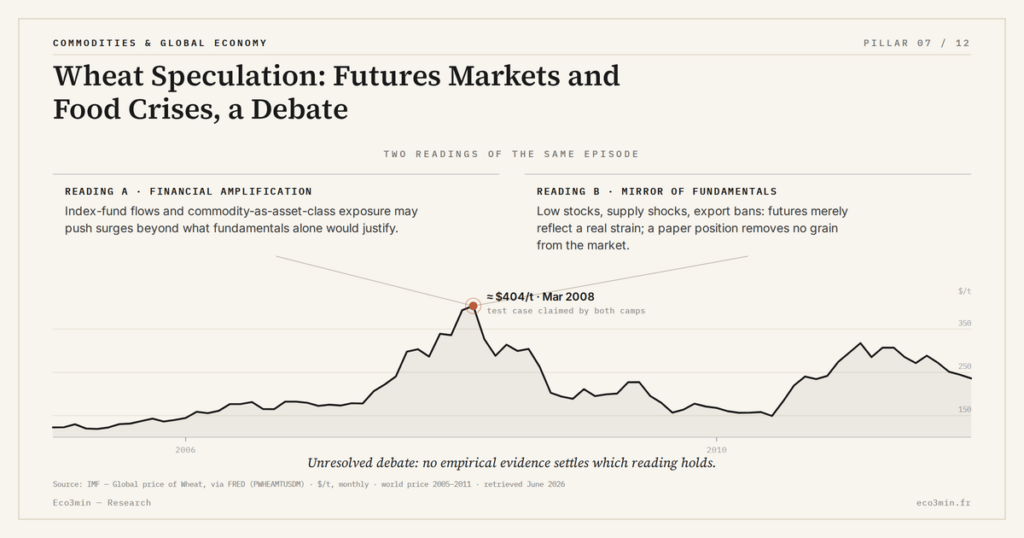
The share of financial speculation in wheat-price surges is the subject of a long-standing, unresolved debate. Two readings clash over the role of futures markets: an amplifier of crises for some, a mere mirror of fundamentals for others.
TL;DR
Whether financial speculation amplifies wheat price surges stays empirically undecided, and the stakes are asymmetric: technical on other markets, the question carries a human dimension for a staple food.
- The two readings: financialisation (index funds, commodity-as-asset-class flows) may amplify surges, while the competing view stresses that futures provide liquidity, hedging and price discovery, with paper positions removing no grain from the physical market.
- The debate stays alive because fundamentals and capital move together (an identification problem) and because each surge revives the concern that finance compounds a food strain, a worry the inconclusive evidence neither confirms nor dispels.
This article lays out that debate without settling it: the arguments of each reading, the empirical case that crystallises them, and the reasons the question remains hard to resolve definitively.
Reading the wheat price as an indicator of strain requires understanding how that price forms, and therefore raising the question of financial markets’ role in its formation. It is one of the direct extensions of the analysis of wheat as a stability signal: if the price can be disconnected from fundamentals, then reading it as a signal warrants caution. The debate on speculation is precisely the discussion of that possibility.
A first reading: speculation amplifies surges
A first reading holds that the growing financialisation of commodity markets has changed how agricultural prices form. On this analysis, the inflow of capital from financial actors — index funds, managers seeking exposure to commodities as an asset class — has introduced into wheat futures markets flows whose logic is not alimentary. These flows would follow allocation, portfolio-hedging or trend-following strategies, disconnected from the real conditions of grain supply and demand.
The mechanism this reading advances rests on the idea that financial flows can, in certain configurations, reinforce themselves. A manager taking exposure to commodities as an asset class does not react to the state of the wheat market, but to an allocation logic: they buy because the asset class enters their portfolio, not because they anticipate a grain shortage. If these flows become large relative to the size of the futures market, their grouped entry and exit could impart to the price movements unrelated to fundamentals. This reading also points to periods when the prices of several commodities seemed to move together, independently of their respective balances, which it interprets as the signature of a common financial factor rather than of fundamentals specific to each market. The argument does not establish a definitive causation, but it identifies a channel through which financialisation could, at least at times, weigh on price formation.
This reading also rests on an underlying concern: because wheat is a vital good, any artificial amplification of its price would have direct human consequences, by making the staple food dearer for the most exposed populations. This is what gives the debate its particular charge. Unlike other markets, a price dynamic on wheat is not a purely financial matter: it feeds through, by the chain described in the passthrough to food prices, to the cost of bread. The stakes of the question are therefore not merely theoretical.
A competing reading: liquidity, hedging and price discovery
A competing reading contests this attribution and highlights the economic functions of futures markets. On this view, the presence of financial actors is not a distortion but a condition of the market’s proper functioning. Futures markets fulfil three recognised roles: they provide liquidity, allow risk hedging and contribute to price discovery. Without counterparties ready to take positions, a producer wishing to guard against a fall, or a processor against a rise, would not always find a way to hedge.
This reading advances several arguments. First, a futures position neither removes nor adds grain to the physical market: as long as it does not translate into the holding of real stocks, its effect on the physical price would remain indirect and limited. Second, much of what is labelled “speculation” would in fact be hedging — risk-management operations by actors with real exposure. Third, when the price departs durably from fundamentals, restoring forces — arbitrage, adjustment of physical stocks — would tend to bring it back toward its equilibrium value, which would limit the reach of purely financial overshoots.
This reading insists in particular on the distinction between the paper market and the physical market. A futures position is most often unwound before expiry, with no delivery of grain; it therefore immobilises no real resource and removes nothing from the supply available for consumption. For a financial dynamic to durably affect the physical price, it would have to be accompanied by the holding of real stocks — an observable behaviour distinct from a mere futures position. In the absence of such a move in the physical market, the effect of paper flows would remain bounded. This reading further notes that financialisation did not uniformly raise all commodity prices: some stagnated or fell over the same periods, which it argues against the idea of a dominant, homogeneous financial factor, and in favour of an explanation by the fundamentals specific to each market.
On this view, surges are explained first by fundamentals: low stocks, supply shocks, export restrictions, expectations of shortage. The futures market would merely reflect, sometimes rapidly, information about a real strain. What appears as a speculative excess would, most often, be a legitimate repricing in the face of heightened uncertainty. The 2008 crisis thus became the empirical battleground of these two readings, as recalled by the 2008 crisis as a test case: each camp sought there the confirmation of its thesis, without a verdict imposing itself.
It is often assumed the question has an obvious answer — that speculation is plainly the cause of crises, or conversely has no effect. Both shortcuts are misleading: the state of knowledge does not allow a clear verdict, and presenting either position as settled means ignoring the real difficulty of the subject.
Why the debate stays open
If the question is unsettled, it is first for a methodological reason: empirically distinguishing the share of fundamentals from that of financial behaviour in a price move is extremely difficult. The two often move in the same direction and at the same time — a real strain attracts capital, and capital accompanies the strain — so that isolating each one’s own contribution is an identification problem rarely resolved in an indisputable way. A correlation between financial flows and rising prices does not, on its own, say in which direction causation runs.
To this difficulty is added the central role of stocks and expectations. A decisive part of price formation rests on the state of reserves and on what actors anticipate of the future, two variables that inextricably mix fundamental information and market behaviour. An expectation of shortage can be perfectly rational given the fundamentals while producing, through the behaviour it triggers, a dynamic that resembles an overshoot. The boundary between justified repricing and excessive amplification then becomes blurred, even for after-the-fact analysis.
This indeterminacy is found even in the regulatory sphere. Debates on framing positions in agricultural futures markets have accompanied the major surges, without leading to a shared diagnosis: the measures considered or adopted in different jurisdictions reflect divergent appraisals of the problem, some treating speculation as a factor to contain, others as a neutral element of how markets work. The fact that authorities facing the same episodes could draw different readings from them illustrates, on its own, the absence of consensus. This divergence is not surprising: lacking the ability to measure speculation’s own contribution unambiguously, the appraisal of the problem depends in part on assumptions that are not fully testable. The debate then shifts from the empirical ground to that of interpretation, where positions reflect as much different analytical frames as established facts.
Part of what keeps this debate alive, despite the difficulty of resolving it, is the asymmetry of its stakes. For most financial markets, whether a price overshoots its fundamental value is a question of allocative efficiency, consequential but bounded. For a staple food, the same question carries a human dimension: an amplified price, even temporarily, can translate into reduced access to bread for vulnerable populations. This asymmetry means the debate does not behave like a purely academic dispute that could be set aside until the evidence settles it. It recurs with each major surge, because each surge revives the concern that financial dynamics might be compounding a food strain — a concern that the inconclusive state of the evidence neither confirms nor dispels. The persistence of the debate is therefore not only a function of unresolved data, but of the weight of what is at stake: a question that would be technical on another market becomes, on wheat, one that observers are reluctant to leave open indefinitely.
The result is a body of studies with mixed conclusions: some find amplification effects in certain periods, others conclude that fundamentals dominate, without a general consensus emerging. This absence of a verdict is not a failure of analysis, but the reflection of a complex reality where several factors overlap. The debate is in fact part of a broader discussion on price formation across agricultural price cycles, where the respective parts of real and financial forces are subject to the same uncertainty.
For reading the wheat price as an indicator, the lesson is less an answer than a posture. Acknowledging that the share of speculation remains debated invites neither over-interpreting every move in the price as the pure reflection of a physical strain, nor conversely as a financial distortion unrelated to the real. The price integrates both, in proportions that vary and are hard to untangle. This interpretive caution, which holds for the whole of the agricultural commodities category, is probably the most solid conclusion the debate allows: not a verdict on speculation, but an invitation to read the price aware of what it blends.
Last updated — 28 June 2026
Disclaimer – Financial Information: The analyses, commentary, and content published on eco3min.fr are provided for informational and educational purposes only. They do not constitute investment advice or a solicitation to buy or sell financial instruments. Past performance is not indicative of future results. All investment decisions involve risk and are the sole responsibility of the reader.
Read next
Full pillar →Reading the refinery utilisation rate: the threshold, the season, the turnarounds
A refinery runs full near ninety percent, not a hundred: the last slice of nameplate capacity is a…
IMO 2020: the regulatory shock that rewrote product spreads
An environmental rule on marine sulfur can move a refining spread more than a swing in crude. IMO…
The 2022–2023 refining golden age: anatomy of an episode
In 2022, refined fuel prices climbed faster than crude. That gap, measured by the 3-2-1 crack spread, reached…