The 50/30/20 Budget: Resilience in a High-Rate Era
The 50/30/20 budget: how this simple rule has become a strategic indicator for saving, investing, and preserving optionality in a high-rate environment.

The 50/30/20 budget: how this simple rule has become a strategic indicator for saving, investing, and preserving optionality.
Between still-elevated inflation, slowly progressing wages, and interest rates remaining above 3% in late 2025, the monthly budget has become a macro stake — at the household scale. To understand concretely how rate variations influence financial decisions, see the impact of rates on household wealth. Many people rush to allocation simulators or real-return-after-inflation tools, but the foundation remains monthly cash steering. The 50/30/20 budget rule appears everywhere — yet is often applied as a frozen recipe, when it can become a real dashboard.
What may surprise in this situation: many analysts watch monetary policy or equity markets, but the silent adjustment is happening in household budgets. When 2 to 3 points of rates remain anchored, the slightest budget drift is paid heavily in interest, overdrafts, and delayed investments. Related reading: our study of Eco3min’s financial tools and simulators.
TL;DR
With rates still above 3% in late 2025, the 50/30/20 budget works less as a recipe than as a dashboard of household financial resilience. What sits inside the needs half is a list of staples whose cost can be read in work time: household staples costed in hours of US work.
- Households keeping fixed costs nearer 35% than 50% mechanically retain more free savings capacity when rates stay elevated.
- The consensus emphasis on sustaining consumption sits against the mechanics: when 2–3 points of rates stay anchored, budget drift is paid in interest and overdrafts.
- Illustratively, a 5-point drift in discretionary spending represents about €50,000 of compound interest over 25 years at 5% — the savings column behaves like a free option on future opportunities.
Three important things to remember
- Fixed costs are exploding: rents and mortgages have risen by roughly 15–25% since 2021 in many large cities, mechanically pushing the “50” column well beyond.
- The discretionary share lies: subscriptions, deliveries, in-app purchases — €100 to €200 per month on average in 2025, often unidentified as “30% leisure”.
- The 20% column is the adjustment variable: when prices rise, savings take the hit, not fixed costs. Hence the need to revise the rule rather than endure it.
What this signals at a deeper level
Part of institutional consensus pushes for sustained consumption to support growth around 1–1.5% in the euro area in 2025–2026. This approach assumes households will continue to draw down savings, tolerating high effort rates. The reading offered here diverges: the real risk is not slowing consumption, but household balance sheets too stretched to take advantage of investment opportunities when valuations correct.
With inflation still around 2.5–3% in 2025 in many developed countries, leaving savings liquid without a strategy means accepting real erosion. Conversely, regular investment capacity — even modest — allows households to take advantage of diversified ETFs or balanced allocations across equities, bonds, and cash. This is the entire point of simple allocation frameworks: they only work if the budget releases cash every month.
One notable observation: when modelling a household earning €3,000 net, the difference between 10% and 20% of savings/investment represents €300 per month. Invested at 5% gross annually over 25 years, this produces roughly €180,000 versus roughly €360,000. The “small” budget slip of today doubles or halves future room for manoeuvre.
Short-term risks and opportunities
1. Shifting from 50/30/20 to 40/30/30 (offensive target)
A strong but realistic hypothesis for certain profiles: aiming for 40% fixed costs, 30% discretionary spending, 30% savings/investment for 12 to 24 months. Why now? Because government bond yields still hover around 3–3.5% and global equity ETFs have, over long horizons, delivered 6–8% annualised. Concentrating saving effort while rates remain elevated has a durable leverage effect.
2. Arbitraging “false fixed” costs
Many lines classified as incompressible are not: overpriced insurance, broadband + mobile + streaming overlaps, underused car. A line-by-line review, paired with a real-return calculation on what those savings could produce, changes perception: €80 saved can become €30,000 over 25 years at 5%.
3. Investment positioning
For most individuals, a reasonable framework has historically combined global equity ETFs, bond/money-market exposure, and a security cash sleeve, provided the “20” of the budget rule is at least respected each month. More cautious profiles have leaned more heavily on bonds and cash. Position sizing on individual risky assets has rarely exceeded a small share of total wealth per single line.
Discreet but important indicators
- Financial freedom rate: percentage of income that can be redirected to savings/debt reduction. Floor target: 20%; comfortable target: 25–30%.
- Housing effort rate: ideally below 30% of net income; beyond 35%, adjustment margins shrink drastically.
- Consumer credit instalments: if they exceed 5–7% of net income, the 20% column is mechanically crushed.
- Automatic investment capacity: amount invested in ETFs/PEA/life insurance each month. Target: at least 50% of the “20” directed to productive assets, not only cash.
- Personal stress test: simulate a 10% income decline over 6 months via an allocation simulator and check that the budget holds without revolving credit.
Probable medium-term scenarios
Scenario 1 — Durably high rates, contained inflation (majority scenario)
Dominant projections assume policy rates remain above 2.5% at least through 2026, with inflation around 2–3%. In this framework, yields on rate products remain decent, but real estate does not become “fluid” again immediately. Overstretched budgets will pay long for past excesses. Past excesses of that kind accumulate wherever payment friction is lowest, and the friction differential is precisely the object of the comparison between card and cash spending.
Scenario 2 — Sharper slowdown, faster rate cuts
If growth falls below 1% and unemployment rises, central banks will have more room to ease. Hypothesis: gradual rate cuts from late 2026 onward. This would relieve credit, but also yields on safe products. Investors who have built strong saving capacity by then will be able to take advantage of equity entry points or index corrections.
Scenario 3 — Regulatory or fiscal shock on savings
Nothing rules out fiscal adjustments on capital income or specific caps on certain advantaged products. This scenario rests on the hypothesis of states seeking additional revenue. In this case, diversification across envelopes (PEA, life insurance, retirement savings) and geographies via global ETFs becomes even more critical.
In all cases, the link with the short term remains the same: a controlled budget today creates the optionality of tomorrow. It is less visible than a winning trade, but infinitely more structuring. Invisible and structuring at once, that arbitration is exactly what savers process through the mental accounts they assign to their money.
This reading of the budget as a freedom indicator only takes its full meaning when placed within the order of financial decisions. The in-depth analysis on structuring financial decisions over time shows that the budget is not an end in itself, but a prerequisite: as long as the spending → saving → investment sequence is reversed, even the best 50/30/20 rule remains ineffective.
This reading of the budget as an indicator of financial freedom nonetheless assumes a minimal foundation in understanding the trade-offs between spending, saving, and investing, which falls directly under financial education and conditions the ability to transform a simple budgeting rule into a true long-term strategic tool. The mechanics are unpacked in our analysis of everyday financial trade-offs.
This regular saving capacity only makes sense if it fits within a coherent allocation logic. A structured asset allocation then distributes capital between growth, stability, and liquidity. Simple frameworks such as balanced allocations offer a useful reading grid to transform budget discipline into a legible wealth strategy.
In passing, certain elements could invalidate this reading grid. A much faster disinflation combined with a strong rise in real wages would reduce pressure on budgets without major individual effort. Conversely, a surprise rise in bond yields or an employment shock would push more households beyond the 50% fixed-cost threshold, making the 50/30/20 rule obsolete for part of the population. Fixed-cost thresholds only look like constants inside a single decade; stretched across a century, the split between essentials and the rest belongs to the long history of the US consumption basket.
Ultimately, the 50/30/20 budget is neither a magic wand nor a financial blog gadget. It is a steering framework that, adapted to 40/30/30 or 45/25/30 depending on profiles, can transform a constraint (paying rent, repaying credits) into a strategic capacity (investing, training, changing professional trajectory). This is not the central scenario for most households today, but those that treat their budget as a true balance sheet will have an edge on market opportunities. We will reassess tomorrow with an environment that may already be different.
Three takeaways
- The real question is no longer “can I apply the 50/30/20 budget?” but “what share of my income truly protects my future freedom?”.
- Each 5-point drift in discretionary spending erases tens of thousands of euros of compound interest, silently.
- A controlled budget is a free derivative: it raises the capacity to take advantage of market corrections without cash flow stress.
Last updated — 21 August 2026
Disclaimer – Financial Information: The analyses, commentary, and content published on eco3min.fr are provided for informational and educational purposes only. They do not constitute investment advice or a solicitation to buy or sell financial instruments. Past performance is not indicative of future results. All investment decisions involve risk and are the sole responsibility of the reader.
Read next
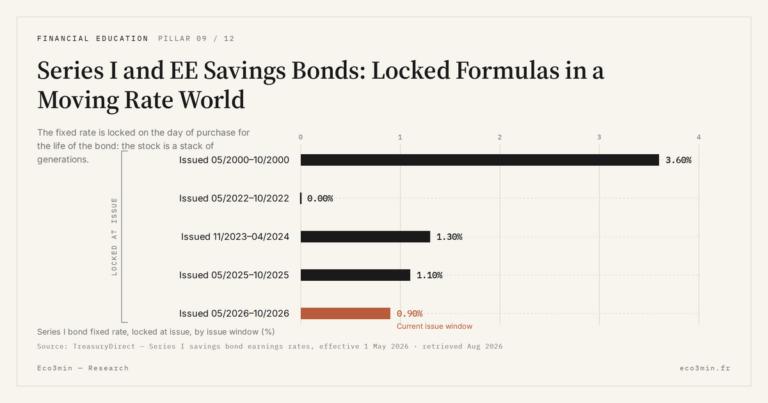
Full pillar →Series I and EE Savings Bonds: Locked Formulas in a Moving Rate World
US savings bonds lock a rate formula at the moment you buy them, for the life of the…
Where the Livret A’s Money Goes: The Caisse des Dépôts Circuit and Social-Housing Finance
The savings held on Livret A accounts do not sit idle. A regulation-set share is centralised at the…
France’s LEP vs the Livret A: A Means-Tested Higher Rate, Explained
France’s Livret d’épargne populaire is often described as "the Livret A, only better". The description misleads: the LEP…