Term Premium Back in Positive Territory 2024-2026: Durable Regime or Passing Oscillation?

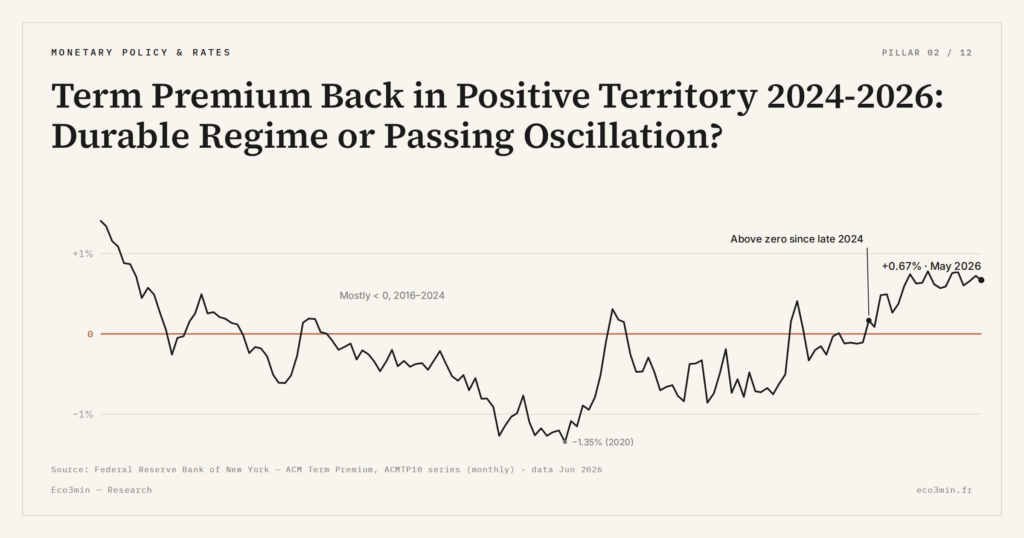
In August 2024, after eight consecutive years in negative territory, ACMTP10 moved durably above zero. The crossing is not statistical noise but the combined effect of three forces whose respective weight and durability the academic literature debates without resolution.
TL;DR
ACMTP10 has held above zero since August 2024, settling into a 40-to-80-basis-point band by end-2025, a regime academics have yet to call structural or cyclical.
- Three forces feed the regime: QT since June 2022 (Fed balance sheet from 8.9 to 6.8 trillion, over 2 trillion of duration returned, FRED WALCL), a structural primary deficit projected near 6% of GDP for 2025-2030 (CBO), and r-star revised toward 1.0-1.5% real.
- The debate is unresolved at end-2025: a structural reading (Acemoglu-Restrepo, Goodhart-Pradhan) ties the rise to global demographic aging; a cyclical reading (Bauer-Rudebusch, FRBSF) treats QT, deficits and r-star as reversible.
Persistent QT, structurally widened US fiscal deficits, upward r-star revision: three converging forces, two competing readings — structural (Acemoglu-Restrepo) versus cyclical (Bauer-Rudebusch). The debate is not settled.
1. The Moment of the Shift: August 2024
The durable crossing of ACMTP10 above zero is dated precisely on the NY Fed dashboard: August 2024. The six-month moving average crosses the line at that point and stays above continuously through year-end 2025. The fine trajectory shows oscillations in July-September 2024 around the neutral line, then a stabilization above starting October 2024. At year-end 2025, the premium stood in a 40-to-80-basis-point zone per the monthly estimates published by the New York Fed.
The durable nature of the crossing is what distinguishes this episode from the brief oscillations observed during the 2016-2024 phase. During that phase, the premium had approached zero several times — notably late 2018, mid-2023 — without ever crossing it on a sustained basis. The 2024 crossing instead comes with stabilization beyond the line across several consecutive quarters, qualifying it as a regime change under the ACM model. For the reference decomposition of the 10-year yield, the sign change of the residual alters the economic interpretation of every DGS10 move.
The precise timing of the shift — 18 months after the cycle’s last hike in July 2023, and more than two years after QT started in June 2022 — invites examination of the structural forces that accumulated during this period of apparent monetary stability. None of the three principal forces emerged abruptly in August 2024; all had been in place for several quarters. The crossing results from their cumulative accumulation rather than from a single identifiable trigger.
2. The Three Converging Forces: QT, Fiscal Deficits, r-star
The first force is prolonged QT. Initiated by the Fed on June 15, 2022 at a capped pace of 60 billion dollars in Treasuries per month (95 billion cumulative with Agency MBS), QT continued without major interruption through mid-2025, with a pace deceleration to 25 billion in Treasuries per month decided in June 2024. The Fed balance sheet moved from approximately 8.9 trillion dollars in mid-2022 to about 6.8 trillion in mid-2025 per FRED WALCL — over 2 trillion in nominally returned duration to the market. The central-bank policy lever on balance-sheet composition kept running while media attention concentrated on short-rate hikes. This quiet persistence of QT is the first identifiable driver of the premium rise.
The second force is the widening of US fiscal deficits. According to updated Congressional Budget Office projections published in January 2025, the structural primary federal deficit would stand around 6% of GDP over 2025-2030 absent legislative change — a historically high level outside recession. This projection spans two consecutive administrations: the end of the Biden term (infrastructure and industrial investment policies via the Inflation Reduction Act and the CHIPS Act) then the Trump return (extension of the 2017 tax cuts and new budgetary measures). The resulting rise in net Treasury supply mechanically adds to QT in terms of duration absorption by the market. 10-year Treasury auctions have seen their bid-to-cover ratio drop below 2.3 several times since 2023 per Treasury Department official releases, an operational signal of tighter marginal absorption. A perspective on gold and the public-debt burden traces the associated historical path.
The third force is the upward revision of r-star — the long-term real equilibrium interest rate. The thread is followed through in our mapping of secular stagnation dynamics. The Laubach-Williams estimates maintained by the New York Fed had placed r-star around 0.5% in real terms during the 2010s, and around 0.8% in early 2024. Publications in late 2024 and 2025 raised the estimation range to between 1.0% and 1.5% in real terms. This revision shifts the long-term anchor of all nominal rates: a higher r-star implies a higher neutral policy rate, hence higher short-rate expectations over the long horizon, and hence — through the ACM identity mechanism — a higher long-term nominal yield. Part of the DGS10 rise attributable to r-star transits through the ACMY10 component, but a part can also be absorbed by the term premium via the repricing of free duration risk.
None of the three forces acts in isolation. Their convergence — QT returning duration, deficits raising net supply, higher r-star revising the long-term anchor — produces a macro-financial environment consistent with a durable positive-premium regime. The academic controversy is not about the existence of these forces, which are documented and accepted on both sides, but about their relative weight and their durability.
3. FOMC Communications Accompanying the Regime Change
The FOMC accompanied the regime change with a series of explicit statements, traceable in the official FOMC press conference transcripts. At the December 13, 2023 conference, Jerome Powell first mentioned the topic publicly: “term premiums have been low for some time and we have seen some adjustment.” This measured, descriptive formulation marked the official recognition by the Fed that the term premium component moves on a long cycle and that this dynamic deserves committee attention.
The following FOMC press conferences — January then March 2024 — picked up and refined this language. During spring 2024, several regional governors spoke publicly on the topic. John Williams, President of the New York Fed whose Laubach-Williams work is the academic reference on r-star, delivered a notable intervention at the National Association for Business Economics (NABE) in October 2024 in which he indicated that an upward r-star revision — toward a 1.0% to 1.5% real range — is now consistent with observed data. Lorie Logan, President of the Dallas Fed, also intervened several times on the term premium question during 2024-2025, in a perspective combining recognition of the regime change and prudence on its persistence.
The topic also entered the semi-annual Monetary Policy Reports the Fed transmits to Congress. The February 2025 report includes a methodological box on ACM decomposition and its interpretation in a positive regime — the first time the topic is treated this explicitly in an official document destined for Congress. This officialization marks the institutional maturity of the ACM framework in central-bank communication.
4. The Academic Debate: Structural vs Cyclical Reading
The academic controversy on the durability of the positive regime sets two readings against each other that are not mutually exclusive but whose long-term implications differ substantially. The factual ground — the three forces described in section 2 — is shared by both camps. The disagreement is on the weight of structural versus cyclical components in this convergence.
The structural reading is most visibly defended by Daron Acemoglu and Pascual Restrepo across several 2024-2025 publications. Their argument rests on global demographic aging. In the United States, in Europe, in Japan and now in China, the dependency ratio — population over 65 relative to the working-age population — rises structurally. Per UN projections updated in 2024, the global dependency ratio would move from 13% in 2020 to about 22% by 2050. This demographic transition reduces global net savings (retirees dissave), raises consumption demand relative to savings, and therefore structurally raises the premium demanded for carrying long sovereign debt. The reading extends Charles Goodhart and Manoj Pradhan’s work published in 2020 under the title The Great Demographic Reversal, which had theoretically anticipated this repricing. If the structural reading is correct, the positive regime is locked in for the decade and beyond.
The cyclical reading is most consistently defended by Michael D. Bauer (Universität Hamburg, formerly FRBSF) and Glenn D. Rudebusch (FRBSF), across several FRBSF Economic Letter publications between 2024 and 2025. Their argument rests on the causal attribution of the three converging forces. For Bauer and Rudebusch, QT is by construction cyclical: once the Fed reaches its target reserve adequacy ratio (likely around 2026-2027 per the decelerated pace projections), QT will end and duration will cease being returned to the market. Fiscal deficits, while structurally widened, are also politically cyclical: a bipartisan consensus on public debt trajectory, or a favorable growth shock, could modify the net issuance trajectory. As for r-star, its upward revision remains contested: several subsequent studies (notably Bauer-Hamilton 2024) suggest current estimates over-weight recent cyclical conditions. If the cyclical reading is correct, the premium could narrow or even cross back below zero as the Fed balance sheet normalizes and deficits moderate.
Neither reading prevailed by year-end 2025, and both camps recognize that resolution will only come from observing the next several years. The Treasury market implicitly prices a combination of both scenarios: 5-year-forward 10-year rates, observable on the rate-swap market, embed an expected term premium of about 50 to 80 basis points — a level consistent with a durable positive regime but without excess.
5. What Remains Indeterminate
Three major zones of uncertainty structure the reading of the 2024-2026 positive regime. The first concerns the QT trajectory: the Fed has not explicitly communicated a numerical target for terminal balance-sheet size, indicating merely a level “somewhat above what is strictly necessary for efficient implementation of monetary policy.” Per primary dealer analyses published in NY Fed surveys, QT could end between late 2025 and late 2026 depending on assumptions, which would eventually remove one of the three drivers.
The second zone of uncertainty concerns the fiscal deficits trajectory. CBO 2025 projections assume no legislative change, but political decisions can substantially modify the trajectory upward or downward. The third zone of uncertainty concerns r-star itself: estimation of this quantity remains one of the most active research objects in monetary economics and is subject to periodic revisions.
For the consequences on the asset-price architecture of the positive regime, these three uncertainty zones condition the amplitude and duration of the expected transmission. Reading the positive regime as locked in would overinterpret the available data; reading the positive regime as transitory would underinterpret the structural convergence of the three forces. The rigorous stance consists in recognizing the observed empirical change without prejudging its duration.
Conclusion
The durable crossing of ACMTP10 above zero in August 2024 is an empirical fact documented by the New York Fed and officially recognized by the Fed in its communications since late 2023. The three converging forces — QT, deficits, r-star — producing this regime are shared by all analysts. But their relative weight and their durability divide an active academic literature. For the prior negative episode, the same interpretive prudence had imposed itself retrospectively. The present calls for the same analytical discipline.
- ACMTP10 durably crossed zero in August 2024 and remains in positive territory through year-end 2025, after eight consecutive years below zero — a regime change measured by the NY Fed and officially recognized by the FOMC.
- Three converging forces feed the positive regime: prolonged QT since June 2022 (over 2 trillion of duration returned to the market), structural fiscal deficits projected around 6% of GDP over 2025-2030 by the CBO, upward r-star revision toward 1.0-1.5% in real terms (Williams NABE October 2024).
- The academic debate sets a structural reading (Acemoglu-Restrepo, Goodhart-Pradhan: global demographic aging, durable regime) against a cyclical reading (Bauer-Rudebusch, FRBSF: reversible factors, possible narrowing).
- Three zones of uncertainty condition the reading: QT end trajectory, future drift of fiscal deficits, stability of the r-star estimate. None is resolved at year-end 2025.
Last updated — 17 June 2026
Disclaimer – Financial Information: The analyses, commentary, and content published on eco3min.fr are provided for informational and educational purposes only. They do not constitute investment advice or a solicitation to buy or sell financial instruments. Past performance is not indicative of future results. All investment decisions involve risk and are the sole responsibility of the reader.
Read next
Full pillar →Real Rates: The True Cost of Capital Is Repricing
Why real rates are reasserting themselves as markets' anchor and how to recalibrate investment and financing decisions facing…
Real Interest Rates: The Quiet Signal Reshaping Markets
Real interest rates: why their persistence in positive territory in 2026 is reshaping the rules for bonds, equities,…
OAT-Bund Spread: A Quiet Gauge of French Sovereign Risk
OAT-Bund spread: how this yield gap has become a key signal on French sovereign risk, fiscal policy and…