ACMTP10 and the 10-Year Treasury Term Premium: the Adrian-Crump-Moench Decomposition Separating Rate Expectations from Duration Compensation


The nominal 10-year Treasury yield is not an opaque aggregate but the observable sum of two components the market prices separately, per the Adrian-Crump-Moench decomposition published by the New York Fed in 2013.
TL;DR
The same twenty-basis-point move in the 10-year Treasury carries different meaning depending on which component repriced: short-rate expectations, the term premium, or inflation breakevens.
- During the 2013 taper tantrum, the 10-year rose from 1.66% (May 1) to 2.98% (September 5), 132 basis points in four months, and the current ACM estimate attributes almost all of it (about 130 basis points) to the term premium.
- On March 9, 2020 the yield closed at 0.54% and ACMTP10 hit its daily record low of minus 1.65%, expectations and term premium compressing together.
- The October 2023 climb to a 4.98% close (October 19) came with a term premium back above zero (+0.46% on October 20) for the first time since spring 2021, whereas the October 2022 push to 4.25% was driven by short-rate expectations.
The ACMTP10 series, updated monthly by the New York Fed, isolates the residual term premium from expected short-rate paths. After a mostly negative stretch from 2017 to 2024, the positive readings observed since October 2024 reframe how the 10-year yield is read.
1. The 10-Year Yield Is Not a Single Number
The nominal 10-year Treasury yield published daily by the Treasury Department and tracked under the FRED code DGS10 presents itself to readers as a single figure. The presentation creates an illusion of unity. The figure aggregates two distinct economic constraints, priced by different sets of market participants, that do not respond to the same shocks. The property is old — it traces back to Frederick Macaulay’s (1938) formalization, to the rational-expectations theory applied to the term structure by Fisher (1930) and Hicks (1939) — but its reproducible empirical quantification only became fully operational with the 2013 Adrian-Crump-Moench work.
The first constraint is temporal. An investor buying a ten-year Treasury forgoes the return achievable by rolling short maturities over ten years — three-month T-bills, overnight repo, money market accounts. For the long-duration holding to be financially indifferent to the rolling alternative, the ten-year yield must incorporate the expected path of short rates across the decade. That component — the ten-year average of expected short rates — is not directly observed. It arises from rational-expectations models, the quarterly Summary of Economic Projections published by the Federal Open Market Committee, and short-rate futures prices (SOFR since 2021, Eurodollar before the transition implemented between 2021 and 2023 under Commodity Futures Trading Commission oversight). Related explainer: how the 10-year yield transmits to asset prices.
The second constraint is residual. Once expected short rates are pinned down, the investor demands additional compensation for carrying long-duration paper. The compensation prices two distinct risks: reinvestment risk if short rates evolve differently from expectations, and price risk insofar as a long bond is mechanically more sensitive to yield changes than a short one. For an order of magnitude: a 10-year Treasury carries a modified duration between 8 and 9 years, meaning a 100-basis-point yield move drives a price move of roughly 8 to 9%. A 2-year Treasury carries a modified duration around 1.9 years. The price risk of a long bond is structurally four to five times larger than that of a short bond, and the term premium compensates precisely for that gap. A closer look: duration versus convexity, by the data.
To these two financial constraints a third dimension is added, upstream from the monetary regimes and interest-rate pillar: the term premium may itself absorb the perception of sovereign risk — implausible for US Treasuries in normal regimes but recurring in episodes (the 2011 debt-ceiling crisis, the 2023 ceiling standoff, the persistent fiscal disputes of 2023-2025 documented by the Congressional Budget Office, which projected in January 2025 a total federal deficit of 6.2% of GDP in 2025, 5.2% in 2027 and 6.1% in 2035 under current law, the primary deficit excluding interest staying near 2.5%).
Market size sets the context for any term-premium analysis. According to SIFMA data updated quarterly, total marketable Treasury debt stood near 29 trillion dollars at year-end 2025, of which about 18 trillion in notes (2- to 10-year maturities) and bonds (10- to 30-year maturities). The foreign holder share, measured by the Treasury International Capital Reports of the Treasury Department, declined from 48% of debt held by the public at year-end 2008 to 31% in mid-2025 (FDHBFIN over FYGFDPUN) — a structural drop within which China-plus-Japan combined fell sharply (from 46% of foreign holdings at year-end 2010 to 21% in June 2025 per TIC: Japan 1,155 billion and China 731 billion out of 9,094 billion). This recomposition of the holder base feeds the residual dynamic: less structural duration demand from price-insensitive buyers, more duration to absorb by price-sensitive intermediaries, hence the rising premium demanded.
On the supply side, the issuance calendar is dense and public. Treasury runs auctions per a schedule published each quarter in its Quarterly Refunding Statement: weekly bill auctions across 4, 8, 13, 17, 26 and 52 weeks; monthly note auctions at 2, 3, 5, 7 and 10 years; quarterly bond auctions at 20 and 30 years. The 24 primary dealers recognized by the New York Fed (Goldman Sachs, JPMorgan, Citigroup, Morgan Stanley, Bank of America, and 19 other firms per the official list as of January 15, 2026) are contractually required to submit bids at every auction, which guarantees primary liquidity but transfers temporary duration carry onto them. The bid-to-cover ratio at 10-year auctions — total demand relative to issuance — has become an operational indicator tracked by market participants: a ratio below 2.3 in 10-year notes since 2023 has been repeatedly described as a duration-stress signal. Beyond the primary market, the secondary market also exhibits “specials” in the repo market, where specific maturities trade well below the general collateral rate due to short-covering demand — a duration-stress signal that the term premium captures indirectly.
The formal decomposition reads: DGS10ʹ≈ʹE[short-rate path over 10 years]ʹ+ʹACMTP10. The identity is not a negotiable economic approximation. It is the result of a reproducible empirical regression published in 2013 as NY Fed Staff Report 340 under the title Pricing the Term Structure with Linear Regressions, later issued as NBER Working Paper 19774. The three co-authors — Tobias Adrian (then at the New York Fed, now Director of the Monetary and Capital Markets Department at the IMF), Richard K. Crump (Senior Research Advisor at the New York Fed), and Emanuel Moench (Director of Macro Research at the Halle Institute for Economic Research) — produced the reference methodology for decomposing the Treasury term structure.
Reading the ten-year yield as the sum of rate expectations and term premium is not academic finesse. It is what central banks acting on the yield curve do when they calibrate long-asset purchases: they do not seek to alter expectations of their own policy rate — already steered by forward guidance — but to compress the term premium by removing duration. The analytical distinction is therefore also operational. The European Central Bank and the Bank of Japan in turn built their asset-purchase programs around this reasoning, with national specifications but a common logic. Krishnamurthy and Vissing-Jorgensen (2012) have separately documented that Treasuries enjoy a “convenience yield” — a recurring discount versus other safe assets tied to their liquidity, regulatory collateral eligibility, and safe-haven status — that complicates the direct interpretation of the term premium and can drive a wedge between the ACM-estimated term premium and the “true” economic compensation demanded.
2. Adrian, Crump, Moench (2013): What ACMTP10 Actually Measures
The Adrian-Crump-Moench model operates in two stages. In the first, Treasury yields across maturities are regressed on five latent factors extracted via principal component analysis of daily data going back to 1961. These five factors capture parallel, slope, curvature and residual movements of the term structure. The first factor typically explains over 90% of yield variance (the level component), the second between 5 and 8% (slope), the third about 2% (curvature), the next two capturing fine residuals. In the second stage, asset prices are decomposed into a risk-neutral pricing component (which assumes investors are indifferent to risk) and a residual term that measures precisely the compensation demanded for rate risk. Applied to the ten-year point of the curve, that residual is ACMTP10.
Mathematically, the model belongs to the class of affine term-structure models. Each yield at maturity tau writes as a linear function of the five factors: y(τ,ʹt)ʹ=ʹA(τ)ʹ+ʹB(τ)’X_t, where X_t is the vector of five latent factors at time t, and A(τ) and B(τ) are functions of maturity derived from model parameters. The specificity of ACM 2013 versus prior affine models (Duffie-Kan 1996, Dai-Singleton 2000) is to estimate parameters in two successive stages via linear regressions rather than joint likelihood maximization — hence the title Pricing the Term Structure with Linear Regressions. The operational advantage is considerable: the estimation procedure is reproducible with standard statistical software, the estimators are consistent even when the likelihood is complicated, and numerical convergence is fast. The disadvantage is that stagewise estimation can introduce small-sample biases, a point documented by Bauer and Hamilton (2018) who proposed bootstrap-based corrections.
The full methodology, its intermediate steps, and the estimation choices behind it are detailed in the ACM 2013 model in detail. Three properties deserve emphasis here because they shape the correct interpretation of any published figure, and they are reflected in the FRED ACMTP10 dataset page maintained as a reference at Eco3min.
First, ACMTP10 is the output of a statistical regression, not an accounting identity. The figure therefore depends on the estimation choice, on assumptions about the error distribution, and on the estimation window. The New York Fed periodically re-estimates the model on the full history, which means the term premium published at a given date can be revised retrospectively. The June 2018 figure published in 2018 is not exactly the same as the figure displayed today on the NY Fed ACM dashboard, though discrepancies typically remain modest — usually a few basis points. This property is shared by all affine term-structure models: Cochrane and Piazzesi (2005), Joslin-Singleton-Zhu (2011), and the full class of extended Nelson-Siegel dynamic models documented by Diebold and Li (2006). Joslin-Singleton-Zhu (2011) offer a competing approach constraining the decomposition through different canonical restrictions; results differ at the margin but converge qualitatively with ACM 2013 on movement directions.
Second, the model assumes risk-neutral pricing for the mathematical decomposition, which does not mean real investors are risk-neutral — precisely the residual unexplained by that assumption constitutes the term premium. ACMTP10 measures, by construction, what risk-neutral pricing fails to explain in the observed yield: the economic compensation effectively demanded by holders of long duration. This approach allows a robust signal to be extracted even when expectations are hard to observe directly — for instance during binding forward-guidance episodes, where expectations are partly steered by official communication rather than freely derived. See also: Our rundown of duration.
Third, ACM 2013 is not the only available decomposition model. The Kim-Wright (2005) model, published within the same academic tradition, offers an alternative decomposition based on three latent factors and slightly different modeling assumptions. The two series are published in parallel by the Fed on its dashboard. Over 2010-2020, the gap between the two estimates was anything but negligible (a median of about 60 basis points on daily data, up to 170), and the very existence of that divergence reminds users that the decomposition is statistical rather than accounting. During the 2013 taper tantrum (May 1 to September 5), Kim-Wright (FRED THREEFYTP10) shows a term-premium rebound of about 75 basis points; the current ACM estimate puts it near 130 basis points. The direction matched, the magnitude differed substantially. The selection of ACM 2013 as the reference in FOMC communications since 2020 (explicit citations by Jerome Powell at FOMC press conferences, by Lael Brainard before her departure to the National Economic Council, and by John Williams, President of the New York Fed) reflects a pragmatic convergence of the central-banking community toward this methodology, not a demonstration of methodological uniqueness. The European Central Bank publishes its own Bund 10-year term-premium estimate following an ACM-inspired methodology with factors adapted to the euro curve structure. The Bank of England has published since 2014 a Gilt 10-year term-premium estimate that also follows an affine multi-factor approach.
The Adrian-Crump-Moench decomposition is not an analyst opinion but the output of a reproducible five-factor regression published by the New York Fed since 2013. Reading ACMTP10 requires accepting three things: the decomposition is statistical and not accounting-based; risk-neutral pricing assumptions frame the interpretation; and the figure published at a given date can be revised retrospectively when the model is re-estimated on the full history.
3. Why the Decomposition Is Not an Opinion: the Double Identity of the Treasury Yield
The ACM identity addresses the temporal dimension of the ten-year yield: rate-expectations component plus term-premium component. A second complementary decomposition runs alongside, grounded in the inflationary versus real nature of the yield. The nominal 10-year Treasury (FRED DGS10) can also be written as the sum of the 10-year TIPS yield (FRED DFII10, which represents the real yield on inflation-protected securities) and the 10-year breakeven inflation rate (FRED T10YIE, which measures market-implied inflation expectations). This latter identity, popularized by Fleckenstein, Longstaff and Lustig (2014), is itself only approximate: a TIPS liquidity premium term enters, usually small but not negligible during TIPS market stress like March 2020.
The two decompositions operate on different layers and do not contradict each other: ACM dissociates what stems from short-rate expectations from what stems from duration compensation; the TIPS-breakeven decomposition dissociates expected real yield from expected inflation. A rigorous analysis of the ten-year yield rests on reading both grids simultaneously, as detailed in the full 10-year yield decomposition.
This dual reading is what separates serious Treasury analysis from event-driven commentary. When the 10-year yield moves twenty basis points on a single session, the relevant question is not only whether the Fed has spoken: it is which component moved, and therefore which economic mechanism was repriced. If only the expectations component moved, the market is revising its read of the policy path; if only the term premium moved, structural duration demand is repricing; if only the breakeven moved, inflation expectations were hit. Three distinct mechanisms, mobilizing three distinct investor communities — pension funds for long duration, macro hedge funds for expectations, TIPS managers for breakeven inflation.
Causal attribution after a market move is never perfect, but the framework provides a decomposition that holds up better than real-time commentary. The New York Fed publishes the updated decomposition monthly on its ACM dashboard, which allows every episode of the ten-year yield to be re-read retrospectively under both grids.
Five examples illustrate the utility. In May-June 2013, during the “taper tantrum” triggered by Ben Bernanke’s remarks on a gradual slowdown of QE3 purchases, the 10-year yield jumped from 1.66% on May 1 to 2.98% on September 5 — 132 basis points in four months. The current ACM decomposition attributes almost all of that move to a term-premium rebound (from 0.28% to 1.57%, about 130 basis points), leaving little to short-rate expectations. On March 9, 2020, the 10-year yield closed at 0.54% before recovering, in a move where the expectations component and the term premium compressed simultaneously — the ACMTP10 hit its daily record low of minus 1.65% that day, and the monthly series bottomed at minus 1.36% in July 2020. In October 2022, the 10-year yield peaked at 4.25% per FRED DGS10: the ACM decomposition attributes a substantial share of the move to the short-rate expectations component — the Fed had just delivered its third consecutive 75-basis-point hike on September 21, taking the fed funds target range to 3.00-3.25%, with a fourth to follow on November 2 — and a residual share to a term premium that remained negative despite the hike. In October 2023, the 10-year yield closed at 4.98% on October 19, its cycle high: the decomposition assigns this time a far larger share to a term-premium move (ACMTP10 turned positive, +0.46% on October 20 and +0.40% for the month, its first positive readings since spring 2021), while short-rate expectations had stabilized around the assumed cycle peak. In January-April 2025, the Treasury market tensions tied to tariff disputes and the debt-ceiling standoff again moved primarily the term premium, with ACMTP10 jumping from 0.24% on April 4 to 0.82% on April 21, about 60 basis points in under three weeks per the NY Fed series (+22 basis points between end-March and end-April). Five moves at times of comparable headline size in DGS10, five different internal compositions — five mechanisms that an undifferentiated reading of the nominal yield would have conflated. Down to the mechanism: Central Banks and Monetary Policy: Institutions, Rate Cycles, and Market Transmission.
4. The Fed Balance Sheet as Term-Premium Transmission Channel
The term premium is not a quantity the Fed controls directly through its policy rate. It is the residual demanded by marginal duration holders — and that residual responds massively to the composition of the central bank’s balance sheet. The property has been documented since the first quantitative easing program. The reference study is Gagnon, Raskin, Remache and Sack (2011) on QE1; D’Amico and King (2013) refined the analysis on QE2; Bauer and Rudebusch (2014) proposed an alternative read centered on the signaling effect. The Fed balance sheet transmission channel operates through several mechanisms that compound.
The first channel is the portfolio effect. By buying long-duration Treasuries, the Fed removes collateral from the market. Investors who held those securities receive cash and must reallocate it to other assets — corporate bonds, MBS, equities. Demand for these other assets rises, their prices climb, their yields fall. The upward pressure on prices propagates through the risk structure, and the term premium on Treasuries compresses because marginal holders now accept lower compensation for long duration — there is less duration available to be carried. Gagnon et al. (2011) estimated that QE1 reduced the 10-year term premium by 30 to 100 basis points, depending on the assumptions. Krishnamurthy and Vissing-Jorgensen (2011) produced similar estimates while distinguishing effects on Treasuries, on Agency MBS and on corporate bonds.
The Operation Twist episode (September 2011 – June 2012) is particularly informative for isolating the duration channel. During that period, the Fed sold short-maturity Treasuries (under 3 years) and bought long-maturity Treasuries (6 to 30 years) for a total of 667 billion dollars, keeping the balance sheet unchanged in value. Neither a signaling effect on short rates (total balance sheet held constant), nor an effect of injected cash (operations are liquidity-neutral). Academic estimates converge on a 10-year term premium reduction of roughly 15 to 30 basis points specifically attributable to Operation Twist — an important result because it isolates the portfolio balance channel from the other channels. More on this: Our short rates-versus-long rates comparison.
The second channel is signaling. Fed purchases signal a commitment to keeping short rates low for longer than the policy-rate tool alone would suggest. The effect, foregrounded by Bauer and Rudebusch, operates on the expectations component rather than on the term premium strictly speaking, but the two effects are empirically hard to separate. The share attributed to each channel varies across episodes: QE3 (September 2012 to October 2014) likely operated more through the portfolio effect (expectations being already anchored by forward guidance), while the March 2020 Covid emergency programs combined strong portfolio effects with an immediate signaling impact in a context of liquidity panic.
The third channel is preferred-habitat. The theory of Modigliani and Sutch (1966), updated by Vayanos and Vila (2009), posits that certain investors have strong preferences for specific maturity segments (pension funds for the very long end, life insurers for the 10-20 year tenor, banks for the front end). When the Fed removes duration from a particular segment, these investors are forced to accept lower compensations or to migrate to other segments, which propagates the compression. The empirical calibration of this effect by Greenwood and Vayanos (2014) suggests that a 1% change in 10-year duration free float translates into a few basis points on the demanded premium — nonlinearly, with documented threshold effects.
Other major central banks have implemented comparable programs. The European Central Bank launched its Asset Purchase Programme (APP) in March 2015 and the Pandemic Emergency Purchase Programme (PEPP) in March 2020, accumulating over 4 trillion euros of balance sheet. Altavilla, Carboni and Motto (2020) documented effects on the Bund 10-year term premium of roughly 50 to 100 basis points attributable to these programs. The Bank of Japan went further with its Yield Curve Control regime introduced in September 2016: through unlimited purchases, it directly capped the 10-year JGB yield at a target level (initially zero, gradually widened before being abandoned in March 2024, together with the negative policy rate). During the strict YCC period, academic estimates suggest the JGB term premium was effectively driven to zero or slightly negative — the estimated term premium can no longer be interpreted as a free-market residual but as an explicit policy target. Background: how policy transmits through rate cycles.
QT — quantitative tightening — reverses the mechanism. When the Fed lets Treasury holdings mature without rolling them, duration returns to the market progressively. Marginal buyers must absorb these additional flows, and the term premium they demand widens. The QT engaged by the Fed since June 2022 started at a capped pace of 60 billion dollars in Treasuries per month (95 billion cumulative with Agency MBS), reduced to 25 billion in Treasuries per month from June 2024 and to 5 billion from April 2025, before the FOMC ended runoff on December 1, 2025. Over that period, the Fed balance sheet moved from 8.91 trillion dollars (June 29, 2022) to 6.66 trillion (June 25, 2025) and 6.54 trillion (December 3, 2025) per WALCL; it stood at 6.75 trillion on September 16, 2026. Single causation toward the term-premium rise is contested — widened US fiscal deficits and the upward revision of r-star also play a role, which the academic literature acknowledges. The data behind this: the central-bank assets series.
Hanson and Stein (2015) have separately documented an indirect effect: QE purchases pushed certain actors into longer-duration assets than they would normally hold, creating an asymmetric vulnerability at the moment of QT. When these actors seek to unwind, the premium demanded can widen faster than the nominal pace of balance-sheet runoff. The central bank therefore does not have linear control over the term premium — it possesses a powerful but asymmetric channel of influence between balance-sheet expansion and contraction phases.
5. Misreadings to Avoid: Term Premium Is Neither 10-2 Spread Nor Real Yield
Four misreadings recur in non-specialist literature. They deserve naming explicitly because they produce interpretation errors when ACMTP10 is commented on in the financial press.
The first misreading equates the term premium with the 10-2 spread (the difference between the 10-year and the 2-year Treasury yields). The two quantities are related but distinct. The 10-2 spread measures the steepness of the Treasury curve and reflects both short-rate expectations at different horizons and the term premium. For the longer view, see a negative term premium and its drivers. A positive 10-2 spread is consistent with a negative term premium if expected short rates at 10 years exceed those at 2 years. Conversely, a negative 10-2 spread (inverted curve) can coexist with a positive term premium if 2-year expected short rates exceed 10-year ones while remaining consistent with positive duration compensation at the 10-year point. The 2018-2019 commentary on yield-curve inversion frequently conflated the two notions: at the end of August 2019 (three daily closes, August 27 to 29), the 10-2 spread briefly turned negative while the ACMTP10 term premium sat between −0.7% and −1.3% over July-October — the curve was inverted because short expectations were abnormally high, not because duration was overvalued. A related historical angle appears in the chronology of gold against expanding Treasury debt.
The ACMTP10 term premium is neither the 10-2 spread nor the TIPS real yield. The 10-2 spread measures curve steepness (expectations plus term premium at both ends); the TIPS real yield measures nominal yield minus expected inflation. The three quantities often move together in stressed regimes but respond to distinct economic forces, as illustrated by the 2016-2024 historical anomaly during which a negative term premium and a steep curve coexisted for several years.
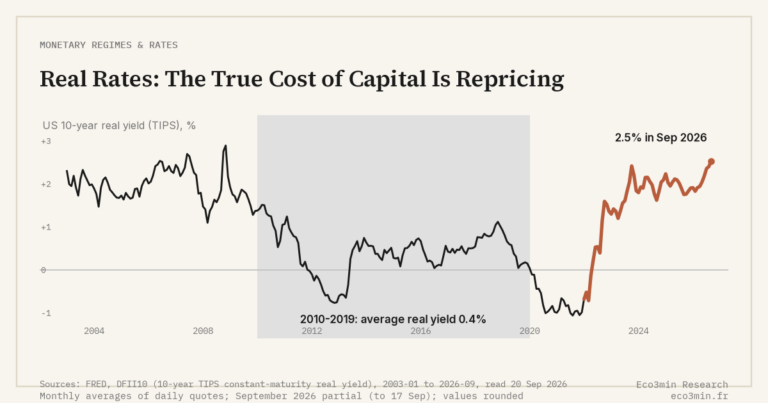
The second misreading equates the term premium with the TIPS real yield. The real yield measures what an investor receives in constant purchasing power after deducting expected inflation. The term premium measures duration compensation. A 10-year Treasury can show a positive real yield with a negative term premium — precisely what was observed through 2018 and most of 2019, and again from spring 2022 (DFII10 back above zero in April 2022 while ACMTP10 stayed negative). The two decompositions sit on distinct layers, as explained in section 3. Conversely, in March 2020, the TIPS real yield fell to −0.57% on March 6 (it would only cross below −1.0% in August 2020) while the ACMTP10 term premium hit its daily record low of −1.65% on March 9: two aligned negative residuals at the same time, two distinct economic mechanisms at work. For context: the copper/gold ratio viewed through safe-haven demand for gold.
The third misreading concerns directional interpretation. A rise in the term premium is often described in the press as a “tightening of monetary conditions” or as a “loss of confidence in US debt.” Both interpretations are possible but do not exhaust the spectrum. A term-premium rise can also reflect a return to normality after a period of anomaly (the 2024-2026 case), a structural change in duration demand (aging pension funds, exits by Chinese and Japanese Treasury holders documented by TIC since 2016, changes in bank capital rules that penalize duration on the banking book), or simply a technical revision of the ACM model itself. Reading ACMTP10 requires isolating the dominant structural cause before drawing a conclusion, which is typically only possible with an observation lag. Market commentary that interprets a term-premium rise in the hours following a release is, by construction, a preliminary interpretation that later revisions may invalidate.
The fourth misreading, more technical, concerns the “convexity adjustment.” Due to the convexity of the price-yield relationship for long bonds, the expected return on rolling short positions mathematically differs from the return on holding a long position to maturity, even in the absence of risk — this is Jensen’s inequality applied to duration. The convexity adjustment, typically of the order of 5 to 15 basis points on a 10-year Treasury depending on the ambient rate volatility, is included in the ACM-estimated term premium but is not, strictly speaking, a risk compensation. Cochrane and Piazzesi (2008) documented that separating pure risk premium from the convexity adjustment requires additional assumptions on rate dynamics. For most operational uses the distinction is negligible; for fine academic analyses it matters. Worth reading alongside: our review of common mistakes about bonds and interest rates.
6. The 2016-2024 Anomaly and the Positive Return Observed Since 2024
On the ACMTP10 data published by the New York Fed, the 10-year Treasury term premium turned negative in January 2016 and, apart from three brief positive interludes (November 2016 to February 2017, March to May 2021, September to November 2023), stayed below zero until September 2024; October 2024 opens the positive stretch that has held since. On monthly values the floor was reached in July 2020, at minus 1.36%; on daily values, on March 9, 2020, at minus 1.65%. This negative phase is the longest monetary anomaly in the modern history of US Treasuries: before 2015, the ACM series, which starts in June 1961, shows only three isolated negative months (December 1961, November 1964, May 1965).
Three forces converged to produce the anomaly. The first is the persistence of Fed QE programs. QE3, completed in October 2014, left a stock of duration removed from the market for years — the Fed continued to reinvest coupons and amortization payments until 2017, and the balance sheet only began contracting with the first QT episode between 2017 and 2019, interrupted by the Powell pivot of January 2019 then brutally reversed by the Covid response of March 2020. The second force is the Zero Interest Rate Policy (ZIRP) regime between 2008 and 2015, then again between 2020 and 2022, accompanied by forward guidance that anchored short-rate expectations at very low levels: the FOMC dot plots published through March 2021 kept the median fed funds rate at 0.1% through 2023 (the June 2021 round was the first to move the 2023 median, to 0.6%). The third force is the March 2020 Covid shock, which triggered a massive flight-to-quality into Treasuries as a global safe asset, compressing both expectations and the term premium to extreme levels for several weeks.
The 2016-2024 trajectory was not monotonic. Three sub-periods stand out. Between 2016 and end-2018, the term premium moved between −0.62% (August 2016) and +0.18% (December 2016), then held between −0.2% and −0.5% through 2017-2018 as the Fed ran its first hiking cycle. Documentation: the Federal Reserve’s record of FOMC policy decisions. Between January 2019 and February 2020, far from approaching zero, it deepened from −0.52% (February 2019) to −1.28% (August 2019) as the Powell pivot interrupted the tightening. Between March 2020 and September 2024, it widened again (monthly floor of −1.36% in July 2020), moved back up as the Fed engaged the 2022-2023 hiking cycle, with two positive interludes (spring 2021, autumn 2023) — the durable cross above zero only occurred in October 2024, fifteen months after the cycle’s last hike of July 2023. A related read: how central banks transmit to markets.
The positive return documented since October 2024 marks a regime shift whose durability the academic community has not yet settled. The six-month moving average of ACMTP10 turned positive in December 2024 and has stayed there since, at +0.69% in August 2026. Three factors converge in this new regime: the QT phase run by the Fed from June 2022 to December 2025 shrank its balance sheet by 2.4 trillion dollars (8.91 to 6.54 trillion per WALCL); widened US fiscal deficits under two consecutive administrations (Biden then Trump’s second term) expanded net Treasury supply per Congressional Budget Office data, with a total federal deficit projected between 5.2% and 6.2% of GDP through 2035 (CBO, January 2025); and the debate on r-star — the real equilibrium interest rate — in which the FOMC’s longer-run fed funds median rose from 2.5% (December 2019) to 3.1% (June 2026) while the New York Fed’s own Holston-Laubach-Williams estimate barely moved (1.27% in Q4 2019, 0.87% in Q4 2024, 1.01% in Q2 2026). In depth: our map of the bond access routes.
FOMC communications have accompanied this evolution explicitly. At the November 1, 2023 press conference, asked whether a higher term premium argued for slowing runoff, Jerome Powell answered that “QT is certainly on that list” of candidate explanations for higher long rates, while judging that “it may be playing a relatively small effect.” John Williams, at the ECB’s Sintra forum on July 3, 2024, argued that “the case for a sizable increase in r-star has yet to meet two important tests” and that the New York Fed’s estimates “are currently near the estimates from prior to the pandemic.” The positive-premium regime therefore coexists with a QT-plus-deficits context and with an r-star that the reference model does not see rising, without single causation being established.
The durability question of the positive regime restored in 2024 remains open. A structural reading, in the line of Goodhart and Pradhan’s The Great Demographic Reversal (2020), holds that aging in the US, Europe and Japan reduces global net savings and structurally raises the premium demanded for carrying long sovereign debt. A cyclical reading, which follows from the balance-sheet channel estimates cited in section 4 (Gagnon et al. 2011, D’Amico and King 2013), holds that what asset purchases compressed, their withdrawal releases: the positive return would then reflect mainly the QT and deficit context, and could narrow if the balance sheet expands again and deficits moderate. Neither view had prevailed by year-end 2025, and both camps acknowledge that resolution will only come from observing the next several years.
As of September 22, 2026. ACMTP10 stood at +0.64% on September 18 (daily) and +0.76% for August 2026 (monthly), positive every month since October 2024 per the New York Fed series. The 10-year yield (DGS10) closed at 5.01% on September 16, 2026, its high of the year, while the fed funds target range has been 3.75-4.00% since September 17, 2026 (3.50-3.75% from December 2025). Runoff ended on December 1, 2025 and the balance sheet, at 6.75 trillion dollars on September 16, 2026 per WALCL, has been growing again since its December 2025 low of 6.54 trillion: the positive premium now coexists with a Fed that is no longer withdrawing duration.
7. What a Positive Term-Premium Regime Changes
When the 10-year Treasury term premium is positive and durable, the architecture of asset prices shifts. The Treasury yield becomes a more binding floor for the cost of equity capital: the Equity Risk Premium — the spread between expected equity returns and the risk-free rate — must rebuild on a higher reference base to remain competitive. Aswath Damodaran, professor of finance at NYU Stern School of Business, publishes a monthly implied US ERP estimate. The Damodaran estimates show that a 50- to 100-basis-point shift in the 10-year yield, when transmitted through the term-premium channel rather than the short-rate expectations channel, translates ceteris paribus into visible multiple compression for long-duration equity indices (technology, growth, biotech). Reference data: The ERP series.
The transmission mechanism is not mechanical but cumulative. The implications for equity valuation depend on several simultaneous parameters: the duration for which the premium stays positive, the level reached, the inflationary context, the earnings growth backdrop, and the broader state of financial conditions. A short-lived positive term premium in a strong earnings-growth context can be absorbed by cash-flow expansion; a prolonged positive term premium in a moderate-growth context will translate more directly into multiple compression. Per Damodaran’s implied ERP series (updated January 2026), the US implied ERP stood at 4.33% at the start of 2025 and 4.23% at the start of 2026, against a 2001-2024 average of 4.92% — the repricing has so far passed through the risk-free rate rather than through a wider premium.
The 2024-2026 positive regime thus reintroduces elements of asset-price discipline that had been suspended during the negative-premium years. The most directly exposed asset classes are long-duration equities (pure growth, tech, quality), listed real estate (REITs, whose valuation multiples are discounted off long yields), and long-maturity investment-grade corporate bonds. Short-duration assets or near-term cash-flow generators are mechanically less exposed. The corporate bond market saw long-tenor investment-grade spreads tighten from late 2024 (a move that may look paradoxical but reflects increased demand for absolute yield as reference rates rose), while high yield experienced a more volatile dynamic.
The effect spills beyond the US perimeter. US and UK defined-benefit pension funds, whose actuarial liabilities are discounted at long Treasury or Gilt rates, see their “funded status” improve mechanically when yields rise — which reduces their appetite for additional duration and potentially feeds the rise in the premium demanded by the secondary market. In the United States, Milliman 100 Pension Funding Index data show that the funded ratio of the 100 largest defined-benefit plans moved from 99.6% at end-2021 to 105.1% at end-June 2025, a direct consequence of higher discount rates. On the global dollar side, the net outflow of foreign holders documented by TIC since 2016 produces a second-round effect: less foreign demand for USD duration means more duration to absorb by domestic actors, hence a higher demanded term premium. The loop closes: higher term premium, recomposed ERP, valuations under pressure, international transmission through portfolio flows. Which maturity anchors that ERP is not a detail: computing the equity risk premium against the 2-year rather than the 10-year flipped the sign in 68 months since 1976.
Reading the 10-year yield as a black box hands over to media narratives what the ACM decomposition has rendered objectively separable since 2013.
Open Conclusion
ACMTP10 does not settle the macroeconomic question of the moment — whether the positive-premium regime is locked in for the decade or whether the conditions that produced it can reverse. But the tool gives readers a reading grid that holds up better than real-time commentary on US debt. Every move in the 10-year Treasury can now be reread along two complementary dimensions: expectations component versus term-premium component, real component versus inflation component. Treasury analysis gains in discipline what it loses in simplicity.
The controversy between the structural reading (Goodhart-Pradhan) and the cyclical reading (balance-sheet channel) will only be settled by observing the years ahead. The operational question for holders and issuers of duration is less one of prediction than one of strategy robustness across scenarios: a public or private financing strategy that assumes a negative term premium to remain sustainable differs from a strategy that can adapt to a regime carrying 50 or 80 basis points of positive premium. Structural participants — the Treasury Department in its issuance average-duration strategy, primary dealers in their temporary carry, pension funds in their actuarial matching — have been silently recalibrating their parameters since 2024 without that recalibration always being visible in public communication.
What is settled, however, is the methodological utility of the framework. As the New York Fed reminds in its monthly publications since 2013, the decomposition is not an opinion but a reproducible regression — and it is this property, more than any forecast, that justifies making it the reference framework for analyzing the 10-year Treasury. The six satellite articles of the ACMTP10 cluster at Eco3min each deepen a specific angle: the methodological detail of the ACM model, the full decomposition of the 10-year yield, transmission through the Fed balance sheet, the anatomy of the 2016-2024 negative episode, the analysis of the positive regime restored since 2024, and the cross-asset implications. Taken together, they constitute the most comprehensive reading grid available in English at Eco3min for approaching the 10-year Treasury as a composite economic object rather than as a single indivisible number.
- The nominal 10-year Treasury yield (FRED DGS10) decomposes into expected short rates over ten years plus the residual term premium (FRED ACMTP10), per the Adrian-Crump-Moench methodology published by the NY Fed in 2013, complemented by the TIPS-breakeven double identity on the inflation component.
- The decomposition is statistical and reproducible, not accounting: ACMTP10 figures can be revised retrospectively when the model is re-estimated, and the Kim-Wright (2005) model remains published in parallel as an alternative reference.
- The ACMTP10 term premium is neither the 10-2 spread nor the TIPS real yield, and includes a technical convexity adjustment that may account for a few basis points without strictly constituting risk compensation.
- After a mostly negative stretch from 2016 to September 2024, the term premium has been positive every month since October 2024 (+0.76% in August 2026) — a regime shift whose durability the literature has not settled between a structural reading (Goodhart-Pradhan, global demographics) and a cyclical reading (balance-sheet channel, QT plus deficits).
Last updated — 22 September 2026
Disclaimer – Financial Information: The analyses, commentary, and content published on eco3min.fr are provided for informational and educational purposes only. They do not constitute investment advice or a solicitation to buy or sell financial instruments. Past performance is not indicative of future results. All investment decisions involve risk and are the sole responsibility of the reader.
Read next
Full pillar →Real Interest Rates: The Quiet Signal Reshaping Markets
Real interest rates: why their persistence in positive territory in 2026 is reshaping the rules for bonds, equities,…
OAT-Bund Spread: A Quiet Gauge of French Sovereign Risk
OAT-Bund spread: how this yield gap has become a key signal on French sovereign risk, fiscal policy and…
Inverted Yield Curve: Reading a Regime Signal Without Immediate Effect
The inverted yield curve operates as a regime signal, not a timing tool. Its lagged effects are constitutive…